
Image Editing AI Explained: How Nano Banana Transforms Visuals
Explore how image editing AI works beyond prompts and APIs. Learn Nano Banana's approach to structure-aware image transformation. Start understanding AI editing systems.
 AuthorYueZhu
Image editing AI beyond the prompt box
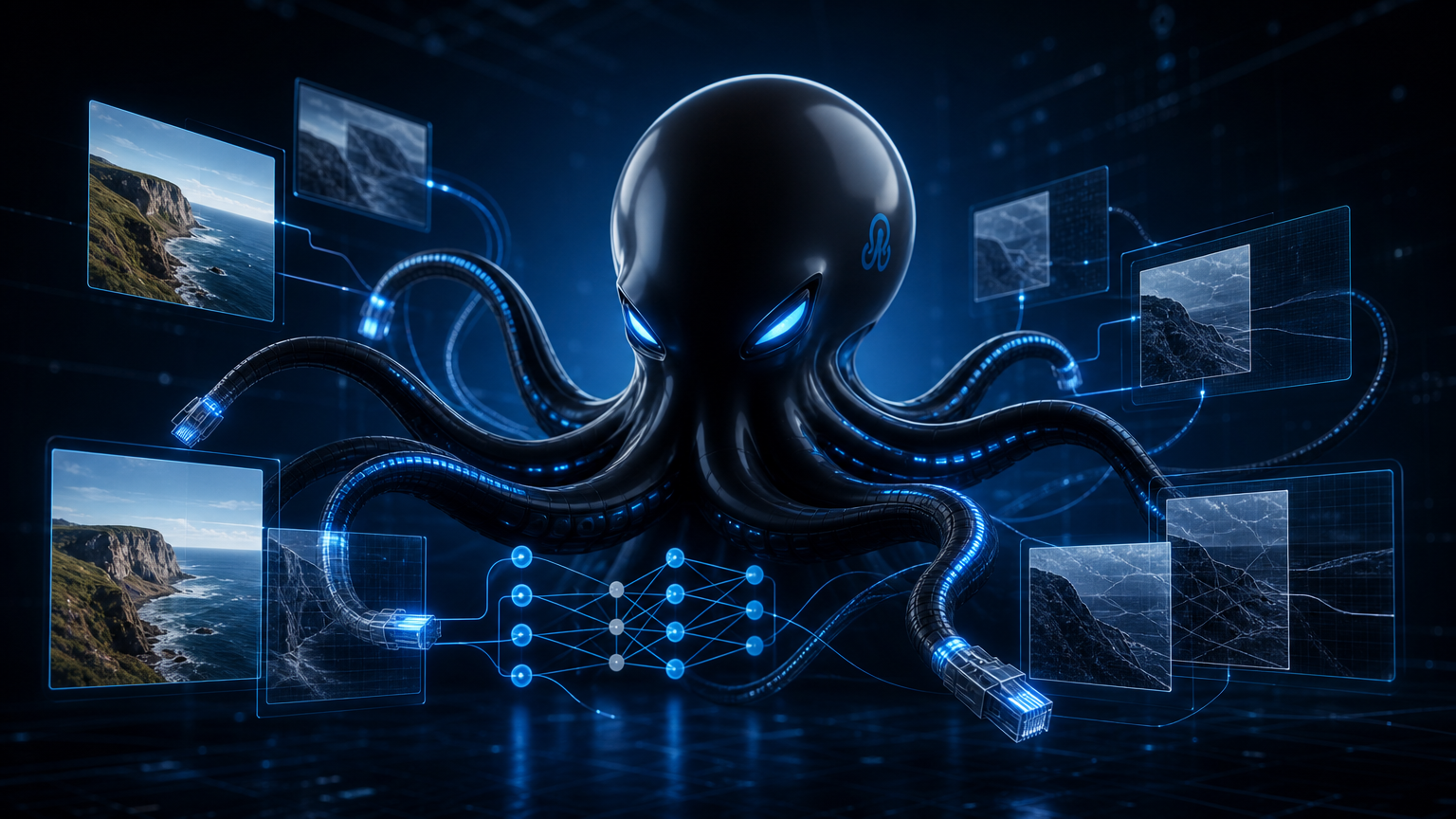
Most introductions to image editing AI start with a prompt box: type what you want, wait for the output, repeat. That interface hides what is actually happening. Image editing AI is not a single filter or a magic brush. It is a set of methods that let a model read an image, interpret a natural-language instruction, decide what should change, and render a new image while protecting the parts that should stay the same.
Nano Banana is a useful case study because it makes those methods visible. Instead of treating each edit as an isolated generation, Nano Banana keeps the image in a conversational loop. You can upload a photo, ask for a change, inspect the result, and keep editing from the latest state. That loop only works because the underlying image editing AI can do three things well: understand structure, honor preservation constraints, and maintain state across turns.
Google DeepMind's Gemini image page describes Nano Banana as native image generation and editing inside Gemini. Google's Gemini blog update highlights stronger handling of compound image editing instructions. Those improvements matter because editing is harder than generation: the model must know what to keep before it can decide what to change.
What image editing AI actually does
Traditional image editing is pixel arithmetic. A blur filter averages neighboring pixels. A clone stamp copies pixels from one region to another. A color grade applies a transform across channels. These operations are deterministic: the same input and settings always produce the same output.
Image editing AI is different. It is a conditional generation process. The model receives an image and a text instruction, encodes both into a shared representation, and then generates a new image that satisfies the instruction. The output is not computed from the input pixels through a fixed formula. It is sampled from a distribution of plausible images that match the combined condition.
This creates a different engineering contract. A blur filter never invents new content. Image editing AI can add, remove, or replace content. A clone stamp preserves everything outside the selected area. Image editing AI must learn which areas to preserve on its own. The value of modern image editing AI is flexibility. The cost is that the model can make unexpected changes outside the intended region.
For production teams, this means image editing AI should be treated as a draft generator, not a final retouching tool. Human review remains essential for logos, faces, text, and brand-sensitive details.
How Nano Banana reads and edits an image
Nano Banana is built on Gemini's native multimodal architecture. The same model can consume text, images, audio, and video, and it can output images. This matters for image editing AI because the edit instruction and the source image are processed together, not by separate pipelines.
When you send an image and a request like "replace the background with a warm cafe interior," the model does not receive a pixel map and a string. It receives a unified representation where visual regions and language concepts are aligned. The model learns associations such as "background" referring to areas behind the main subject, "warm" referring to color temperature, and "cafe interior" referring to tables, chairs, and ambient light.
Ars Technica's report on Nano Banana noted that Google focused on improved editing behavior, including better handling of instructions that combine multiple changes. That improvement comes from the model learning richer mappings between language and image structure.
The practical result is that Nano Banana can handle compound edits. A prompt like "change the jacket to navy, keep the face unchanged, and move the subject outdoors" requires the model to segment the image by concept, apply a color change to one segment, preserve another segment, and generate a new background. Image editing AI succeeds when those segments align with human expectations.
Three methods that make modern image editing AI work
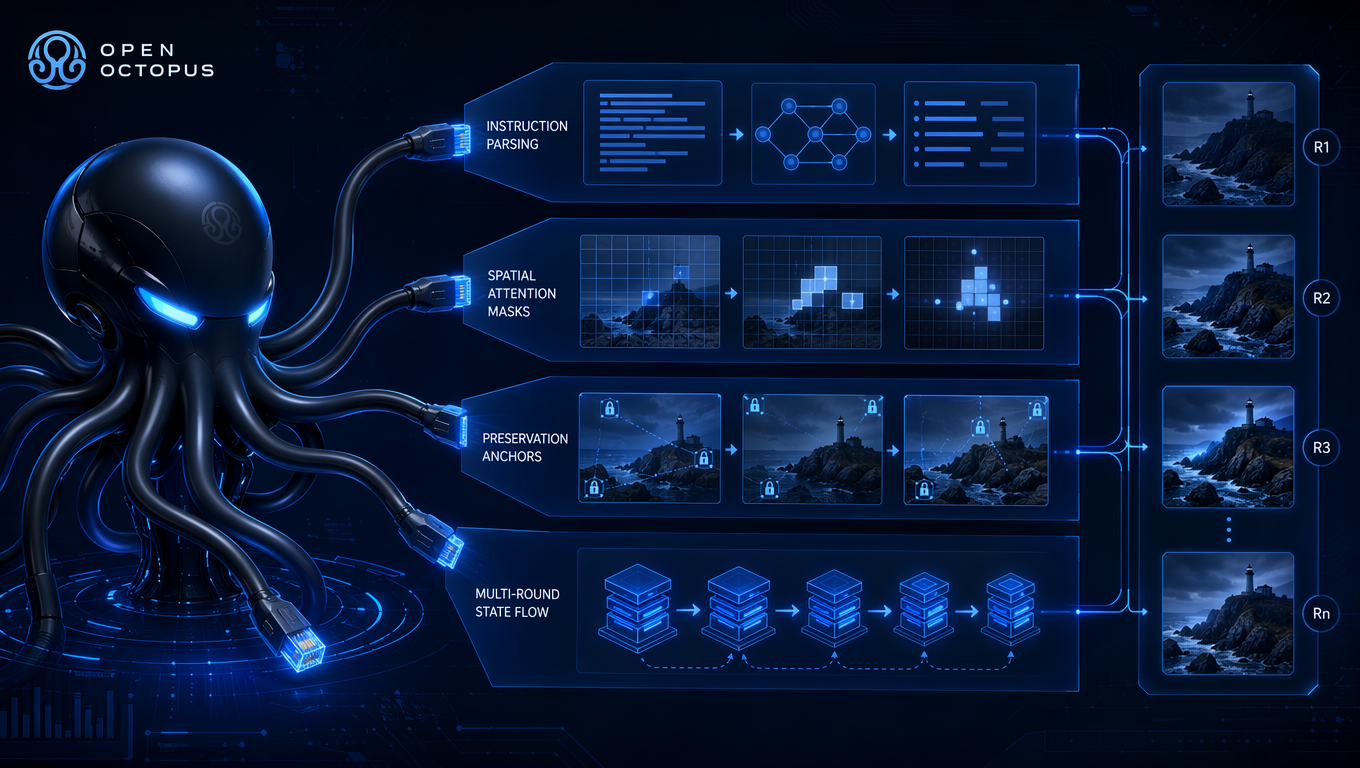
Understanding image editing AI becomes easier when you break it into three methods: instruction parsing with spatial attention, preservation constraints, and multi-round state maintenance.
Instruction parsing and spatial attention
The first method is translating language into image operations. When a user says "remove the cup on the desk," the model must locate the cup, identify the desk surface behind it, and fill the region with visually consistent content. This is more than object recognition. The model must also understand occluded areas, shadows, and surface textures.
Spatial attention is what makes this possible. The model learns to focus on relevant regions and ignore irrelevant ones. A good image editing AI does not repaint the entire image for a local change. It identifies the region of interest and generates only the necessary modifications.
Preservation constraints and identity anchoring
The second method is knowing what not to change. Preservation constraints are the difference between a useful edit and a destructive one. When a user says "change the background but keep the product label unchanged," the model must anchor the label and protect it from the background generation process.
Identity anchoring is the hardest form of preservation. Faces, logos, and distinctive product shapes are easy for humans to recognize and hard for models to hold stable. Nano Banana improves on this by using the conversational state: if a face was approved in turn two, the model can refer back to that approved version in turn five. This is why image editing AI workflows often recommend saving intermediate outputs and reusing them as anchors.
Multi-round state maintenance
The third method is keeping track of changes across turns. One-shot image editing AI treats every request as independent. Conversational image editing AI treats the current image as the starting point for the next request.
Multi-round state maintenance is powerful but risky. Each turn can introduce small drift. A face might become slightly softer. A product edge might shift. A shadow might change direction. Over many turns, these small changes compound. Production image editing AI workflows must set a drift threshold and return to an approved checkpoint when the output diverges too far.
Why conversational editing changes the workflow
The biggest shift that image editing AI brings is not quality. It is workflow design. Traditional editing requires selecting tools, masks, and layers before applying a change. Conversational editing lets a user describe the goal and iterate in language.
This changes who can edit images. A marketer can produce campaign variants without opening Photoshop. A product manager can test visual directions without waiting for a designer. A developer can add image editing to an app through an API instead of building a layer-based editor.
It also changes review requirements. Because image editing AI can alter unexpected regions, every output needs inspection. The most productive teams use the AI for exploration and reserve final approval for humans. The Nano Banana guide turns this into a repeatable workflow: start with a clean base image, edit one major thing per turn, protect what must not change, and stop at an approved state.
Where image editing AI still fails
Image editing AI is not reliable for every task. Knowing the failure modes helps teams set appropriate expectations and build guardrails.
Text and logos. Generated or edited text often contains misspellings, distorted characters, or inconsistent fonts. Logos can shift shape or lose detail. Any image that will be used for packaging, compliance, or brand publication should go through manual review.
Precision boundaries. The transition between edited and unedited regions can show subtle artifacts. Hair, fur, transparent materials, and fine textures are especially difficult. These issues may not appear in a thumbnail but become visible at full resolution.
Multi-round drift. As noted earlier, repeated edits can gradually alter identity, lighting, or proportions. The solution is to limit chain length and return to approved checkpoints.
Unpredictable cost. Every edit turn consumes tokens. A five-turn session costs more than a single generation. Production systems should track cost per accepted image, not per API call.
The Nano Banana review covers these limitations in more detail, including pricing and production trade-offs.
Choosing the right image editing AI workflow
Use image editing AI when the task benefits from language-driven iteration. Avoid it when the task requires pixel-perfect control or strict compliance.
| Task fit | Good candidate? | Why |
|---|---|---|
| Background replacement | Yes | Natural language describes the new scene clearly |
| Object removal | Yes | Spatial attention and inpainting handle this well |
| Style transfer | Yes | The model can reinterpret texture and lighting |
| Product variants | Yes | Same subject with controlled changes |
| Logo refinement | No | Text and shape precision are unreliable |
| Legal evidence | No | Output is not deterministic or auditable |
| Strict brand layouts | No | Manual design tools provide pixel control |
| High-volume cheap edits | No | Token costs add up quickly |
For teams ready to move from experimentation to production, the Nano Banana API guide covers endpoint patterns, queue handling, and cost control. For hands-on testing, use the Nano Banana online playground. For copyable prompt patterns, see the Nano Banana prompts guide.
Verdict
Image editing AI is best understood as a conditional generation system with three core methods: spatial attention for locating changes, preservation constraints for anchoring identity, and multi-round state for iterative refinement. Nano Banana makes these methods practical by combining them inside a conversational interface.
The technology is not a replacement for professional design tools. It is a faster way to explore visual directions, produce drafts, and automate repeatable edits. The teams that benefit most treat image editing AI as a creative accelerator with a human review layer, not as a hands-off production pipeline.
Start with small, bounded edits. Protect faces, logos, and text. Measure cost per accepted image. And stop iterating once the output reaches an approved state. That discipline turns image editing AI from a demo into a production workflow.