Together AI API
Unified Access and Multi-Model Routing for Developers

How OpenOctopus Simplifies AI API Management
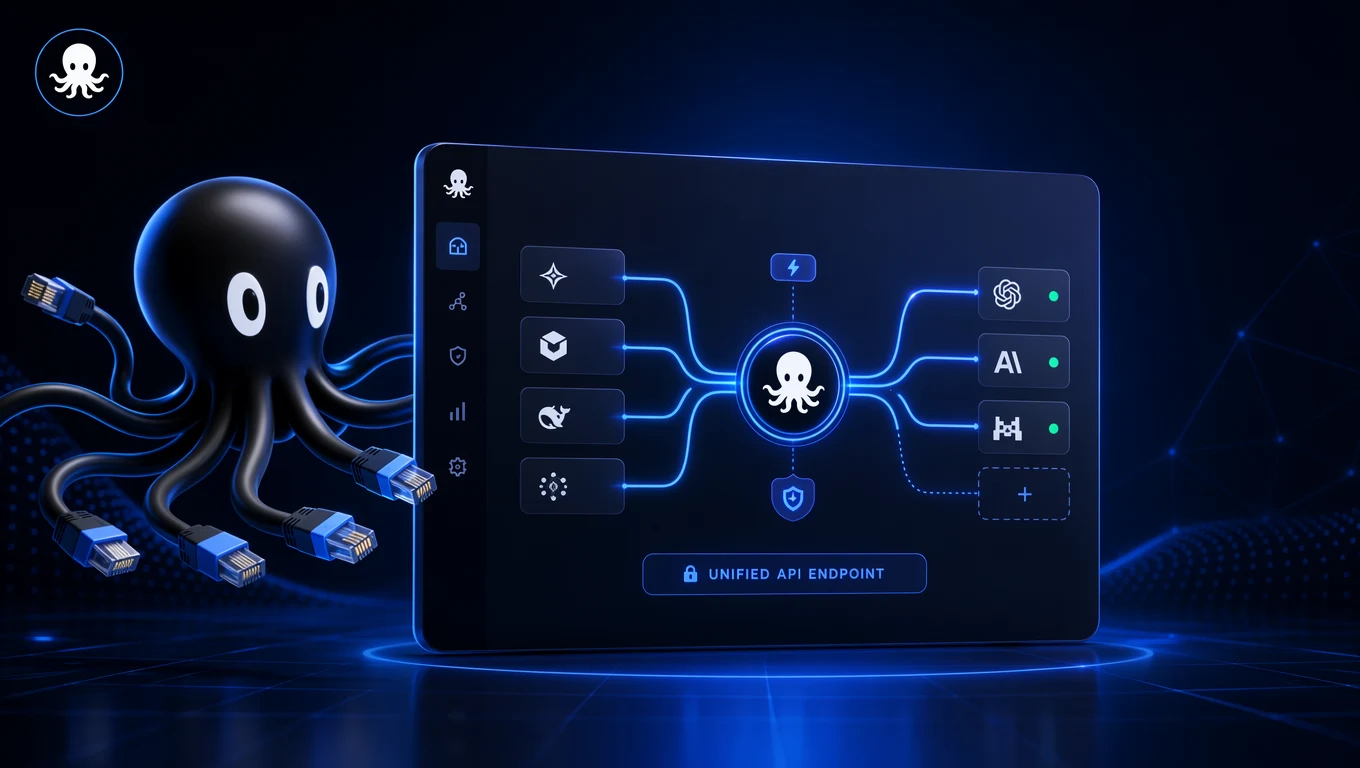
OpenOctopus delivers a unified developer API that consolidates access to multiple AI providers through one integration layer.
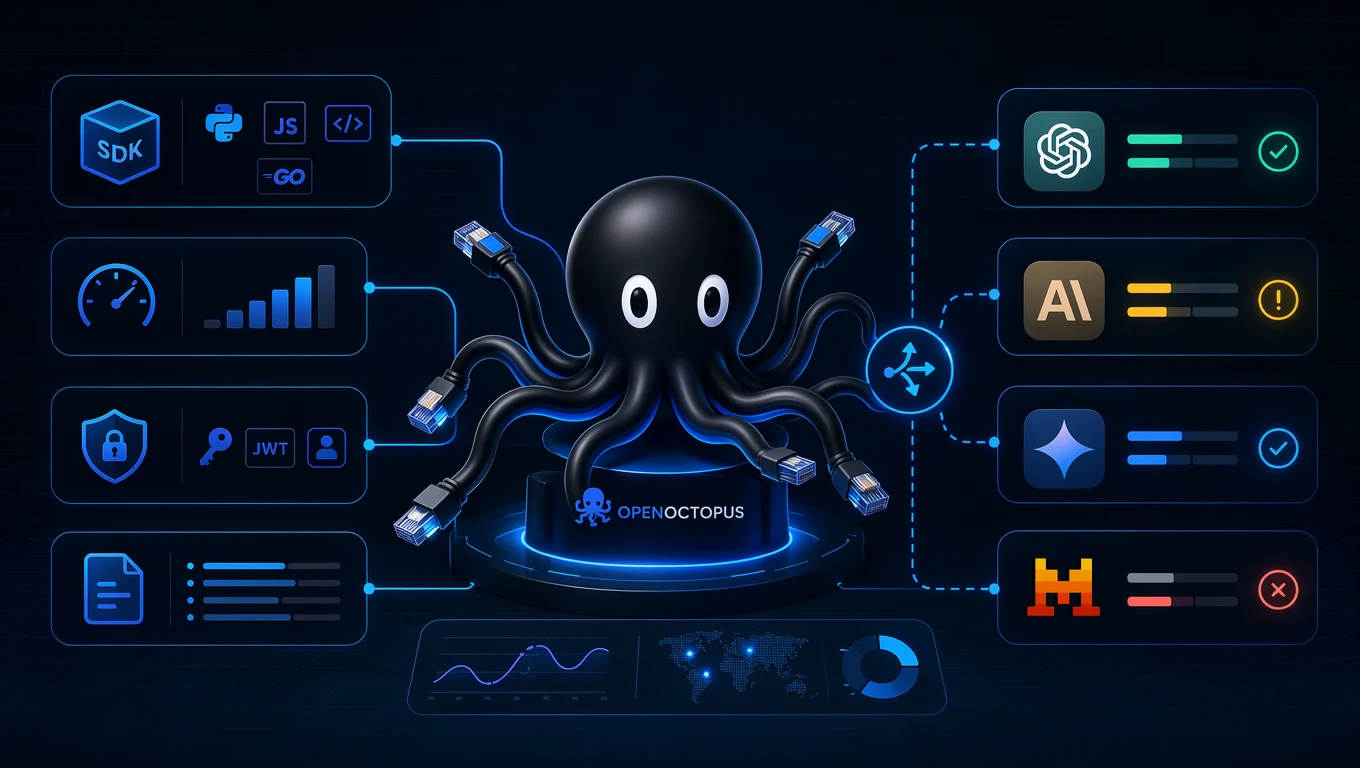
- Unified AI API Management: One endpoint for text, code, image, and video models. Replace multiple provider integrations with a single OpenAI-compatible API layer that normalizes routing, authentication, and billing.
- Multi-Model Routing: Dynamically route requests across providers based on workload requirements. Switch between models without changing integration code.
- OpenAI-Compatible Migration: Drop-in replacement for existing OpenAI SDK workflows. Update your
base_urland API key — no rewrite required. - Provider Fallback: Automatic failover when a provider experiences degradation or rate limits. Requests reroute to available alternatives without application-level intervention.
- Centralized Authentication: One API key for all providers. Eliminate the operational overhead of managing multiple credentials, rotation policies, and permission scopes.
- Model Switching: Change models by updating a single parameter. Test new releases, A/B test providers, and optimize for cost or quality without architectural changes.
- Cost Visibility: Unified billing and usage analytics across all providers. Track token spend, identify optimization opportunities, and forecast infrastructure costs in one dashboard.
- Reduced SDK Fragmentation: Stop maintaining separate clients for each provider. One SDK integration covers your entire AI infrastructure stack.
- Human Technical Support: Real engineers respond to integration questions and routing issues. No automated ticket queues.
- Multimodal Orchestration: Coordinate text, image, video, and embedding workflows through a single API orchestration layer with consistent request schemas.
Why AI API Management Gets Complex
Production AI infrastructure rarely depends on a single provider. Teams integrating Together AI API access alongside OpenAI, Anthropic, Google, and other providers quickly encounter operational complexity that prototype-stage development does not reveal.

| Operational Pain Point | What Happens | Production Impact |
|---|---|---|
| SDK Fragmentation | Each provider distributes its own SDK with different installation packages, version cycles, and dependency trees. A typical stack might include the OpenAI Python client, Anthropic's SDK, Google's Generative AI library, and Together AI API client libraries — each with breaking changes, deprecation timelines, and incompatible error handling patterns. | Engineering teams spend cycles maintaining multiple clients instead of building product features. |
| Provider-Specific Authentication | API key formats, header conventions, and token expiration policies vary across providers. Some use Bearer tokens, others require project-based credentials, and rotation policies differ significantly. | Managing auth workflows in production requires custom credential management systems or secrets rotation infrastructure. |
| Rate Limit Heterogeneity | Providers enforce different rate limit strategies: requests per minute, tokens per minute, concurrent connection limits, and burst allowances. These limits change without notice and are documented inconsistently. | Production systems must handle 429 errors, implement backoff strategies, and track limit proximity per provider. |
| Inconsistent Error Schemas | An OpenAI timeout returns a different structure than an Anthropic rate limit or a Together AI API validation error. | Building reliable retry logic requires parsing provider-specific error payloads, mapping them to unified exception types, and applying appropriate recovery strategies. |
| Model Rollout Timing Differences | New models deploy on different schedules across providers. A model available through one provider's beta program might not reach unified platforms for days or weeks. | Teams wanting early access to frontier models sometimes need direct provider integrations alongside their unified routing layer. |
| Pricing Model Variations | Token pricing differs not just in absolute cost but in structure: per-request fees, input/output token splits, context window premiums, and batch discounts. | Comparing true costs across providers requires normalizing these models, which unified AI API management platforms attempt to simplify. |
| Monitoring Fragmentation | Latency, error rates, and cost metrics spread across multiple provider dashboards. | Building a unified operational view requires extracting data from disparate APIs, normalizing time zones and metric definitions, and constructing custom monitoring pipelines. |
| Multimodal Payload Complexity | Image and video requests involve base64 encoding, MIME type negotiation, size limits, and format conversions that vary per provider. | A payload valid for one image generation API might fail validation on another due to dimension constraints or content policy differences. |
| Fallback Logic and Vendor Lock-in | Without a unified routing layer, implementing provider fallback requires custom logic in application code that detects degradation, selects alternatives, handles partial failures, and maintains state. | Engineering teams effectively build a mini-router inside every service, increasing maintenance burden and architectural fragility. |
For teams evaluating unified infrastructure, the AI API Platform: Unified Multi-Model API Access Guide explains how centralized orchestration addresses these complexity sources.
How Developers Use Together AI API
Developers search for Together AI API access for several valid reasons: exploring open-weight and frontier models, evaluating inference cost structures, prototyping applications that require specific model capabilities, or researching multi-model provider ecosystems. This page addresses that search intent from an AI API management perspective.
Why Together AI API Search Intent Leads to Routing Questions
Teams evaluating Together AI API often discover that production workloads require more than one model family. Reasoning tasks might need GPT-4o or Claude. Code generation might perform better on DeepSeek Coder. Image synthesis might require Flux or SDXL. Video generation might use Veo or Kling. Each capability potentially introduces a new provider integration.
This proliferation creates a routing problem: how do you send each request to the optimal model without managing five separate SDKs, authentication systems, and billing dashboards?
How AI API Management Becomes Harder at Scale
At low volume, direct provider integrations are manageable. At production scale, the operational surface area expands non-linearly:
- Request volume amplifies rate limit and retry complexity
- User concurrency exposes latency variation across providers
- Cost accumulation makes pricing optimization operationally significant
- Error rates demand automated fallback and circuit-breaking
- Model updates require regression testing across integrations
A unified routing layer does not eliminate this complexity but centralizes it. Instead of distributing retry logic, fallback rules, and monitoring across every service, teams configure these concerns once in an AI API management platform.
Unified Routing Layers in Production Workflows
OpenOctopus provides an OpenAI-compatible API layer that routes requests to underlying providers. Developers use familiar SDK patterns while gaining multi-model access, automatic failover, and centralized cost visibility. This approach treats Together AI API as one node in a broader AI infrastructure graph rather than an isolated integration.
Transparency Note
This page is not official Together AI documentation. It is a developer-focused guide to AI API management, multi-model routing, and OpenOctopus unified API workflows. For authoritative Together AI API specifications, refer to Together AI's official developer documentation.
Teams comparing provider options may also find Best AI API: Compare Top AI APIs for Developers useful for evaluating infrastructure capabilities across the ecosystem.
Core Components of AI API Management
Managing multi-provider AI infrastructure requires a structured evaluation framework. The following components reflect how engineering teams assess AI API management capabilities before production deployment.
| Component | Purpose | Operational Risk If Missing |
|---|---|---|
| Routing Policy | Match workloads to optimal providers based on cost, latency, quality, or manual rules. | Suboptimal provider selection degrades user experience or inflates costs. |
| Model Fallback | Automatically switch providers when failures or degradation occur. | Hardcoded single-provider integrations create single points of failure. |
| SDK Compatibility | Enable existing OpenAI SDK code to work without rewrites. | Custom SDK integrations require ongoing maintenance per provider. |
| Authentication | Centralize key management instead of distributing credentials across providers. | Distributed credentials increase exposure and operational overhead. |
| Rate Limits | Handle burst traffic, queue management, and backoff strategies. | Unhandled rate limits cause cascading failures under load. |
| Logging | Maintain centralized request/response logging and traceability. | Fragmented logs make incident response slow and unreliable. |
| Latency Management | Track variability across providers, regions, and model types. | Unpredictable latency degrades product quality inconsistently. |
| Cost Visibility | Provide per-request, per-model, and per-provider cost tracking. | Opaque spending leads to surprise bills and margin erosion. |
| Error Handling | Normalize error schemas and retry policies across providers. | Provider-specific errors require custom handling per integration. |
| Monitoring | Offer unified dashboards for uptime, latency, and error rates. | Siloed monitoring obscures systemic degradation patterns. |
| Migration Effort | Estimate code changes, testing requirements, and rollback procedures. | Underestimated migration effort delays product launches. |
Applying This Framework
Actual routing performance depends on model choice, provider latency, request size, concurrency, and workload type. No unified platform eliminates these variables — it centralizes their management. Teams should validate routing behavior under realistic load before production deployment.
AI API management is the practice of governing, routing, monitoring, and optimizing access to multiple AI model providers through a centralized infrastructure layer. It encompasses authentication management, rate limit handling, cost tracking, latency optimization, error normalization, and failover orchestration. Effective AI API management treats AI providers as interchangeable infrastructure components rather than tightly coupled dependencies. This approach reduces vendor lock-in, simplifies provider migration, and enables teams to optimize for cost, quality, and latency dynamically as provider capabilities and pricing evolve.
For a deeper exploration of evaluation criteria, see the AI API Platform: Unified Multi-Model API Access Guide.
Developers focused on cost optimization should also review Cheapest AI API: Low-Cost AI APIs for Developers.
How Multi-Model Routing Works
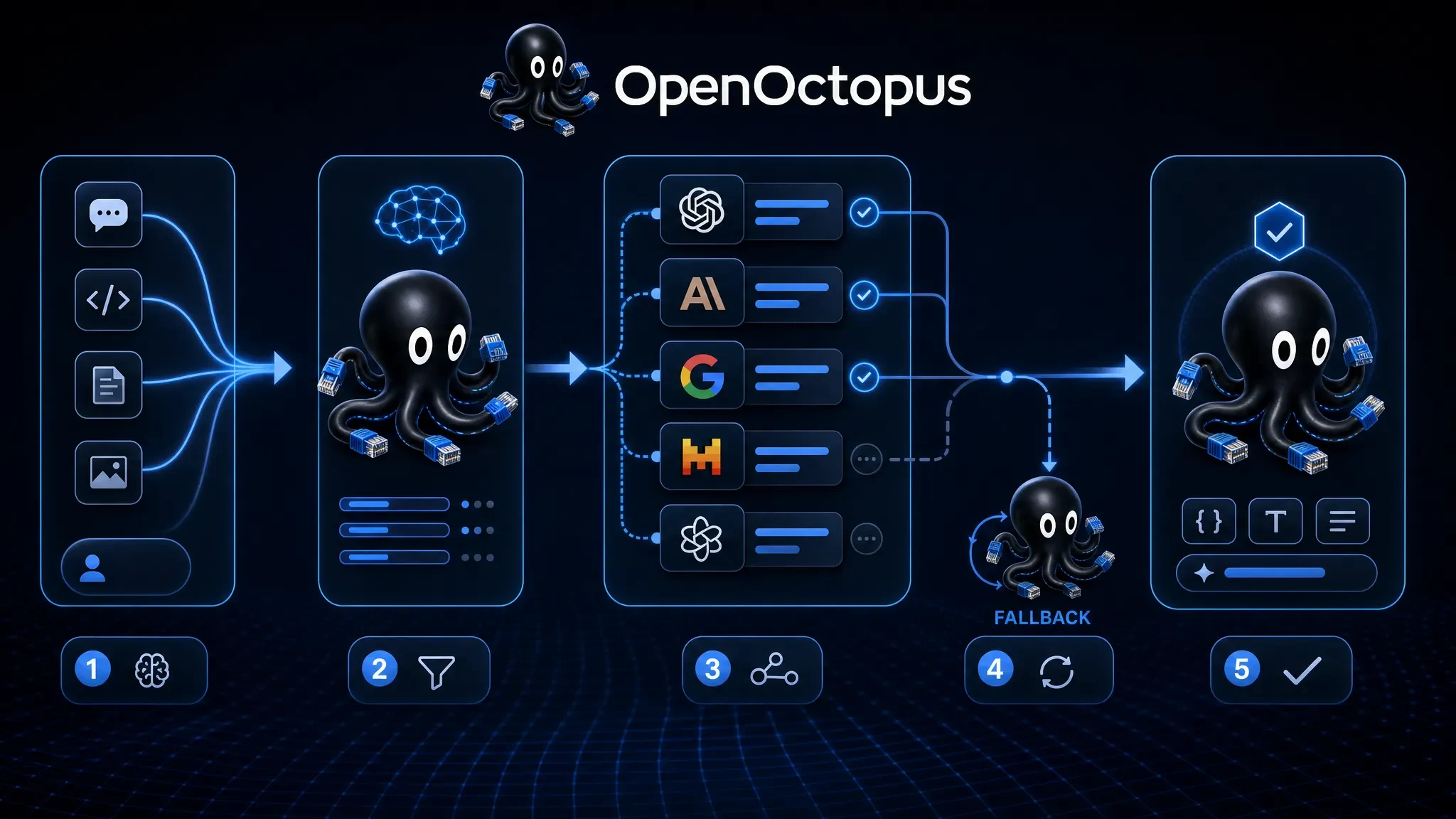
Multi-model routing is the core engineering capability that enables unified AI API management. Understanding routing architecture helps teams evaluate any AI API management platform effectively.
Routing Flow
User Request
↓
Request Classification Layer
↓
Provider Selection Logic
↓
Load Balancer
↓
Selected AI Provider
↓
Response Normalization
↓
Application Response
The routing pipeline begins with request classification. The system analyzes model type requested, latency requirements, cost sensitivity, and geographic origin. The routing engine then applies configured rules to determine optimal provider selection. Common routing strategies include cost-based routing, latency-based routing, quality-based routing, and fallback routing. When the primary provider fails or degrades, the router automatically retries or failovers to an alternative. This behavior depends on workload characteristics, provider availability, and configuration — it is not universally optimal for every request type.
Routing Factors
| Factor | Why It Matters |
|---|---|
| Latency | Impacts user experience for real-time applications. Slow inference degrades perceived product quality. |
| Provider Health | Determines reliability. Degraded providers trigger automatic failover to maintain uptime. |
| Model Capability | Matches workload requirements to provider strengths. Different models excel at different tasks. |
| Cost | Enables optimization. Non-critical requests can route to lower-cost providers without quality loss. |
| Geography | Reduces regional latency. APAC users may experience 300ms higher latency to US-based providers without geographic routing. |
Different providers return responses in slightly different formats. An AI API management platform normalizes these into consistent schemas, allowing applications to switch providers without modifying parsing logic. When switching from GPT-4o to Claude or to a Together AI API model, applications should not need to rewrite prompt templates, parsing logic, or error handlers.
OpenAI-Compatible Integration
Integrating with OpenOctopus takes three steps. The OpenAI-compatible workflow minimizes migration friction for teams already using OpenAI SDK patterns.
Step 1 — Get API Key
Sign up at OpenOctopus and generate an API key from the dashboard. One key routes to all supported providers.
Step 2 — Replace base_url
Update two parameters — api_key and base_url — and your existing code works with OpenOctopus:
from openai import OpenAI
client = OpenAI(
api_key="YOUR_OPENOCTOPUS_API_KEY",
base_url="https://api.openoctopus.com/v1"
)
response = client.chat.completions.create(
model="MODEL_NAME",
messages=[
{"role": "user", "content": "Route this request to the best available model."}
]
)
Step 3 — Access Multiple Providers
Switch models by changing the model parameter. No client reconfiguration, no new SDK imports, no auth changes:
# Route to a reasoning model
response = client.chat.completions.create(
model="claude-3-sonnet",
messages=[{"role": "user", "content": "Explain quantum error correction"}]
)
# Route to an open-weight model
response = client.chat.completions.create(
model="llama-3-70b",
messages=[{"role": "user", "content": "Summarize this research paper"}]
)
Migration Benefits
| Benefit | Why It Matters |
|---|---|
| Reuse Existing SDK | Lower migration effort. Teams change two parameters instead of rewriting integration code. |
| Unified Auth | Easier scaling. One API key eliminates credential sprawl across providers. |
| Shared Schema | Reduced maintenance. Consistent response formats eliminate per-provider parsing logic. |
| Faster Provider Switching | Operational flexibility. A/B test models, optimize costs, and handle outages through configuration changes. |
The OpenAI SDK has become the de facto standard for AI API integration. By maintaining compatibility with this interface, OpenOctopus allows teams to adopt multi-model routing without rewriting application code, retraining developers, or retesting parsing logic. This compatibility layer is particularly valuable for teams currently using direct OpenAI integration who want to add Together AI API or other providers without architectural disruption.
Tradeoffs of Unified AI API Layers
Unified AI API management provides significant operational benefits, but it is not the right choice for every team or workload. This section outlines honest limitations that engineering teams should consider.
Benefits
- Centralized Routing — Configure provider selection, fallback logic, and retry policies in one place instead of distributing them across services.
- Unified Monitoring — Observe latency, error rates, and costs across all providers through a single dashboard.
- Reduced Fragmentation — Eliminate the need to maintain separate SDKs, authentication systems, and billing integrations for each provider.
- Simpler Workflows — Onboard new models by updating a configuration parameter rather than integrating a new API client.
Tradeoffs
- Abstraction Layers — A unified routing layer introduces abstraction between your application and provider APIs. This may obscure provider-specific features, beta endpoints, or custom parameters.
- Beta Feature Lag — Provider APIs expose beta features, fine-tuning endpoints, and custom parameters before unified platforms integrate them. Direct integration may be necessary for cutting-edge capabilities.
- Provider-Specific Limitations — Some provider SDKs offer features that do not map cleanly to OpenAI-compatible interfaces: advanced streaming metadata, custom authentication flows, provider-specific tool formats, or proprietary response extensions.
- Routing Overhead — Unified layers add a network hop that, while typically minimal, may not satisfy latency-critical applications with sub-100ms requirements.
- Schema Normalization Limits — Different providers handle system messages, tool calling, and JSON mode with subtle incompatibilities. Edge cases exist around function calling schemas and structured output guarantees.
Scope Boundaries
This page focuses on Together AI API search intent, multi-model API access, AI API management, OpenAI-compatible workflows, developer routing strategies, and API orchestration. It does not deeply cover:
- Together AI internal architecture or infrastructure details
- Private enterprise contracts or custom SLA negotiations
- Fine-tuning pipelines or model customization workflows
- Dedicated GPU hosting or on-premise inference deployment
- Custom model training or dataset preparation
For teams evaluating whether unified routing fits their architecture, the AI API Platform: Unified Multi-Model API Access Guide provides a broader decision framework.
Practical Engineering Considerations
The following observations come from operational experience managing multi-provider AI infrastructure. They reflect real-world behaviors that documentation rarely captures.
| Operational Risk | What Happens | Mitigation Strategy |
|---|---|---|
| Retry Storms | When a provider degrades, naive retry logic can amplify load exponentially. If ten services retry three times with no backoff, a 20% error rate becomes a 60% request amplification. | Implement jittered exponential backoff, circuit breakers, and cross-provider fallback to prevent retry cascades. |
| Provider Outages | Outages are not binary. A provider might return 200 status codes while responses degrade in quality or latency doubles over five minutes. | Monitor not just HTTP status but time-to-first-token, completion quality signals, and error rate trends. Trigger automated fallback before users notice degradation. |
| SDK Streaming Differences | Streaming implementations vary subtly across providers. Chunk boundaries, SSE formatting, and completion indicators differ. | Unified API layers normalize these streams, but teams should verify streaming behavior for their specific use case during integration testing. |
| Schema Mismatch | An image generation request valid for one provider might fail on another due to dimension limits, aspect ratio constraints, or content filter differences. | Normalizing payloads across providers requires careful validation layers, particularly for video requests with frame rate and duration constraints. |
| Timeout Handling | Provider timeout behavior is inconsistently documented. Some providers hang indefinitely on overloaded queues. Others return 504 Gateway Timeout. Some drop connections without HTTP status. | Implement aggressive client-side timeouts with fallback triggers rather than relying on server-side behavior. |
| Rate Limit Nuances | Rate limits often have multiple dimensions: requests per second, tokens per minute, and concurrent requests. Hitting any dimension triggers throttling. | Surface rate limit metadata consistently, but ensure application code handles 429 responses gracefully with appropriate backoff. |
| Prompt Portability | Prompts optimized for one model often underperform on another. System instructions and few-shot examples that work well on GPT-4o might produce lower-quality outputs on Claude or open-weight models. | Validate prompts across target providers before production deployment. Model switching requires prompt tuning, not just parameter changes. |
| Auth Workflow Complexity | Some providers require organization IDs, project tokens, and location parameters in addition to API keys. Others use OAuth flows or service account credentials. | Centralizing these behind a single API key simplifies application code but shifts credential complexity to the platform layer. |
| Logging Fragmentation | Correlating requests across providers requires consistent trace IDs. Without centralized logging, debugging means checking multiple dashboards with different retention policies and query languages. | Propagate trace context and aggregate logs centrally to enable reliable incident response. |
| Fallback Edge Cases | Failover involves state management, partial response handling, cost differences, and quality variation. A code generation request that fails on one provider might succeed on another but return different formatting. | Applications must handle semantic differences between providers, not just binary success or failure. |
| Normalization Edge Cases | Different providers handle system messages, tool calling, and JSON mode with subtle incompatibilities. | Test specific patterns across target providers. Edge cases exist around function calling schemas and structured output guarantees. |
Teams starting new projects may want to explore Free AI API for Developers: Best Free APIs to Start With before committing to paid infrastructure.
Frequently Asked Questions About Together AI API and AI API Management
What is Together AI API used for?
Together AI API provides developers with programmatic access to open-weight and frontier AI models.
- Core capabilities: text generation, code completion, embeddings, and other inference tasks.
- Common use cases: building applications that require specific model capabilities, evaluating inference providers, or integrating open-source models into production workflows.
- Operational reality: production applications often require multiple model types, which introduces routing complexity, SDK fragmentation, and operational overhead. A unified AI API management layer addresses this by consolidating Together AI API access alongside other providers into a single orchestration endpoint.
Is this page official Together AI documentation?
No.
- What this page is: an independent developer guide published by OpenOctopus. It is not affiliated with, endorsed by, or officially connected to Together AI.
- What we cover: Together AI API access patterns, routing strategies, and integration approaches.
- What to verify officially: authoritative technical specifications, rate limits, pricing, and model availability should always be checked through Together AI's official developer documentation.
- Our focus: AI API management methodology, multi-model routing architecture, and unified infrastructure patterns that apply broadly across providers including Together AI.
How does OpenAI-compatible integration reduce migration cost?
OpenAI-compatible integration leverages the OpenAI SDK as a de facto industry standard.
- What changes: only two parameters —
base_urlandapi_key. - What stays the same: existing SDK, request formatting, error handling, and parsing logic.
- What is eliminated: the need to learn new SDKs, rewrite integrations, or retest parsing logic.
- Outcome: the compatibility layer preserves existing engineering workflows while extending provider reach, making it the lowest-friction path for teams adopting multi-model AI API management.
How does OpenOctopus help manage AI APIs?
OpenOctopus provides a unified AI API management platform through a single OpenAI-compatible endpoint.
- Built-in capabilities: provider routing, automatic failover, centralized authentication, cost visibility, and response normalization.
- Model coverage: text, code, image, and video providers through one integration.
- Support: human technical support for integration questions and routing configuration.
- Platform focus: reducing provider fragmentation and simplifying multi-model orchestration for development teams building and scaling AI products.
How can teams avoid provider lock-in?
Avoiding provider lock-in requires architectural decisions made early in the development lifecycle.
- Prevention strategies:
- Abstract provider-specific code behind interfaces.
- Use OpenAI-compatible SDKs where possible.
- Store prompts in provider-agnostic formats.
- Normalize response parsing.
- How platforms help: a unified AI API management layer accelerates this strategy by handling normalization centrally.
- Reality check: complete lock-in avoidance is rarely achievable — prompt behavior varies across models, and some features remain provider-specific.
- Realistic goal: reducing switching costs from weeks of refactoring to days of prompt tuning and configuration changes.
When should teams use direct provider APIs instead of unified routing?
Teams should consider direct provider APIs in the following scenarios:
- Provider-specific features are required that remain unavailable through unified layers.
- Beta access is needed to new models before platform integration completes.
- Extreme latency sensitivity makes additional routing hops unacceptable.
- Custom pricing or throughput agreements exist with a single provider.
- Recommended hybrid approach: many production teams use unified routing for common workloads and direct integrations for specialized capabilities, balancing operational simplicity with access to cutting-edge features.
Start Managing AI APIs with OpenOctopus
Reduce provider fragmentation and simplify your Together AI API infrastructure. Get unified access to multiple AI models through one OpenAI-compatible endpoint with built-in routing, fallback, and cost visibility.