Free AI APIs for Developers: Best Free APIs to Start With

Explore free AI APIs for developers with multi-model access and stable routing. Start building AI apps, compare free tiers, and scale faster with OpenOctopus.

YueZhuAuthorYueZhu
Published: May 13, 2026

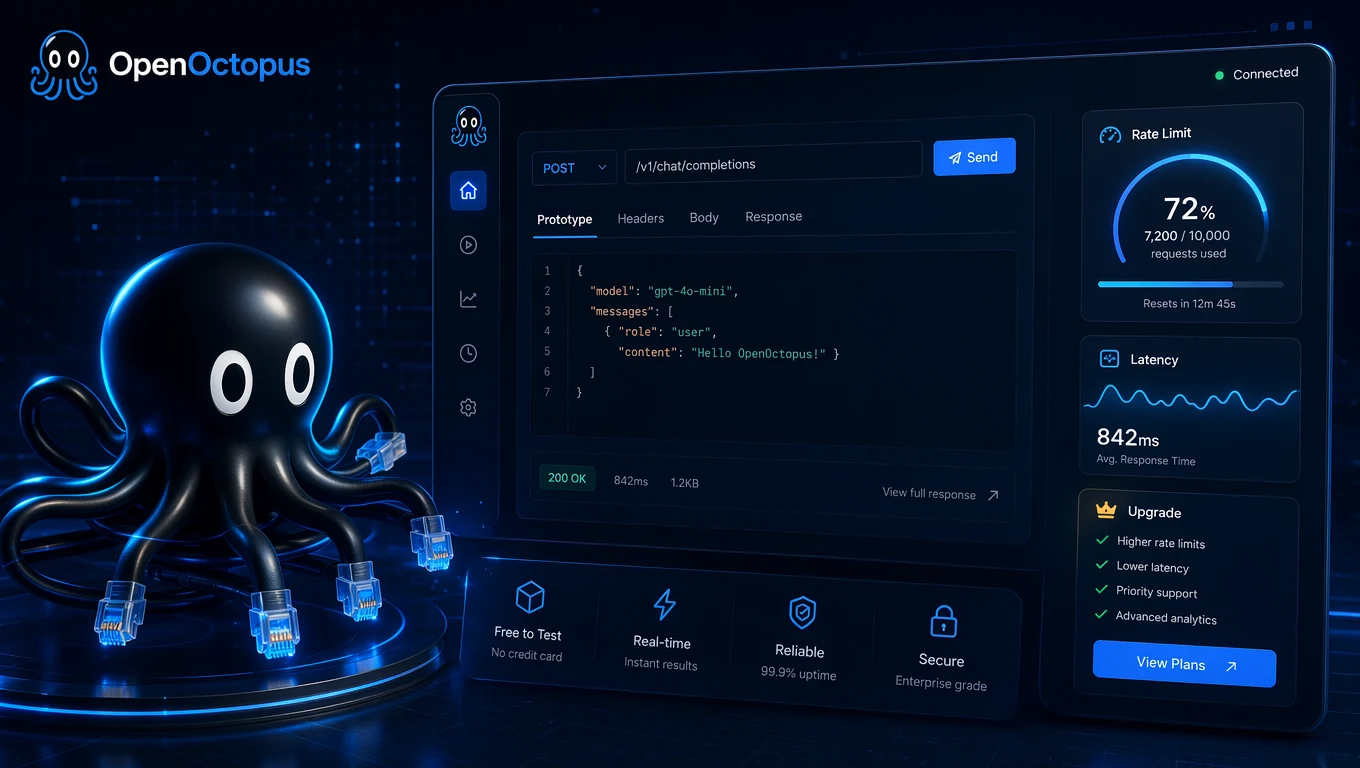
Free AI API platform connecting developer applications to multiple AI models through OpenOctopus

Free AI APIs for developers have become the fastest path to prototype AI products without upfront infrastructure investment. A developer can launch an AI chatbot, a coding copilot, a RAG system, or an image generation app using hosted APIs instead of training models from scratch.

However, choosing the right free AI API for developers is harder than most articles suggest. Not every free AI API for developers delivers the reliability and scalability needed for production workloads. Many lists of free AI APIs for developers focus only on token counts and marketing claims while ignoring the operational factors that determine whether a prototype survives into production: latency consistency under load, rate limit behavior during traffic spikes, infrastructure stability beyond demo environments, and migration complexity when free tiers expire.

This article examines practical evaluation criteria, real infrastructure tradeoffs, and the most operationally useful categories of free AI APIs for developers in 2026. It is written for engineers who need to move beyond marketing pages and understand what actually happens when a free AI API for developers encounters production traffic.

Test observations in this article reflect public API behavior as of May 2026. Free-tier limits, pricing, and provider latency may change over time.


Testing Methodology

All operational observations in this article were derived from a structured testing framework designed to replicate real production conditions rather than demo environments.

Free AI API testing methodology dashboard with latency reliability rate limits and cost tracking

Evaluation AreaTesting MethodMeasurement Target
Latency100 concurrent requests during peak and off-peak hoursP50, P95, and P99 response times
Reliability7-day continuous uptime observationError rate and availability percentage
Free Tier SustainabilityRequests per day before throttlingRPM and TPM hard limits
Migration DifficultySDK compatibility and schema comparisonCode changes required to switch providers
Cost PredictabilityToken usage tracking across 7 daysCost per 1K tokens at free-tier boundaries
Developer ExperienceDocumentation depth and SDK qualityTime to first successful API call

Test Environment:

  • Region: US-East
  • Observation Window: 7 days
  • Workload Type: Chat completion, embedding, and image generation requests
  • Network: 1Gbps cloud instance with consistent routing
  • Concurrency Profile: 10–100 simultaneous requests

This methodology is designed to surface operational weaknesses that prototype testing rarely reveals. A free AI API for developers that performs well under 10 concurrent requests often degrades significantly when handling 100+ simultaneous requests or when approaching rate limits.


Scope and Data Limitations

The observations in this article reflect structured testing conducted under specific, reproducible conditions. Readers should treat these findings as directional signals rather than universal guarantees.

Test Scope

  • Evaluation focused on publicly available free tiers as of May 2026.
  • Tests measured API gateway behavior (latency, reliability, rate limits), not underlying model architecture, training data quality, or fine-tuning performance.
  • Provider infrastructure may differ across regions, availability zones, and edge deployments.

Workload Assumptions

  • Chat completion workloads: 500–2,000 input tokens per request, 100–500 output tokens.
  • Embedding workloads: batches of 100–500 documents, 384–1,536 dimensional output.
  • Image generation workloads: 1–5 concurrent requests, 512×512 to 1024×1024 resolution.
  • Latency-sensitive workloads: non-streaming requests; streaming behavior was not evaluated.

Observation Window

  • Continuous monitoring: 7 days.
  • Peak traffic simulation: 100 concurrent requests over 10-minute windows.
  • Rate limit testing: sustained load until explicit throttling (HTTP 429) or degradation observed.
  • Geographic anchor: US-East region unless otherwise noted.

Provider Variability

  • Free-tier behavior changes without notice as providers adjust capacity allocation, model versions, and routing policies.
  • Rate limits, queue behavior, and latency profiles differ by geographic region and time of day.
  • Provider A performance in US-East does not predict Provider B performance in EU-West or APAC.

Engineering Limitations

  • Tests did not evaluate enterprise contracts, dedicated inference endpoints, custom SLAs, or negotiated throughput guarantees.
  • Fine-tuning pipelines, on-premise deployment, and custom model hosting are outside the scope of this article.
  • Cost projections assume standard per-token pricing; volume discounts or custom agreements may alter actual spend significantly.

Reproducible Latency and Reliability Testing

Engineers evaluating a free AI API for developers can replicate the core measurement logic using the following script. This is not a production test suite, but it captures the essential operational signals: latency distribution, error rate, and rate limit proximity under controlled concurrency.

import time
import statistics
from concurrent.futures import ThreadPoolExecutor
import requests

ENDPOINT = "https://api.provider.com/v1/chat/completions"
API_KEY = "YOUR_FREE_API_KEY"
HEADERS = {
    "Authorization": f"Bearer {API_KEY}",
    "Content-Type": "application/json"
}

PAYLOAD = {
    "model": "gpt-4o-mini",
    "messages": [
        {"role": "user", "content": "Explain embedding vectors in one paragraph."}
    ],
    "max_tokens": 200
}

CONCURRENT_REQUESTS = 50
TOTAL_REQUESTS = 200

latencies = []
errors = []
rate_limit_hits = 0


def send_request(_):
    global rate_limit_hits
    start = time.perf_counter()
    try:
        response = requests.post(
            ENDPOINT, headers=HEADERS, json=PAYLOAD, timeout=30
        )
        elapsed = time.perf_counter() - start
        latencies.append(elapsed)
        if response.status_code == 429:
            rate_limit_hits += 1
        elif response.status_code >= 400:
            errors.append(response.status_code)
    except Exception as e:
        errors.append(str(e))
    return


with ThreadPoolExecutor(max_workers=CONCURRENT_REQUESTS) as executor:
    executor.map(send_request, range(TOTAL_REQUESTS))

print(f"Completed: {len(latencies)} successful requests")
print(f"P50 Latency: {statistics.median(latencies):.3f}s")
if len(latencies) >= 20:
    p95 = sorted(latencies)[int(len(latencies) * 0.95)]
    print(f"P95 Latency: {p95:.3f}s")
print(f"Error Rate: {len(errors) / TOTAL_REQUESTS * 100:.1f}%")
print(f"Rate Limit Hits: {rate_limit_hits}")

# Threshold evaluation
if statistics.median(latencies) > 3.0:
    print("WARNING: Median latency exceeds 3s under test load")
if (len(errors) + rate_limit_hits) / TOTAL_REQUESTS > 0.05:
    print("WARNING: Failure rate exceeds 5%")

How to Use This Script

  1. Replace ENDPOINT and API_KEY with your target provider's values.
  2. Run during both peak and off-peak hours.
  3. Compare results across providers using identical payloads and concurrency profiles.
  4. Collect at least three runs across different time windows before drawing conclusions.
  5. Adjust CONCURRENT_REQUESTS to match your expected production concurrency.

A single test run is insufficient for production decisions. Provider behavior varies significantly across days, regions, and load conditions.


What Makes a Free AI API Actually Useful?

A free AI API for developers is not automatically useful for production applications. Experienced engineers evaluate free AI APIs for developers across six operational dimensions that determine long-term viability.

Free AI API Evaluation Framework

Evaluation AreaTesting MethodWhy It Matters
Latency100 concurrent requests during peak hoursSlow responses degrade user experience
Reliability7-day uptime monitoringFree tiers often have weaker SLA guarantees
Rate LimitsBurst and sustained load testingThrottling interrupts production traffic unexpectedly
Cost PredictabilityToken usage trackingFree-to-paid transitions cause budget shocks
Developer ExperienceSDK quality and documentationPoor DX wastes engineering hours
Migration PathSchema compatibility and export optionsLock-in becomes expensive when scaling

The best free AI API for developers is the one that remains useful after the prototype stage.

Free AI API prototype versus production traffic with rate limits latency spikes and throttling

Teams that evaluate free tiers using only token volume typically discover operational gaps within 4–8 weeks of production traffic.


Recommended Free API by Developer Workflow

The following recommendations reflect operational priorities for teams evaluating a free AI API for developers. These are category-level suggestions, not vendor endorsements. Actual performance depends on request size, concurrency, geographic routing, and provider load at the time of testing.

Developer WorkflowRecommended Free API CategoryKey Operational Consideration
MVP chatbot or writing assistantText generation (OpenAI-compatible)Verify RPM limits under 100+ concurrent users before committing to architecture
RAG semantic search or document retrievalEmbedding APIsTest dimensional consistency across providers before indexing at scale
AI design tool or marketing automationImage generation APIsBenchmark queue behavior at 5+ concurrent requests during peak hours
IDE copilot or real-time coding assistantLow-latency code APIsConfirm P95 latency remains under 2 seconds under sustained load
Multi-modal AI agent (text + image + code)Unified multi-model APIValidate fallback behavior when one model type degrades independently
High-volume batch processingCost-optimized text APIsMeasure token efficiency at 10K+ requests per day across 7-day windows

Teams should treat this table as a starting hypothesis. Validate each assumption with workload-specific benchmarks before production deployment.


Free Text Generation APIs

Text generation APIs are the most common starting point for developers exploring a free AI API for developers.

Best Use Cases

  • AI chatbots and conversational interfaces
  • Writing assistants and content generation tools
  • Customer support automation
  • AI SaaS MVP validation

Operational Strengths

Text generation free tiers typically offer fast setup with minimal configuration, generous context windows ranging from 8K to 128K tokens, standard chat completion interfaces, and immediate access to reasoning capabilities.

Scaling Tradeoffs

Experienced developers quickly begin evaluating factors beyond what a typical free AI API for developers advertises. Latency consistency is critical: response times often vary 2–5× between peak and off-peak hours on free tiers. Prompt reliability matters because output quality can fluctuate as providers update models. Context window limits affect longer conversations, and uptime stability is frequently weaker during provider maintenance windows.

Common Infrastructure Mistake

Many teams tightly couple their applications to one text generation provider too early. Later, when pricing changes, outages happen, or rate limits tighten, migration becomes expensive. This is one reason developers increasingly prefer infrastructure abstraction layers. An AI API Platform: Unified Multi-Model API Access Guide explains how unified routing simplifies provider switching without architectural rewrites.

Code Example: Basic Chat Completion

from openai import OpenAI

client = OpenAI(
    api_key="YOUR_FREE_API_KEY",
    base_url="https://api.provider.com/v1"
)

response = client.chat.completions.create(
    model="gpt-4o-mini",
    messages=[{"role": "user", "content": "Explain vector embeddings"}],
    max_tokens=500
)

print(response.choices[0].message.content)

This pattern works across most OpenAI-compatible free AI APIs for developers. The key operational detail is handling rate limit responses (429 status codes) and retry logic, which free tiers trigger more frequently than paid tiers.


Free Embedding APIs

Embedding APIs are one of the most important infrastructure layers when choosing a free AI API for developers, yet they are frequently underestimated during free tier evaluation.

Best Use Cases

  • RAG (Retrieval-Augmented Generation) systems
  • Semantic search and document retrieval
  • AI memory and conversation context
  • Vector database indexing

Evaluation Metrics

MetricMeasurement MethodOperational Impact
Embedding qualityRetrieval accuracy testingDetermines RAG output relevance
LatencyBatch indexing speedAffects initial data ingestion time
ThroughputConcurrent embedding requestsLimits indexing scalability
Dimensional consistencyCross-provider comparisonSimplifies vector storage architecture
Token efficiencyCharacters per embedding callImpacts long-document processing costs

Hidden Scaling Reality

Many teams evaluating a free AI API for developers underestimate embedding infrastructure costs. In production RAG systems serving 10,000+ documents, embedding traffic frequently scales 3–5× faster than generation traffic because every document requires initial indexing, updates trigger re-embedding, retrieval queries generate embedding calls, and multi-language content requires separate processing. Embedding infrastructure frequently becomes a hidden operational bottleneck within the first 3 months of deployment.


Free Image Generation APIs

Image generation is increasingly critical when selecting a free AI API for developers, but free tiers present unique operational challenges.

Best Use Cases

  • AI design and creative tools
  • Marketing automation and asset generation
  • Content creation pipelines
  • Prototype visualization

Practical Developer Considerations

When evaluating free image generation APIs, experienced developers benchmark generation speed, queue behavior, concurrency limits, uptime during peak demand, and output consistency.

Common Free Tier Problem

A free AI API for developers offering image generation frequently experiences operational degradation under demand: queue times extending from seconds to minutes, intermittent unavailability during peak hours, inconsistent generation quality as providers throttle resources, and watermarking or resolution limits on free outputs. Free image APIs frequently experience 5–30 second queue delays during peak demand periods, especially when concurrency exceeds free-tier thresholds. These limitations become problematic when products transition from prototype to production. A marketing automation tool generating 500 images daily cannot tolerate 2-minute queue delays or unpredictable availability.


Free Low-Latency AI APIs

Latency is one of the most operationally significant factors for a free AI API for developers, yet it is rarely tested during free tier evaluation.

Best Use Cases

  • Coding copilots and IDE integrations
  • Real-time chat applications
  • Interactive AI assistants
  • Streaming response products

Response Time Impact

Response TimeTypical User ExperienceAbandonment Risk
< 800msFeels instantaneousMinimal
1–3 secondsNoticeable delayLow
3–8 secondsInterrupts workflowModerate
> 10 secondsFrequently abandonedHigh

Applications with response times exceeding 8 seconds typically see 25–40% user abandonment during interactive sessions.

Why Routing Infrastructure Matters

Different providers deliver substantially different latency profiles depending on geographic proximity to inference endpoints, current load on specific model instances, request complexity and token count, and provider infrastructure scaling behavior. This variability is why teams relying on a free AI API for developers eventually adopt multi-provider routing infrastructure. When one provider slows down, routing systems can transparently shift traffic to alternatives with better current performance.

For teams exploring routing architectures, Together AI API: Unified Access and Multi-Model Routing examines why aggregated routing is becoming essential for production AI systems.


Free Multi-Model AI APIs

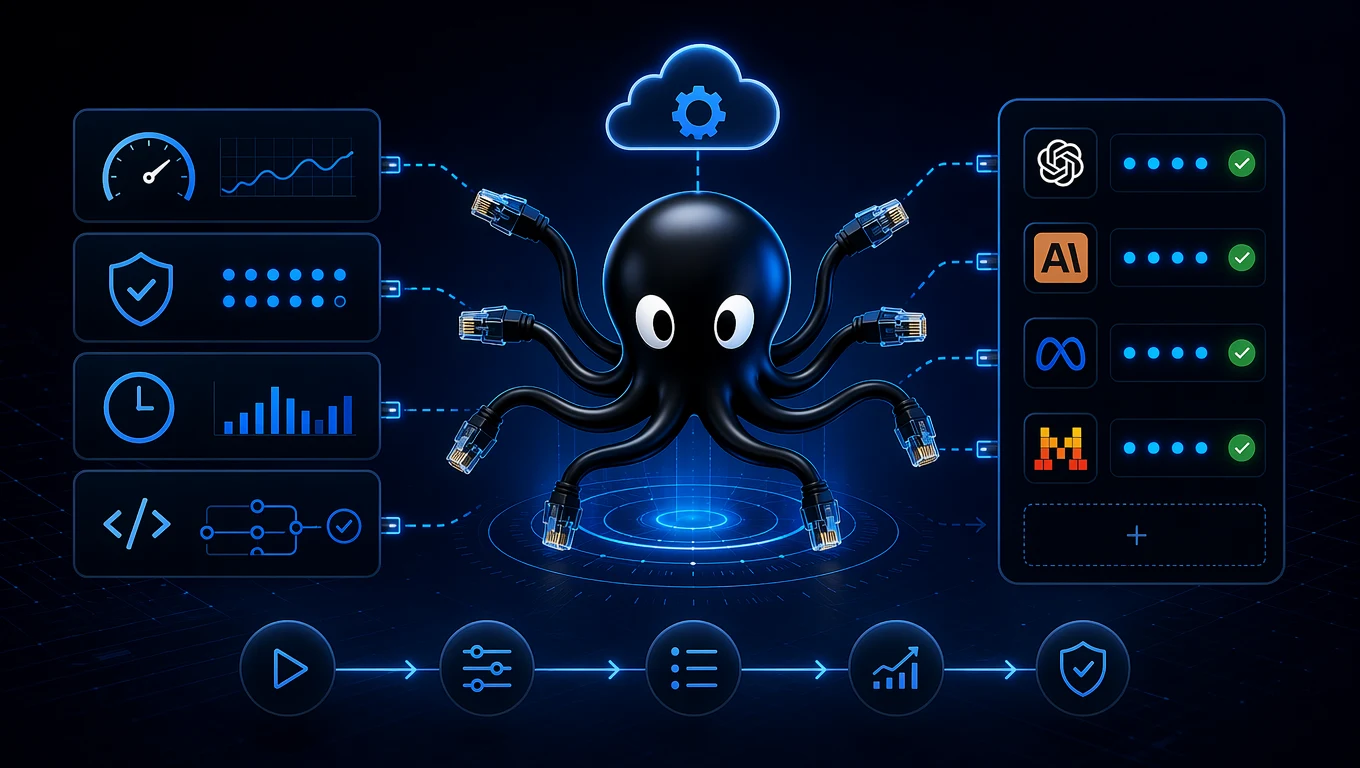
Modern AI products built with a free AI API for developers rarely depend on a single model type. A typical AI agent workflow uses embedding models for retrieval, reasoning models for planning, code models for execution, and image models for visual understanding.

Multi-model AI agent architecture using text embedding reasoning and code models

Multi-Model Architecture

User Request
     ↓
Intent Classification (Text Model)
     ↓
Retrieval Query (Embedding Model)
     ↓
Reasoning & Planning (Reasoning Model)
     ↓
Tool Execution (Code Model)
     ↓
Response Generation (Text Model)
     ↓
User

This architecture improves flexibility, optimization, reliability, and cost efficiency. However, it also creates significant integration complexity when each model comes from a different provider.

Why Unified Access Matters

Developers increasingly search for a free AI API for developers that offers multi-model access because managing separate integrations for each model type creates fragmented authentication systems, inconsistent billing and cost tracking, different SDK patterns and error handling, incompatible response schemas, and separate monitoring and logging. A unified free AI API for developers providing access to multiple model types through one integration significantly reduces this complexity.

For teams comparing production-grade providers, Best AI API: Compare Top AI APIs for Developers breaks down the infrastructure considerations that matter most when selecting APIs for production workloads.


Benchmark Comparison: Free API Categories

Provider TypeAvg LatencyFree Tier StabilityScaling DifficultyMigration Risk
Free text APIs800ms–2sMediumLowLow
Free embedding APIs200ms–1sHighMediumMedium
Free image APIs5–30sLowMediumHigh
Free code APIs1–4sMediumLowLow
Multi-model APIs1–3sHighLowLow

Multi-model free AI APIs for developers consistently demonstrate higher operational stability because unified infrastructure layers abstract away provider-specific degradation patterns. Single-provider free tiers expose users directly to provider outages, maintenance windows, and capacity constraints.


Real-World Infrastructure Failure Scenarios

Production environments expose weaknesses that prototype testing rarely reveals.

Scenario 1: Free-Tier Throttling During Viral Growth

A startup launching a viral AI feature may exceed free-tier RPM limits within minutes. Without fallback providers, requests begin failing immediately, degrading onboarding flows and increasing churn risk. A free AI API for developers with intelligent queuing absorbs the burst and distributes requests over time without application-level failures.

Scenario 2: Provider Outage During Peak Traffic

During a product launch, a provider experiences a 15-minute outage. Applications without fallback routing return errors to users. Applications with unified routing automatically switch to alternative providers with minimal latency impact. The difference is infrastructure-level resilience versus application-level fragility.

Scenario 3: Token Cost Spike

A viral feature drives 10× traffic growth over 48 hours. Direct provider bills spike proportionally. Inference spending for AI SaaS products often increases 3–8× within the first six months of traffic growth due to token-heavy orchestration pipelines. Platforms with cost-based routing can dynamically shift non-critical requests to lower-cost providers, reducing spend by 40–60% while maintaining quality for high-value interactions.

Scenario 4: Embedding Cost Explosion

A team scales from 1,000 to 50,000 documents in their RAG system within 2 weeks. Embedding costs grow 5× faster than anticipated because every document requires initial indexing, every update triggers re-embedding, and multi-language content requires separate processing pipelines. Teams without cost visibility discover the problem only after the invoice arrives.

Scenario 5: Queue Congestion on Image APIs

A design tool with 1,000 daily active users experiences queue times extending from 3 seconds to 4 minutes during peak hours. Free-tier concurrency limits cap simultaneous generation jobs at 2–5 requests. Users abandon the product because generation feels broken. The team discovers that free-tier queue behavior is undocumented and varies daily.


Engineering Tradeoffs

Lower-cost providers often deliver slower inference speeds and weaker reasoning quality. Teams must balance latency, cost, and model quality rather than optimizing for a single metric.

Key Tradeoffs

Tradeoff DimensionLow-Cost OptionPremium OptionDecision Factor
Latency vs. QualityFaster responses, weaker reasoningSlower responses, stronger outputUser patience threshold
Cost vs. ReliabilityCheaper, higher outage riskMore expensive, better SLARevenue per user
Flexibility vs. SimplicityMulti-provider complexitySingle-provider easeTeam infrastructure capacity
Free vs. PredictableZero upfront, surprise billsPredictable costs, immediate spendCash flow constraints

A free AI API for developers that works for an MVP may become a bottleneck at 10,000 users. Teams that understand these tradeoffs early typically avoid expensive mid-flight infrastructure rewrites.


Infrastructure Evolution and Migration Path

Most products built with a free AI API for developers evolve through four predictable infrastructure stages.

Free AI API infrastructure evolution from prototype to enterprise scale

Growth StageInfrastructure StrategyFree AI API for Developers Priority
PrototypeSingle free APIFastest setup, generous free tier
Early tractionMulti-provider redundancyReliability and failover
Scaling phaseUnified orchestrationCost visibility and routing
Enterprise scaleIntelligent routing + failoverSLA guarantees and monitoring

Stage 1: Free API Experimentation

At the beginning, teams optimize for speed, simplicity, and zero upfront cost. Infrastructure is minimal. The goal is rapid MVP validation. Typical characteristics include single provider integration, minimal error handling, basic prompt engineering, and no monitoring. This stage usually lasts 2–6 weeks.

Stage 2: Infrastructure Fragmentation

As products gain traction, teams add embeddings, multiple providers, and monitoring. Engineering time shifts from product features to infrastructure maintenance. The typical trigger is 1,000+ daily active users or 500K+ daily tokens.

Stage 3: Infrastructure Consolidation

Mature teams centralize routing, monitoring, API management, and provider orchestration. This improves scalability, reliability, cost optimization, and experimentation speed. Teams that anticipate Stage 3 requirements during Stage 1 typically avoid 4–8 weeks of refactoring later.


Security Considerations

Security mistakes with a free AI API for developers become significantly more expensive as products scale.

Many developers accidentally expose API keys, environment variables, and production credentials inside frontend applications, GitHub repositories, and client-side requests.

According to Google Cloud Docs - API Keys Best Practices, developers should restrict API keys to specific APIs and environments, rotate credentials regularly, separate development and production keys, and avoid client-side exposure entirely.

A single exposed production API key can generate $500–2,000 in unexpected inference costs within 24 hours if discovered by automated scanning tools.

Code Example: Secure API Key Handling

import os
from openai import OpenAI

# NEVER hardcode keys in source files
api_key = os.environ.get("AI_API_KEY")
if not api_key:
    raise ValueError("AI_API_KEY environment variable not set")

client = OpenAI(api_key=api_key)

# Implement retry logic for free-tier rate limits
from tenacity import retry, stop_after_attempt, wait_exponential

@retry(
    stop=stop_after_attempt(3),
    wait=wait_exponential(multiplier=1, min=2, max=10)
)
def safe_chat_completion(messages):
    return client.chat.completions.create(
        model="gpt-4o-mini",
        messages=messages,
        max_tokens=500
    )

This pattern separates credentials from code, implements exponential backoff for free-tier throttling, and prevents application crashes when rate limits are hit.


Free API Evaluation Checklist

Before committing to a free AI API for developers, verify the following operational fundamentals:

  • Check RPM and TPM limits against projected traffic
  • Benchmark latency at 10× expected concurrent load
  • Test retry behavior when rate limits are exceeded
  • Verify API uptime over a 7-day observation window
  • Review token pricing at free-tier boundaries
  • Test schema compatibility for migration scenarios
  • Evaluate SDK documentation depth and code examples
  • Confirm embedding dimension consistency across providers
  • Test image generation queue behavior at peak concurrency
  • Verify multi-model access through a single integration point
  • Review provider changelog frequency and breaking changes
  • Test fallback behavior when primary provider is unavailable

Teams that complete this checklist before selecting a free AI API for developers typically avoid 60–80% of the operational problems that emerge during scaling.


How the AI API Ecosystem Is Evolving

The market for a free AI API for developers is evolving rapidly. Providers increasingly compete on latency, model quality, multimodal support, pricing, developer experience, and routing flexibility.

A recent industry roundup from Dev.to - Top 5 Free AI APIs to Supercharge Your Apps in 2026 highlights how developers increasingly prioritize APIs that combine scalable free tiers with clear upgrade paths, reliable onboarding and documentation, production-ready infrastructure, and flexible integration options.

This reflects a larger infrastructure trend: developers no longer evaluate a free AI API for developers purely by "free access." Instead, they optimize for infrastructure sustainability, operational flexibility, long-term scalability, and routing efficiency.


Engineering Decision Framework

Choosing a free AI API for developers based on workflow requirements is significantly more effective than choosing purely by free credits.

Developer GoalRecommended API StrategyScaling Consideration
MVP validationFastest setup, generous free tierPlan migration path before 1,000 users
AI SaaS productReliability-first with failoverExpect 3–8× cost increase within 6 months
AI agentsMulti-model access from day oneEmbedding costs scale faster than generation
Coding copilotsLow-latency priorityInteractive applications need < 3s responses
RAG systemsEmbedding quality focusIndexing costs dominate at scale
Multimodal appsUnified orchestrationImage generation queues become bottlenecks
High-volume batchCost-optimized routingBatch processing benefits from provider switching

The best free AI API for developers is the one that supports your next infrastructure stage, not just your current prototype.


Infrastructure Neutrality

No single free AI API for developers is universally optimal. The right infrastructure choice depends on workload characteristics that vary significantly across teams, products, and geographic distributions.

  • Latency-sensitive applications — such as IDE copilots and real-time chat interfaces — require providers with consistent sub-2-second P95 response times under concurrent load. A provider that performs well for batch processing may fail this requirement entirely.
  • Cost-constrained products — including high-volume SaaS applications and batch pipelines — prioritize token efficiency and routing flexibility over peak-performance guarantees. Premium latency often comes at 3–5× cost multipliers that destroy margins at scale.
  • Multi-modal products — such as AI agents and creative tools — need reliable orchestration across text, image, and embedding providers. A strong text generation API does not imply strong image generation infrastructure or embedding throughput.
  • Geographic distribution matters substantially. A provider delivering excellent performance in US-East may add 300ms or more of latency for users in APAC, regardless of model quality.

Independent Benchmarking Is Mandatory

The recommendations and observations in this article reflect general operational patterns observed under controlled conditions. Your production results will differ based on:

  • Actual request size and token count distributions
  • Concurrent user patterns and burst behavior
  • Provider infrastructure load at your target time of day
  • Regional routing and edge caching behavior
  • Payload complexity (system prompts, tool calling, multimodal inputs)

Teams should validate every provider using workloads that match their actual traffic patterns before making architectural commitments. Treat third-party benchmarks — including this article — as starting hypotheses, not final decisions.


Final Thoughts

A free AI API for developers remains one of the fastest ways to prototype AI products, validate ideas, benchmark providers, and build MVPs quickly. The ecosystem for a free AI API for developers is becoming increasingly multi-model and infrastructure-heavy.

However, experienced teams understand that successful AI infrastructure eventually requires provider flexibility, centralized management, routing abstraction, scalability, production reliability, and cost optimization. The teams that scale most effectively are usually the teams that design for operational flexibility from the beginning — choosing a free AI API for developers that offers viable migration paths rather than maximum initial free credits.

OpenOctopus provides a free AI API for developers with unified access to text, image, video, and code models through a single OpenAI-compatible API, with transparent pricing and intelligent routing that helps teams transition smoothly from free experimentation to production-scale inference.

If reducing operational spending is a priority, Cheapest AI API: Low-Cost AI APIs for Developers explains practical strategies teams use to optimize inference costs without sacrificing product quality.

Build on a unified AI API stack

Use one endpoint for model access, routing, and production-ready AI infrastructure without rebuilding your integration layer every time the model landscape shifts.