Best AI API
Compare Top AI APIs for Speed, Pricing, Stability, and Multi-Model Support

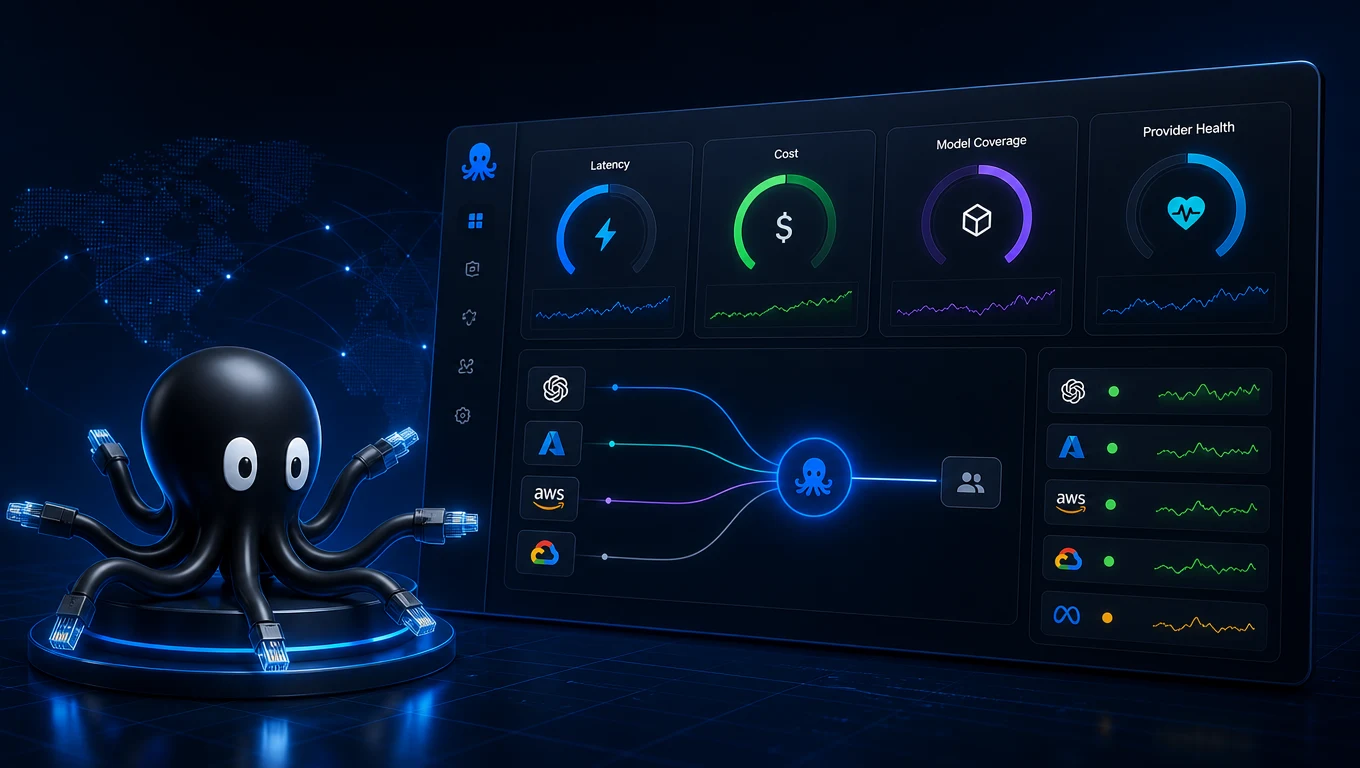
One API for Every AI Model
Modern AI applications routinely combine multiple model providers. A single product might use GPT-4o for reasoning, Flux for image generation, and Veo for video assets. Managing these integrations independently creates SDK fragmentation, billing complexity, and authentication overhead that slows development velocity.
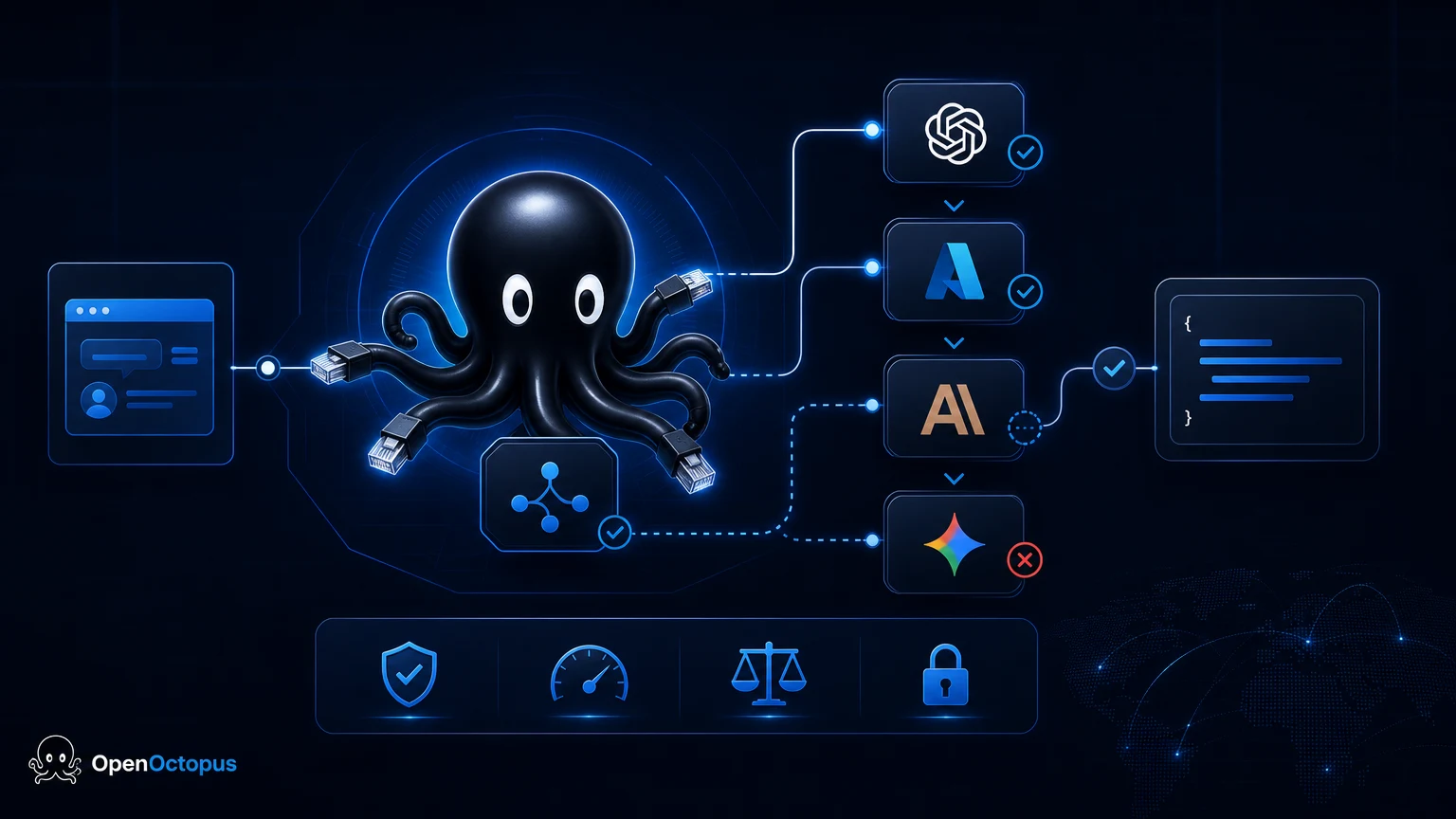
A unified AI API layer routes requests to the optimal model, handles automatic failover, and returns standardized responses. This is the architecture developers look for when comparing the best AI API options for production workloads. Instead of maintaining separate auth systems, retry logic, and rate limit handlers for each provider, teams integrate once and access the entire ecosystem through a single endpoint.
For teams evaluating unified infrastructure, our AI API Platform guide explains how multi-model orchestration reduces operational complexity as products scale beyond initial use cases.

Why the Best AI API Matters for Developer Operations
-
Unified Endpoint: One integration replaces multiple provider SDKs and authentication flows. The best AI API eliminates the integration fragmentation that compounds with every new model provider added to a product stack. Teams searching for the best AI API often discover that endpoint consolidation alone reduces maintenance overhead by half.
-
OpenAI-Compatible: Drop-in replacement. Change base URL and API key — no rewrite required. This compatibility is critical because the OpenAI SDK is the de facto standard most teams already use.
-
Fast Model Access: New multimodal models are added rapidly. As of Q1 2026, model release cycles have compressed to weeks rather than months. The best AI API platform keeps pace without forcing teams to rebuild integrations. Rapid model availability is increasingly a deciding factor when developers choose the best AI API for cutting-edge products.
-
Stable Infrastructure: Production workloads need predictable uptime and automatic failover. The best AI API handles resilience automatically, routing around provider outages without application-level changes. Operational teams evaluating the best AI API prioritize stability metrics over headline performance numbers.
-
Transparent Pricing: Clear per-token pricing with intelligent routing to optimize costs. Unexpected pricing changes from direct providers are a common operational headache that unified platforms mitigate through consistent billing.
-
Human Support: Real engineers respond to production issues. No chatbots or ticket queues. The best AI API includes responsive technical support because infrastructure problems rarely resolve themselves during deployment deadlines. Access to engineers who understand AI infrastructure is a distinguishing feature of the best AI API providers.
-
Multimodal Access: Text, image, video, and code APIs through one schema. Products increasingly require multiple modalities, and managing separate integrations for each creates architectural debt.
-
Developer SDKs: Consistent response formats and unified schemas reduce onboarding time. Teams spend less time reading fragmented documentation and more time building product features.
Ready to simplify your AI infrastructure? Start building
Supported Model Ecosystem (As of Q1 2026)
The AI ecosystem is increasingly fragmented. Developers routinely combine multiple providers in a single product stack, and the best AI API for one use case is often insufficient for another. Understanding the model landscape is essential for making informed infrastructure decisions.
| Category | Representative Models | Common Use Cases |
|---|---|---|
| Text | GPT-4o, Claude 4, Gemini 2.5, DeepSeek-V3 | Chat, reasoning, content generation |
| Code | GPT-4.1, DeepSeek-Coder, Code-Llama | Completion, debugging, code review |
| Image | Flux.1, SDXL, DALL-E 3, Ideogram | Assets, mockups, creative tools |
| Video | Veo 2, Kling, Runway Gen-4 | Demos, social content, prototypes |
| Embeddings | OpenAI text-embedding-3, Voyage | Search, retrieval, recommendations |
| Multimodal | Gemini Vision, GPT-4 Vision, Claude Vision | Document analysis, visual QA |
Update Notice
Model availability, pricing structures, context limits, rate limits, and provider capabilities change rapidly across the AI ecosystem.
This page reflects publicly available information and infrastructure observations as of Q1 2026. Developers should periodically revalidate model availability, pricing, and API behavior against official provider documentation before making production decisions.
Compatible with leading model families. No official partnership implied.
Managing six different SDKs slows product iteration. Teams evaluating the best AI API for multi-model workflows should consider the hidden cost of SDK fragmentation. A unified AI API Platform simplifies multi-model orchestration by providing one authentication layer, one billing system, and one retry handler for the entire ecosystem. For teams prioritizing cost optimization alongside model breadth, our Cheapest AI API analysis breaks down pricing strategies across providers.
Explore the full model catalog and find the best AI API for your use case. Browse All Models

How Developers Evaluate the Best AI API
Choosing the best AI API requires evaluating infrastructure across operational dimensions that impact production reliability. Experienced developers do not rely on marketing claims — they test under realistic conditions and measure outcomes that matter for their specific workloads.
| Dimension | Why It Matters | What to Test |
|---|---|---|
| Latency | Slow inference degrades user experience, especially for interactive applications | Time-to-first-token under sustained load |
| SDK Compatibility | Rebuilding integrations wastes engineering resources and introduces regressions | Drop-in compatibility with existing codebases |
| Model Breadth | Products expand beyond text as they mature | Multiple model families accessible through one integration |
| Stability | Production systems cannot tolerate unpredictable downtime | Failover behavior, status transparency, and incident response |
| Versioning | Breaking changes force expensive refactors | Deprecation timelines, migration documentation, and advance notice |
| Pricing | Runaway costs destroy product margins | Per-token pricing consistency and hidden fee detection |
| Multimodal | Modern products combine text, image, and video | Shared authentication and schema across content types |
| Rate Limits | Throttling interrupts traffic during growth phases | Concurrent request limits and burst handling behavior |
| Migration | Switching providers should not require architectural rewrites | Engineering effort estimate and backward compatibility |
| Reliability | Retries prevent cascading failures | Automatic retry with exponential backoff and circuit-breaking |
The best AI API is not always the cheapest — it is the one that remains useful as products scale and requirements evolve beyond initial assumptions. When developers ask what is the best AI API, the honest answer depends on where they are in their product lifecycle and what infrastructure constraints they face.

KDnuggets analyzed Top 5 Super Fast LLM API Providers for latency and throughput characteristics across Cerebras, Groq, SambaNova, Fireworks, and Baseten. Their findings highlight that raw token throughput varies dramatically by provider architecture — from Cerebras' wafer-scale engine delivering over 3,000 tokens per second to Groq's sub-200ms time-to-first-token optimized for interactive workloads. Strapi conducted a Technical Comparison of Top 7 AI APIs for Full-Stack Developers examining OpenAI, Anthropic, Google Gemini, AWS Bedrock, Azure OpenAI, Cohere, and Mistral across pricing structures, context window limits, rate limiting approaches, and SDK support.
Ready to evaluate AI APIs hands-on? Get a free API key Learn About Unified AI APIs
How We Evaluated AI APIs: A Benchmark Methodology
When developers ask what makes the best AI API, the answer depends heavily on evaluation methodology. Benchmark numbers without context are misleading. The following framework describes how experienced teams assess AI API infrastructure before committing engineering resources.
Testing Assumptions. All latency measurements should use time-to-first-token (TTFT) rather than total generation time, because TTFT directly impacts perceived responsiveness. Testing must occur under sustained, production-like load, not single-request conditions, to expose queueing behavior and rate limit interactions. Geographic location of test clients matters — inference latency varies significantly by region due to provider-specific variability in endpoint distribution.
Evaluation Dimensions. Effective comparison requires testing across at least six dimensions: latency distribution (p50, p95, p99), error rate under load, SDK migration effort, streaming chunk consistency, authentication complexity, and billing transparency. No single metric determines the best AI API; tradeoffs vary by use case, infrastructure constraints, and deployment-specific requirements.
Testing Conditions
Reliable AI API evaluation requires declaring testing conditions explicitly.
Important testing variables include:
- geographic region of the test client
- request concurrency level
- streaming vs non-streaming responses
- prompt length and context window size
- provider-side rate limiting
- warm vs cold request behavior
- multimodal payload size
- retry configuration and timeout settings
Without these controls, benchmark comparisons between providers can become misleading or non-repeatable.
Infrastructure Considerations. Production evaluation must account for retry behavior, circuit-breaking logic, and fallback routing. Provider-specific variability in error handling and timeout behavior means an API that performs well in isolation may fail under production-like workloads when the primary provider experiences degradation. The best AI API infrastructure handles these failure modes automatically.
Workload Limitations. Benchmarks using short prompts differ materially from those using long context windows. Embedding workloads behave differently from chat completions. Image generation APIs have entirely different latency profiles than text models. Any reproducible evaluation methodology must declare its workload assumptions and testing assumptions explicitly. The best AI API for embedding tasks may differ from the best AI API for interactive chat, which is why unified platforms that excel across modalities provide the most durable value.
Migration Evaluation. Switching from an existing integration introduces risk. Effective methodology measures the actual engineering effort required: lines of code changed, prompt compatibility verification, monitoring updates, and authentication migration. An API with slightly better raw performance may not justify a three-week migration project.
| Factor | Evaluation Method | Operational Relevance |
|---|---|---|
| Latency | Time-to-first-token under sustained concurrent load | Directly impacts user experience for interactive applications |
| Stability | Repeated request consistency over 24-hour windows | Exposes intermittent degradation not visible in spot tests |
| SDK Compatibility | Migration effort from existing OpenAI integration | Determines engineering cost and timeline for switching |
| Streaming | Chunk consistency and SSE format adherence | Affects real-time UI rendering and progress indicators |
| Reliability | Retry behavior and circuit-breaking under provider outage | Prevents cascading failures in production systems |
| Routing | Multi-model failover and automatic provider selection | Ensures continuity when individual providers degrade |
This methodological approach prioritizes operational realism over synthetic benchmarks. The best AI API for your infrastructure is the one that performs reliably under your specific workload patterns, not the one with the highest headline throughput number. Many developers searching for the best AI API make the mistake of optimizing for peak performance rather than consistent behavior under production constraints.
Benchmark Transparency Note
The evaluation dimensions and operational considerations in this guide are based on common AI infrastructure testing practices observed across production engineering teams.
This page does not publish proprietary benchmark datasets or reproducible provider-wide latency rankings because provider behavior changes frequently across regions, workloads, concurrency levels, and model versions.
Teams should validate latency, retry behavior, streaming consistency, and rate limit handling using their own production-like workloads before selecting long-term infrastructure providers.
Practical Engineering Observations
Operational Observation
The patterns described below summarize issues repeatedly encountered in production AI integrations involving multi-provider routing, streaming APIs, and OpenAI-compatible SDK workflows.
Actual operational behavior varies by provider architecture, deployment region, request volume, and workload type.
This section reflects operational experience integrating AI APIs in production environments. The observations below are not theoretical — they represent patterns that emerge repeatedly when teams move from prototype to production.
SDK Inconsistency. Provider SDKs vary in error handling, retry defaults, and timeout configurations. The OpenAI SDK uses 60-second default timeouts, while other providers use 30-second or 120-second defaults. Error response formats differ: some return JSON with error.message, others nest errors differently. The best AI API platform normalizes these inconsistencies so your error handlers work uniformly. This normalization is one reason developers rank SDK consistency highly when selecting the best AI API for their stack.
Rate Limit Surprises. Rate limits are rarely the headline number. Many providers enforce per-model limits, per-region limits, and per-account limits simultaneously. Burst traffic during product launches frequently hits undocumented thresholds. Teams evaluating the best AI API should test explicitly for 429 handling and verify that retry-after headers are reliable.
Provider Outages. No provider achieves perfect uptime. As of Q1 2026, even major providers experience regional degradation several times per quarter. Production systems need automatic failover routing — not just retry logic, but actual request redirection to alternate providers. Building this yourself requires maintaining health checks, status polling, and routing rules for every provider in your stack.
Streaming Interruptions. Server-sent event streams can terminate unexpectedly. Network intermediaries may buffer chunks, destroying the real-time experience. Some providers send different chunk formats for errors mid-stream. The best AI API infrastructure handles stream reconnection and format normalization transparently.
Model Rollout Delays. When providers announce new models, API availability often lags announcement by days or weeks. Region availability varies. Pricing may change between announcement and general availability. Teams building on cutting-edge models need fallback options when the latest release is not yet accessible.
Multimodal Payload Handling. Image and video inputs require base64 encoding or URL references depending on the provider. Payload size limits vary: some providers accept 20MB images, others cap at 5MB. The best AI API platform abstracts these differences so your multimodal code does not branch on provider.
Authentication Complexity. API key rotation across multiple providers is operationally expensive. Each provider has different key formats, rotation policies, and IP restriction mechanisms. Unified authentication through a single key reduces operational surface area and simplifies security audits. For security-conscious teams, centralized auth is a critical attribute of the best AI API infrastructure.
Timeout Behavior. Provider timeout behavior varies significantly. Some return 408 Request Timeout, others return 524 from Cloudflare, and still others silently truncate responses. Understanding these behaviors is essential for building robust client-side handling. The best AI API platforms abstract these differences so client code handles timeouts consistently regardless of the underlying provider.
These observations inform why many production teams eventually migrate toward unified AI API platforms. The operational complexity of managing multiple direct integrations compounds non-linearly as products grow. Developers who have experienced these challenges firsthand often have the clearest criteria for identifying the best AI API for long-term product success.
Practical Integration for Production AI APIs
Most teams evaluating the best AI API already have OpenAI integrations. A true drop-in replacement requires matching chat completions, streaming responses, function calling, tool use, and rate limit headers without modification to existing code.
OpenOctopus maintains OpenAI-compatible schemas so retry logic, error handlers, and monitoring continue working without modification. This compatibility is essential when migrating to the best AI API for your infrastructure because it eliminates the risk of prompt regressions and breaking existing user experiences.
Google Cloud's API Keys Best Practices recommends restricting keys to specific APIs, rotating credentials on a regular schedule, and avoiding client-side embedding of sensitive tokens. Production systems should implement exponential backoff for 429 responses, circuit breakers for provider outages, and fallback routing to alternate models. The best AI API infrastructure provides these protections automatically rather than requiring teams to build resilience from scratch.
For teams exploring Together AI routing patterns and multi-provider orchestration, our Together AI API guide covers advanced configuration strategies.
View OpenAI-Compatible Integration

Quick Start: Access the Best AI APIs in 3 Steps
Step 1: Sign up and copy your API key.
Step 2: Update your OpenAI SDK client:
from openai import OpenAI
client = OpenAI(
api_key="YOUR_OPENOCTOPUS_API_KEY",
base_url="https://api.openoctopus.com/v1"
)
response = client.chat.completions.create(
model="gpt-4o",
messages=[{"role": "user", "content": "Hello!"}]
)
Step 3: Switch models by changing the model parameter. Access GPT-4o, Claude, Gemini, DeepSeek, Flux, and more through the same client instance.
This migration pattern preserves existing prompts, streaming implementations, and error handling. Teams evaluating the best AI API for rapid prototyping can be productive within minutes rather than days. The simplicity of this three-step onboarding is a practical test for whether a platform qualifies as the best AI API for developer velocity.
Get API Key Read API Reference View SDK Docs
OpenAI-Compatible API Workflows
-
Drop-In Replacement: Change base URL and API key. Existing code works immediately. No refactoring required.
-
Workflow Continuity: All prompts, tools, function calling, and streaming integrations keep working without modification.
-
Minimal Migration Risk: No rewrites. No new SDKs to learn. No breaking changes that force regression testing.
-
Unified Routing: One API key routes across providers dynamically based on availability, latency, or cost preferences.
-
Centralized Billing: One invoice for all AI infrastructure usage. Eliminates reconciliation of multiple provider billing cycles.
-
Multi-Model Switching: Change one parameter to move between GPT, Claude, Gemini, DeepSeek, and specialized models.
Already using OpenAI? Start migrating
Technical Tradeoffs: Unified vs. Direct Provider APIs
Infrastructure Reality
There is no universally "best AI API" across every workload category.
The optimal provider strategy depends on latency requirements, model capabilities, deployment geography, multimodal usage patterns, operational staffing, and infrastructure constraints.
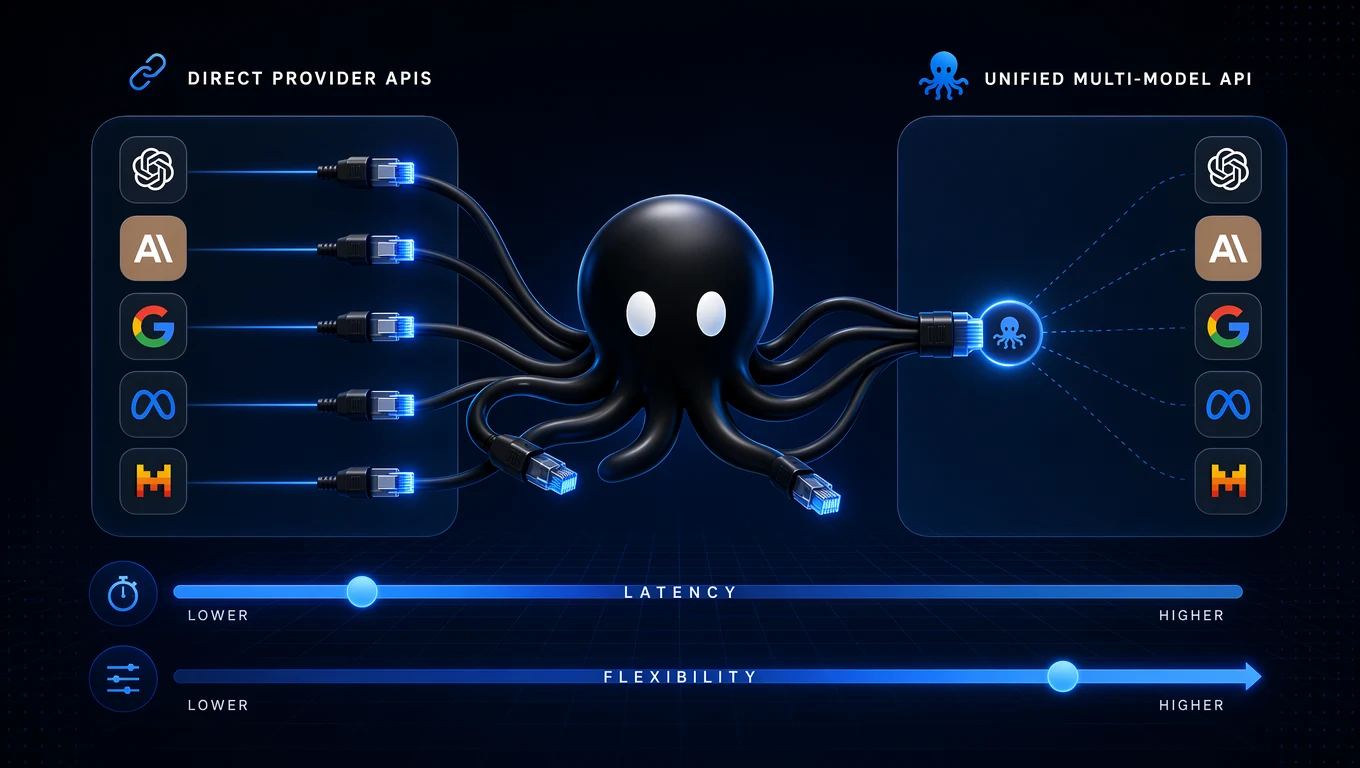
Direct integration offers maximum control. Teams accessing provider APIs directly can use beta features immediately, negotiate enterprise pricing, and access provider-specific tooling like Anthropic's prompt caching or OpenAI's fine-tuning dashboards. The cost is operational complexity: multiple SDKs, authentication systems, billing dashboards, and retry handlers.
Unified AI APIs trade some control for simplicity. One integration, one auth flow, one billing system. For most teams evaluating the best AI API, the fragmentation cost of direct integration exceeds the marginal benefits of provider-specific optimization. This is especially true for small to mid-size teams where infrastructure maintenance diverts resources from product development.
Latency vs. quality: Some providers deliver faster inference. Others offer higher quality at increased response time. The best AI API platform lets teams configure routing rules per request type — fast responses for interactive chat, higher quality for background analysis tasks.
Routing flexibility vs. specialization: Deep specialization enables fine-tuned optimization for a single provider's capabilities. Routing flexibility provides resilience against outages, pricing changes, and model deprecation. For production applications searching for the best AI API, flexibility typically delivers more long-term value because provider landscapes shift rapidly. The best AI API strategy for most teams balances specialization for critical paths with flexibility for everything else.
Known limitations are worth acknowledging explicitly. Direct provider APIs may expose beta models earlier than unified platforms. Provider-specific SDK features may lag in unified implementations. Pricing synchronization can experience delays during provider rate changes. Rollout timing for new models may differ between direct access and unified routing. Advanced provider-specific tooling — such as OpenAI's Playground or Anthropic's Console — requires direct accounts. Acknowledging these limitations is essential for maintaining trust when recommending the best AI API approach for any given team.
These limitations do not invalidate unified architectures. They simply mean teams should choose based on their specific requirements rather than assuming one approach is universally superior.
Official Documentation References
Teams evaluating AI infrastructure providers should validate operational details directly through official documentation, including:
- OpenAI API platform documentation
- Anthropic developer documentation
- Google Gemini API documentation
- provider-specific rate limit and pricing references
- streaming and SDK compatibility specifications
Operational behavior may differ between public benchmarks and real production workloads.
See how unified routing compares on cost and performance. Compare AI APIs across providers or dive into our Cheapest AI API analysis. For teams starting without budget, our Free AI API for Developers guide covers no-cost options for prototyping and learning.
Frequently Asked Questions About the Best AI API
-
What is the best AI API for developers building production applications? The best AI API for production depends on workflow requirements, infrastructure constraints, and team size. As of Q1 2026, most teams eventually need multi-model access because different tasks require different capabilities — GPT-4o for reasoning, Claude for long context, Flux for image generation. A unified AI API platform provides centralized access to multiple providers through one integration layer, reducing SDK fragmentation and operational overhead. When evaluating options, developers should test latency under production load, verify SDK compatibility with existing code, confirm pricing transparency at projected scale, and assess automatic failover behavior during provider degradation. The best AI API remains maintainable as requirements grow beyond initial use cases, avoiding the need for repeated architectural migrations.
-
How do developers compare AI APIs when choosing infrastructure? Experienced developers evaluate AI APIs across stability, pricing transparency, SDK compatibility, multimodal support, latency distributions, and routing flexibility. Effective comparison requires testing under realistic conditions: measuring time-to-first-token during peak usage, verifying error handling for 429 and 500 responses, reviewing rate limit policies for burst traffic, and confirming model family coverage matches product roadmaps. The best AI API comparison treats infrastructure selection as an engineering decision with long-term maintenance implications, not a procurement exercise focused on short-term pricing. Methodology matters more than headline numbers — a provider with slightly lower per-token pricing may cost more in engineering time if SDK migration requires weeks of work.
-
Which AI API supports multiple models through a single integration? OpenOctopus supports text, code, image, video, and embedding models from GPT, Claude, Gemini, DeepSeek, Flux, and more through one unified, OpenAI-compatible API. This eliminates maintaining separate integrations, authentication systems, and billing relationships for each provider. For teams building multimodal products, a single integration layer significantly reduces complexity and allows switching providers or adding capabilities without architectural changes. The best AI API for multi-model workflows is one that normalizes schema differences, handles authentication centrally, and provides consistent error formats across all supported model types.
-
What matters most in AI API reliability for production systems? Production reliability depends on automatic failover routing, intelligent retry handling with exponential backoff, and circuit-breaking logic that isolates degraded providers. Transparent status communication helps teams understand whether problems originate from the API platform or underlying providers. The best AI API infrastructure handles these concerns automatically, allowing developers to focus on product features rather than building resilience from scratch. Additionally, consistent latency distributions matter — occasional extreme outliers can damage user experience more than slightly higher average latency. Teams should evaluate p95 and p99 latency, not just averages.
-
How important is OpenAI compatibility when evaluating the best AI API? OpenAI compatibility is critical for teams with existing integrations. The OpenAI SDK is the de facto industry standard, meaning most teams have code, prompts, monitoring, and error handling built around its interfaces. A compatible API allows migration with minimal risk — often just changing the base URL and API key. Without compatibility, teams face expensive rewrites of prompt engineering workflows, production monitoring systems, and client-side error handling. The best AI API platform maintains schema parity with OpenAI chat completions, streaming, function calling, and tool use so existing investments are preserved.
-
Which AI API is best for multimodal workflows combining text, image, and video? Multimodal workflows require APIs supporting multiple content types through consistent authentication and request schemas. Managing separate integrations for text, image, and video creates significant architectural overhead and complicates error handling. The best AI API for multimodal development provides unified access to all required model types through a single SDK, allowing teams to switch providers or add capabilities without structural changes. As of Q1 2026, multimodal capabilities are expanding rapidly — video generation models have improved substantially, and vision-language models now handle complex document analysis. A unified platform ensures teams can adopt these advances without rebuilding integrations.
-
What should teams consider before switching AI APIs in production? Switching AI APIs requires evaluating migration risk, SDK compatibility, pricing at projected scale, and operational feature parity. Teams should verify existing prompts and streaming implementations work without modification. They should test latency under realistic load and confirm automatic failover, retry handling, and rate limit management meet requirements. A gradual migration approach — routing a percentage of traffic through the new API while monitoring for regressions — reduces risk compared to big-bang replacements. The best AI API transition plan includes rollback procedures, monitoring dashboards for both old and new integrations, and clear criteria for declaring the migration successful.
-
How does the best AI API handle pricing and cost optimization? Cost optimization involves more than lowest per-token price. Intelligent routing directs requests to the most cost-effective provider per task. Transparent pricing with no hidden fees enables accurate cost projection. Unified billing eliminates reconciling multiple invoices across different billing cycles. The best AI API platform provides usage analytics helping teams identify expensive patterns — such as unnecessarily long context windows or redundant embedding calls — and optimize prompt designs accordingly. For teams with significant volume, small per-token differences compound into material savings, but only if the platform's routing logic is transparent and configurable.
Want to explore more? start prototyping for free
Start Building with the Best AI API
Access the latest text, image, video, and code models through one unified, OpenAI-compatible API. Reduce vendor fragmentation, eliminate SDK maintenance overhead, and ship AI features faster with infrastructure that scales alongside your product.