Cheapest AI API: Reduce AI Infrastructure Costs at Scale

Optimize AI API spending through unified routing, multi-model selection, and intelligent cost control.

YueZhuAuthorYueZhu
Published: May 14, 2026
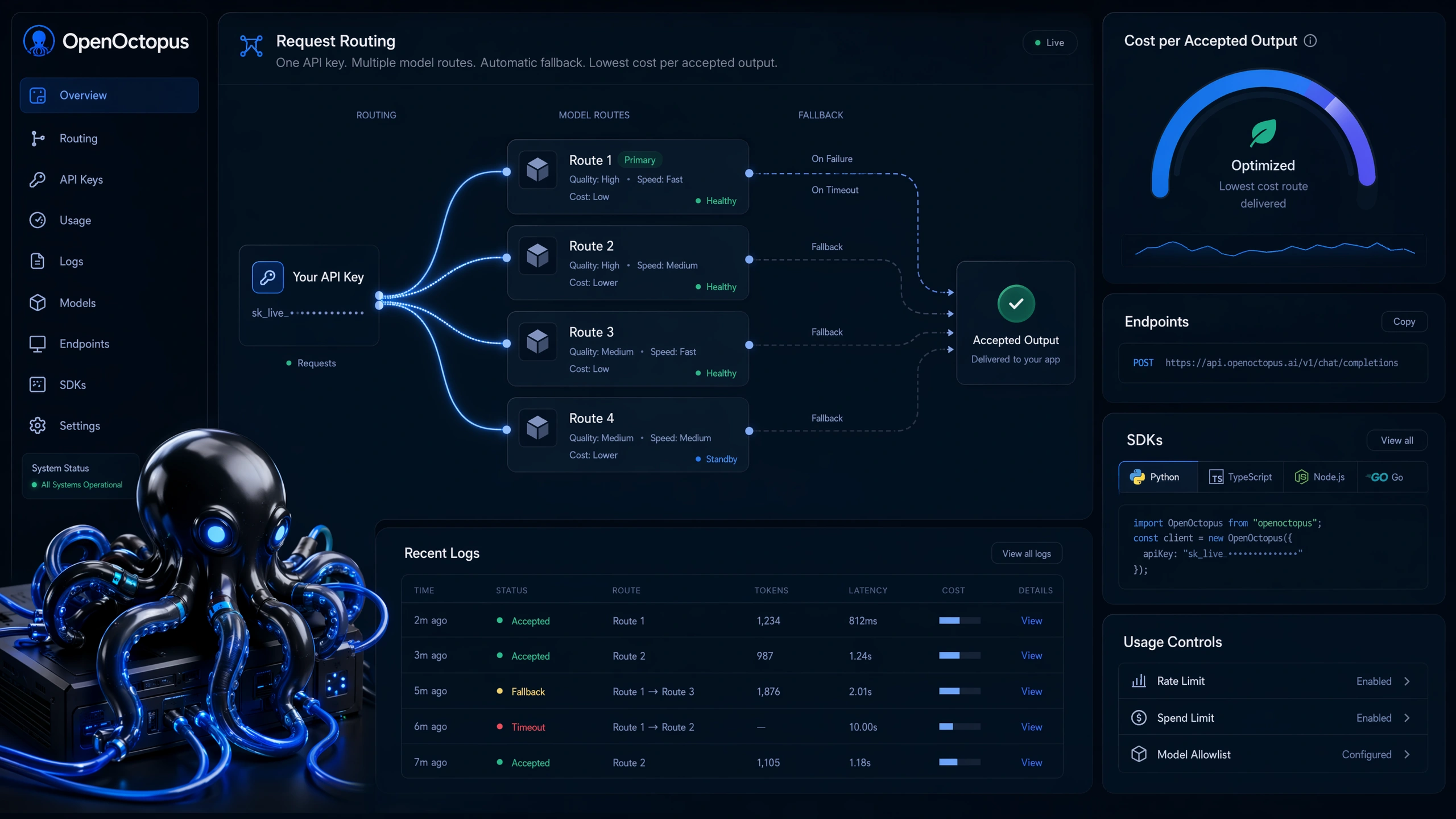
AI API Cost Optimization Dashboard

Unified Cost Visibility

The cheapest AI API is not always the one with the lowest per-token price. Hidden costs accumulate from routing inefficiency, SDK fragmentation, multiple billing dashboards, and engineering time spent managing provider-specific integrations.

A unified AI API platform consolidates these costs into one transparent layer, giving developers real-time visibility into token spending across text, image, video, and embedding models. This visibility alone helps many teams identify unnecessary spending within the first month of centralized monitoring.

Compare AI API Costs

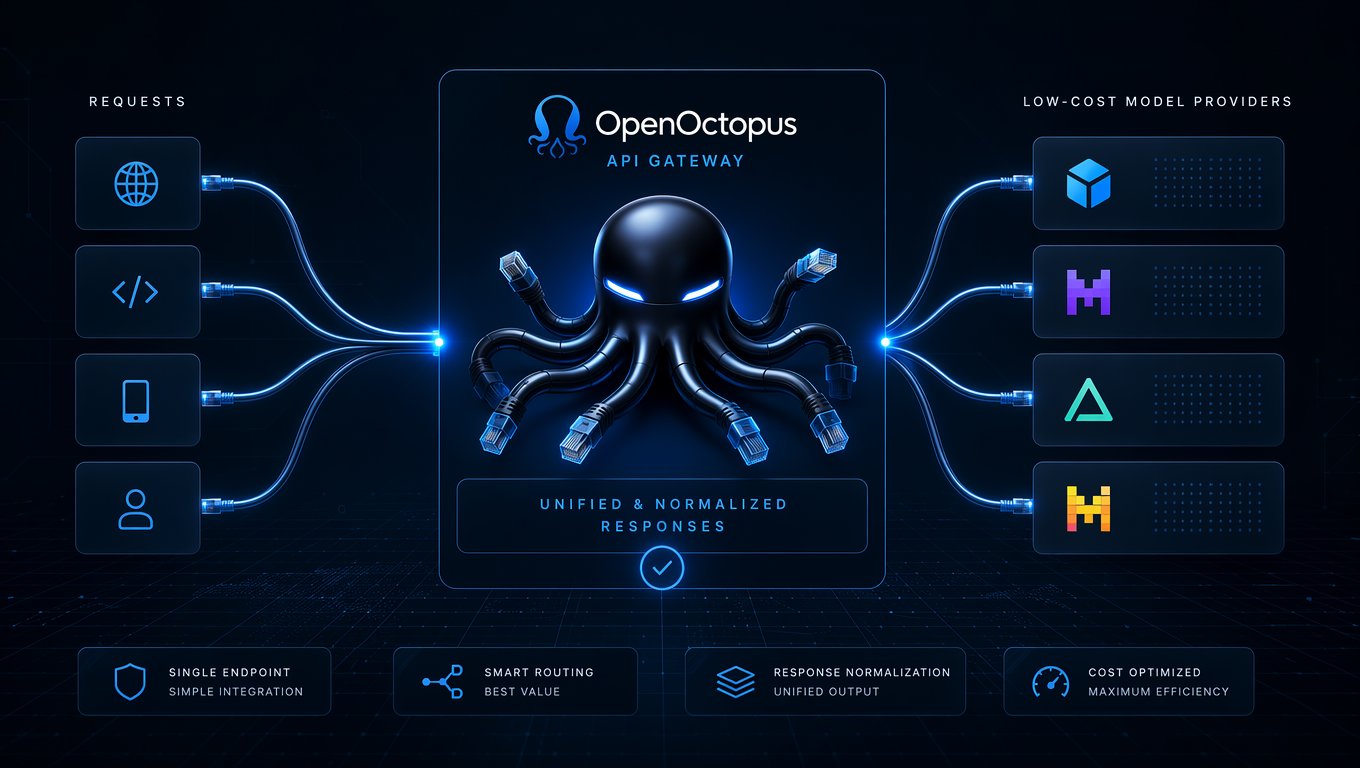
How OpenOctopus Helps Developers Find the Cheapest AI API

  • Centralized Billing: One invoice for every model provider. No more reconciling separate dashboards or tracking token costs across five different interfaces.
  • OpenAI-Compatible Integration: Use existing OpenAI SDK code with a single base URL change. Zero migration friction means zero engineering downtime.
  • Intelligent Model Routing: Automatically route simple requests to lower-cost models and reserve premium models for complex reasoning tasks.
  • Lower Operational Overhead: Managing one unified API layer reduces the engineering hours spent on provider maintenance, authentication, and error handling.
  • Multimodal Access: Access text, image, video, and code models through one endpoint. Eliminate the cost of maintaining separate integrations.
  • Infrastructure Simplicity: Fewer moving parts means fewer failure points. Simplified architecture reduces both operational risk and long-term maintenance cost.

What Actually Makes an AI API Expensive?

Developers often search for the cheapest AI API by comparing per-token pricing tables. This approach misses most of the cost structure that determines actual infrastructure spending.

As of Q1 2026, AI API costs are driven by several factors beyond the published price per thousand tokens.

Cost DriverWhat to MeasureWhy It Matters
Input tokensCharacters sent to the modelLong prompts multiply base cost
Output tokensCharacters returned by the modelVerbose responses inflate spend
Context windowTotal tokens in conversationGrowing history increases per-request cost
Image generationPer-image GPU computeGPU-intensive workloads scale non-linearly
Video generationPer-second computeHighest cost category across AI APIs
Retry overheadFailed and retried requestsSilent cost inflation during degradation
Rate limit handlingQueuing and fallback logicEngineering complexity at burst traffic
Model specializationPremium vs. fast inferenceReasoning models cost significantly more
Fragmented SDKsMultiple integrationsHidden operational and maintenance cost
Routing inefficiencyWrong model for the taskSending simple requests to expensive endpoints

The cheapest AI API strategy is not about finding the lowest per-token price. It is about optimizing the entire request lifecycle so that every token, every image, and every embedding call delivers maximum value at minimum cost.

Many teams discover that their actual AI infrastructure cost is significantly higher than their per-token estimates because they fail to account for retries, queue delays, context overflow, and routing inefficiency.

According to OpenAI Developer Docs - Pricing, token-based pricing varies by model, with input and output tokens often priced separately. Understanding this structure is essential for accurate cost estimation.

Understanding these cost drivers is the first step toward building a genuinely cost-efficient AI infrastructure stack.

Cost Evaluation Methodology

Evaluating AI API costs requires a structured methodology. Pricing tables alone are insufficient because they do not account for workload variability, retry behavior, or operational overhead.

This methodology reflects observations as of Q1 2026. Provider pricing changes frequently, so teams should validate current rates against live documentation before making infrastructure decisions.

Cost FactorWhat to MeasureWhy It MattersSource / Validation
Input token ratePrice per 1M input tokensDetermines prompt costProvider pricing docs
Output token ratePrice per 1M output tokensOften higher than inputProvider pricing docs
Context efficiencyTokens per meaningful requestLong contexts multiply costWorkload testing
Retry rateFailed and repeated requestsSilent cost inflationProduction monitoring
Image generationPer-image or per-step pricingGPU workloads scale differentlyProvider pricing docs
Multimodal payloadCombined text + image + videoCross-modal costs compoundWorkload profiling
Free-tier limitsRPM and TPM boundariesProduction cutoffs vary widelyProvider terms
Migration effortSchema and SDK changesSwitching cost affects total costIntegration testing

According to Google AI Developers - Gemini Developer API Pricing, multimodal input pricing combines text, image, and video tokens into a unified rate structure. This makes cross-model cost comparison more complex than simple text-only evaluation.

Teams should also account for engineering time as an operational cost. Managing multiple providers independently requires separate authentication, error handling, monitoring, and billing reconciliation. A mid-size AI SaaS product may spend a substantial portion of backend engineering time on provider-specific infrastructure maintenance.

Actual savings vary by workload, context length, caching strategy, routing logic, and provider pricing. No universal cost reduction percentage applies to all teams.

Cost Optimization Framework: How Teams Reduce AI API Costs

Experienced engineering teams reduce AI API costs through a systematic framework that optimizes every layer of the inference pipeline. The cheapest AI API approach is not about using the lowest-priced provider for every request. It is about matching each workload to the right model at the right price.

Strategy 1: Workload-Specific Model Selection

Different tasks require different model capabilities. Routing simple chatbot responses to lightweight models while reserving premium reasoning models for complex tasks is one of the most effective cost-reduction strategies.

Workload TypeCost-Optimized Model CategoryPremium AlternativeTypical Cost Ratio
Simple chat responsesFast inference modelsGPT-4o class1:10–1:20
Code completionCode-specialized modelsGeneral reasoning1:3–1:5
Document summarizationLong-context efficientPremium long-context1:5–1:10
Image generationStandard diffusionHigh-fidelity generation1:2–1:4
Embedding indexingLightweight embeddingsDense embeddings1:2–1:3
Complex reasoningBudget reasoningAdvanced reasoning1:5–1:15

Teams that implement workload-specific routing typically reduce inference costs without measurable quality degradation for routine tasks. However, complex reasoning, legal analysis, and specialized coding tasks may still require premium models.

Strategy 2: Multi-Model Routing and Fallback

Provider outages, rate limits, and latency spikes are common in production AI infrastructure. A routing layer that dynamically switches between providers prevents failed requests and eliminates the need to over-provision capacity with expensive providers.

An AI API Platform: Unified Multi-Model API Access Guide explains how centralized routing architecture helps teams manage provider complexity while maintaining cost efficiency.

Strategy 3: Context Trimming and Caching

Long context windows are expensive. Many teams waste tokens by sending unnecessary conversation history, redundant system prompts, and unused metadata with every request. Context trimming reduces token count for conversational applications.

Response caching eliminates repeated inference costs for identical or near-identical queries. Teams serving FAQ-style interactions frequently see cost reductions through aggressive caching strategies.

Strategy 4: Batch Processing and Queue Management

Batching embedding requests, scheduling non-urgent image generation during off-peak hours, and queuing requests to avoid rate-limit penalties all reduce effective per-request costs.

Strategy 5: Centralized Cost Monitoring

Without unified cost visibility, teams cannot optimize what they cannot measure. Centralized dashboards that show token spend by model, provider, endpoint, and time period reveal optimization opportunities that are invisible in fragmented provider billing interfaces.

For teams evaluating multi-model provider options, Best AI API: Compare Top AI APIs for Developers breaks down the infrastructure characteristics that matter most for cost-conscious engineering teams.

Get a free API key · Learn About Unified AI APIs

Practical Engineering Notes

Production AI infrastructure exposes cost optimization challenges that prototype testing rarely reveals. The following observations come from operational experience with AI API platforms at scale.

Retry Storms and Hidden Costs

When a provider experiences latency degradation, poorly configured client applications often retry aggressively. A single failed request can trigger multiple retry attempts, each billed at full price. At high request volumes, retry storms can silently increase costs without any increase in successful output.

Provider Pricing Volatility

AI API pricing changes frequently. Providers adjust rates as models improve, competition increases, and compute costs shift. Teams locked into single-provider architectures face unexpected cost spikes when pricing changes. Infrastructure that supports rapid provider switching insulates teams from individual provider pricing volatility.

Context Overflow

Applications that append full conversation history to every request eventually hit context limits. At that point, applications must either truncate context (risking coherence) or switch to higher-cost models with larger windows. Proactive context management prevents both problems.

Image and Video Cost Spikes

Image generation APIs can produce costs orders of magnitude higher than text APIs per request. Video generation multiplies that further. Products that scale image or video features without cost controls frequently experience budget shocks within weeks of launch.

Free API Limitations

Free AI APIs are valuable for prototyping and experimentation. However, production workloads typically require higher reliability, rate limits, and support than free tiers provide. Teams that outgrow free tiers without a migration plan face expensive infrastructure transitions under pressure.

According to Github - ShaikhWarsi/free-ai-tools, free AI tools and APIs are useful for exploration but may not meet production reliability needs. Developers should plan for infrastructure scaling before free-tier limitations become blockers.

Migration Complexity

Teams that tightly couple their products to a single provider's SDK and schema face expensive migration projects when pricing or performance becomes unsustainable. The cheapest AI API strategy must include a viable migration path from day one.

For teams exploring unified routing as a migration strategy, Together AI API: Unified Access and Multi-Model Routing examines how aggregated infrastructure reduces both switching costs and operational overhead.

Operational Overhead

Managing multiple AI providers independently requires separate authentication, error handling, monitoring, and billing reconciliation. Engineering teams frequently underestimate this overhead. A mid-size AI SaaS product may spend a substantial portion of backend engineering time on provider-specific infrastructure maintenance.

Quick Start: Optimize AI API Costs in Minutes

Getting started with cost-optimized AI infrastructure takes under five minutes. The OpenAI-compatible API design means existing code requires only a base URL change.

Step 1: Get Your API Key

Create an account and generate an API key from the OpenOctopus dashboard.

Step 2: Replace the Base URL

Configure your existing OpenAI SDK to route through OpenOctopus.

Step 3: Start Calling Models with Cost Visibility

Use the same request patterns you already know, with unified cost tracking across all providers.

from openai import OpenAI

client = OpenAI(
    api_key="YOUR_OPENOCTOPUS_API_KEY",
    base_url="https://api.openoctopus.com/v1"
)

response = client.chat.completions.create(
    model="MODEL_NAME",
    messages=[
        {"role": "user", "content": "Summarize this document in 5 bullet points."}
    ],
    max_tokens=300
)

Setting max_tokens controls output length, which directly impacts cost. Model selection determines per-token pricing. Context management controls input token volume. Together, these three parameters are the foundation of cost-conscious AI API usage.

This pattern works with the official OpenAI Python SDK, Node.js SDK, and Go client. The same authentication, error handling, and retry logic applies across all supported models.

Unified routing means simple requests automatically use lower-cost models while complex tasks route to premium reasoning engines. No application-level routing logic required.

Get API Key · Start Building Free

Tradeoffs, Limitations, and Scope

Understanding realistic tradeoffs is essential for trustworthy cost optimization. The cheapest AI API is not always the best choice for every workload. This section explains what this page does and does not claim.

What This Page Does Not Claim

  • It does not provide definitive provider-wide pricing benchmarks. Provider pricing changes frequently, and actual costs depend on workload, region, and request characteristics.
  • It does not guarantee specific cost reduction percentages. Actual savings vary by workload, context length, caching strategy, routing logic, and provider pricing.
  • It does not rank providers from cheapest to most expensive. Such rankings become obsolete quickly and oversimplify complex infrastructure decisions.

Known Tradeoffs

Cost vs. Quality Lower-cost models frequently produce acceptable output for simple tasks but struggle with complex reasoning, nuanced instructions, and specialized domains. Teams must evaluate output quality for their specific use case rather than assuming cheaper means worse.

Cost vs. Latency Budget inference endpoints often have higher latency variability. For interactive applications like chatbots and coding assistants, inconsistent response times degrade user experience more than moderately higher costs.

Routing Flexibility vs. Provider Specialization Unified routing layers abstract provider differences, which simplifies infrastructure but may delay access to provider-specific beta features or custom fine-tuning options. Teams with highly specialized requirements may need direct provider access for specific workloads.

Free APIs vs. Production Reliability Free AI APIs are excellent for prototyping. Production workloads typically require higher reliability, rate limits, and support than free tiers provide. The cheapest AI API for prototypes may not be the cheapest AI API in production.

Scope Boundaries

This page focuses on:

  • Text generation APIs
  • Image generation APIs
  • Multimodal applications
  • API-based inference
  • Developer integration workflows

It does not deeply cover:

  • Dedicated GPU hosting
  • Fine-tuning pipelines
  • Custom model training
  • Enterprise private deployments
  • Real-time video infrastructure

As of Q1 2026, the AI API pricing landscape remains highly competitive, with providers adjusting rates in response to model improvements and competitive pressure.

These tradeoffs are why experienced teams design cost optimization as a continuous process rather than a one-time provider selection.

Frequently Asked Questions

  • What is the cheapest AI API for developers? The cheapest AI API for developers depends on workload type, traffic volume, and quality requirements. For simple text generation, fast inference models offer the best cost-to-quality ratio for routine tasks. For image generation, standard diffusion models are significantly cheaper than high-fidelity alternatives. For prototyping, free tiers provide zero-cost exploration. The most cost-effective long-term approach is typically a unified routing layer that automatically selects the cheapest adequate model for each request type rather than relying on a single provider for all workloads.

  • Is the cheapest AI API always the best choice? No. The cheapest AI API for simple tasks is often not the best choice for complex reasoning, legal analysis, or specialized coding. Lower-cost models may produce acceptable output for routine queries but struggle with nuanced instructions. Teams must balance cost against quality, latency, and reliability for their specific use case. The goal is not minimum cost at all costs — it is optimal cost for acceptable quality.

  • How do developers reduce AI API costs? Developers reduce AI API costs through workload-specific model selection, multi-provider routing, context trimming, response caching, and batch processing. Centralized cost monitoring reveals which requests consume the most budget, enabling targeted optimization. Setting output token limits, compressing prompts, and avoiding redundant context history all reduce per-request costs. Teams that implement intelligent routing typically see meaningful cost reductions for routine workloads.

  • What increases AI API costs the most? The largest cost drivers are long context windows, image and video generation, retry storms during provider degradation, and routing simple tasks to expensive premium models. Runaway token usage from unbounded conversation history and unoptimized prompt design frequently cause significant cost inflation compared to controlled deployments. GPU-intensive workloads like image and video generation scale costs far faster than text-only APIs.

  • Are free AI APIs suitable for production? Free AI APIs are generally suitable for prototyping, experimentation, and low-traffic applications. Production workloads typically require higher reliability, rate limits, and support than free tiers provide. Many free APIs throttle aggressively under load, experience queue delays, or limit concurrent requests. Teams should evaluate free tiers against production requirements before committing. Free AI API for Developers: Best Free APIs to Start With explores how to evaluate free APIs for production readiness.

  • How does OpenAI-compatible integration reduce migration cost? OpenAI-compatible integration reduces migration costs by allowing existing SDK code to work with multiple providers through a single base URL change. Teams can switch between providers without rewriting application logic, making it easier to take advantage of pricing changes and promotional rates across the ecosystem. This compatibility eliminates the need to maintain separate integrations for each provider.

  • How does multi-model routing reduce AI infrastructure cost? Multi-model routing reduces costs by sending each request to the cheapest model that can handle the task adequately. Simple queries route to fast inference endpoints. Complex reasoning tasks route to premium models. When one provider raises prices or experiences degradation, traffic shifts to alternatives automatically. This prevents both over-spending on simple tasks and service disruption from provider-specific issues.

  • How should teams compare OpenAI and Gemini pricing? Teams should compare OpenAI and Gemini pricing by evaluating input token rates, output token rates, context window costs, and multimodal pricing separately. According to OpenAI Developer Docs and Gemini Developer API Pricing, both providers use different rate structures for text, image, and video. Teams must calculate costs based on their specific workload mix rather than relying on headline per-token rates. Free tiers and promotional credits also differ significantly between providers.

  • What cost controls should production AI apps implement? Production AI apps should implement per-request token limits, output length controls, context compression, response caching, and usage monitoring. Setting alerts for unusual spending patterns helps catch runaway costs early. Unified dashboards that track spend by endpoint, model, and provider reveal optimization opportunities before they become budget problems. Rate-limit handling and retry logic prevent both service disruption and unnecessary cost inflation.

  • How does OpenOctopus help reduce AI API cost? OpenOctopus reduces AI API costs by providing unified access to multiple providers through one OpenAI-compatible API. Teams gain centralized cost visibility, intelligent model routing, and simplified provider switching without maintaining separate integrations. This infrastructure approach helps teams optimize spending across text, image, video, and embedding workloads from a single control plane.

Start Building with the Cheapest AI API Strategy Today

Reduce AI infrastructure costs, simplify multi-model orchestration, and scale your AI product with unified routing designed for production engineering teams.

Get API Key

Build on a unified AI API stack

Use one endpoint for model access, routing, and production-ready AI infrastructure without rebuilding your integration layer every time the model landscape shifts.