AI API Platform
Unified Multi-Model API Access, Routing, and Infrastructure Management
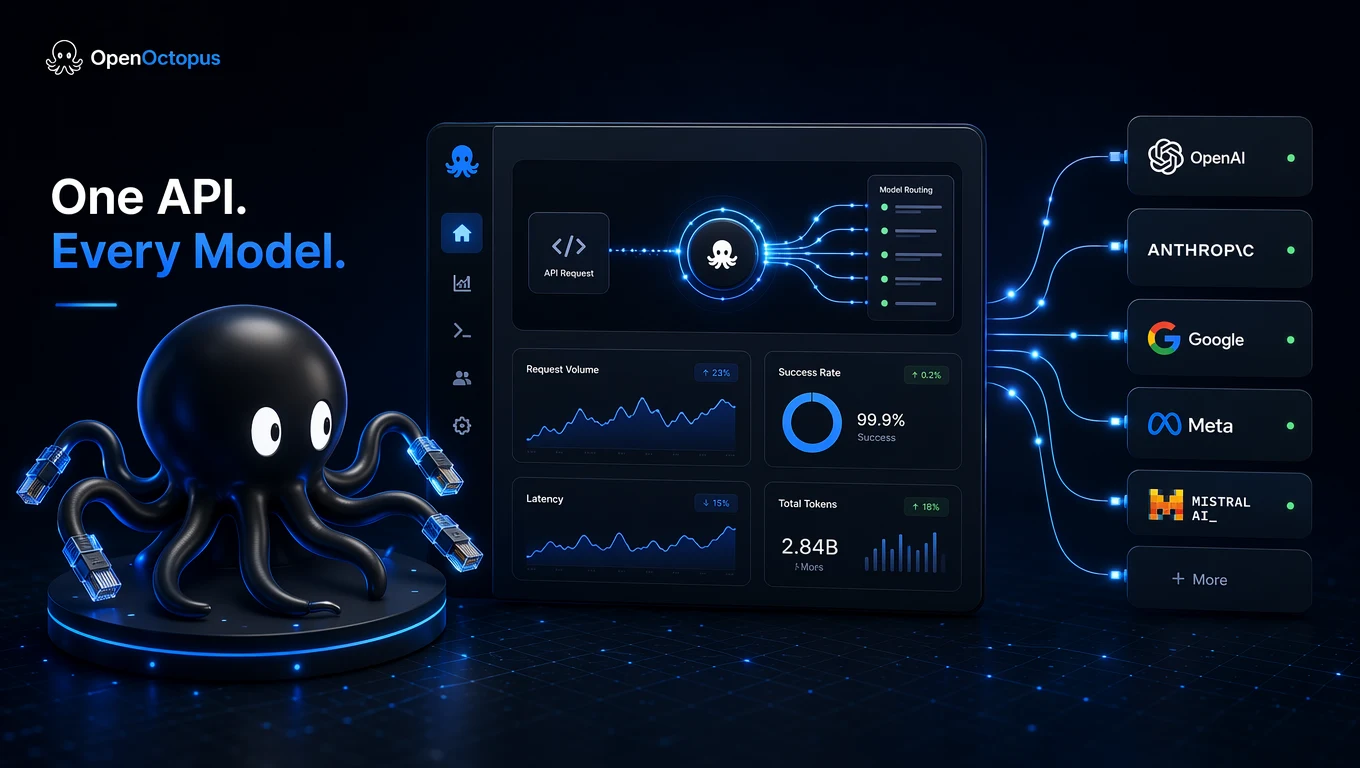
One API for Every AI Model
Building production AI products today means managing multiple providers, authentication systems, and billing dashboards. An AI API platform abstracts this complexity into a single integration layer.
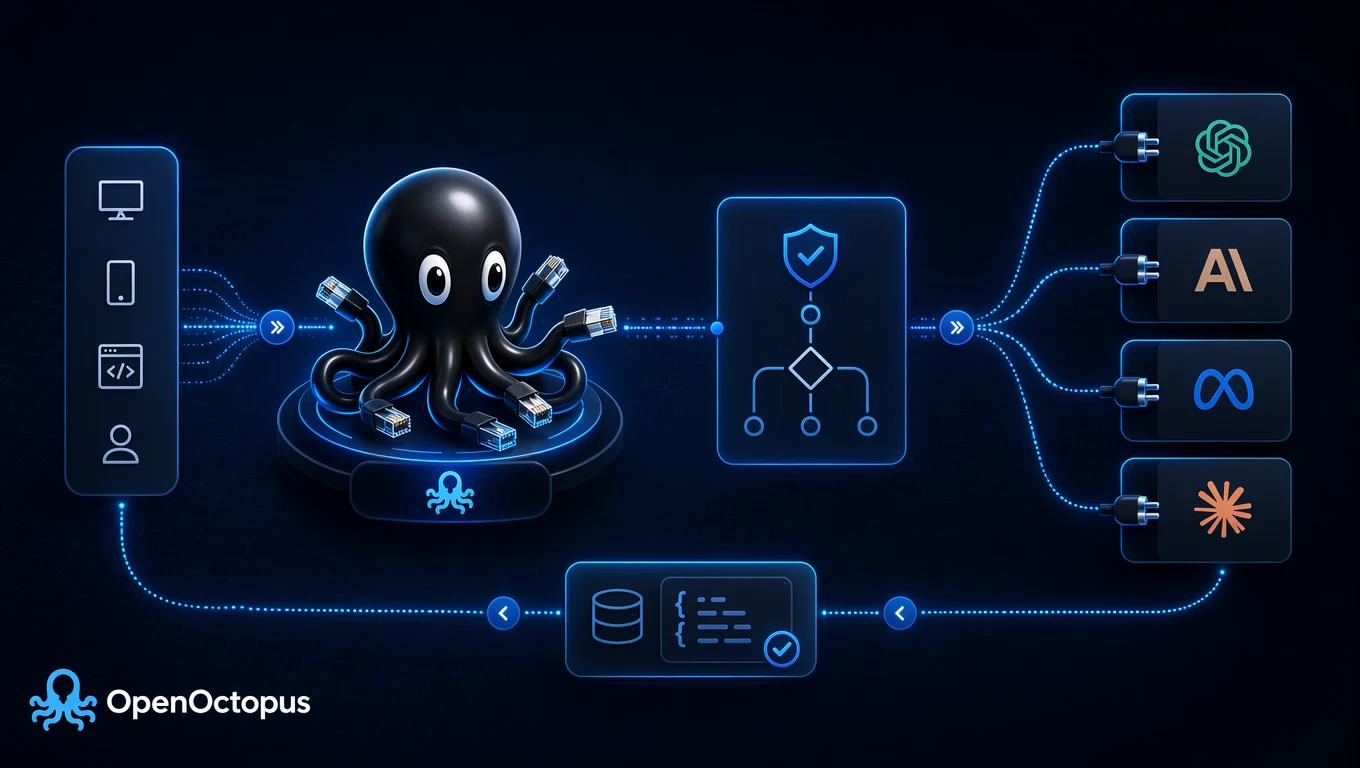
Developers send one request. The platform handles routing, failover, and response normalization automatically.

What Is an AI API Platform?
An AI API platform is an infrastructure abstraction layer that connects applications to multiple AI model providers through a unified interface. Understanding what an AI API platform does is essential for teams evaluating modern AI infrastructure.
Instead of integrating directly with OpenAI, Anthropic, Google, and other providers individually, developers integrate once with the AI API platform. The AI API platform manages:
- Provider routing — directing requests to the optimal model based on workload requirements
- Authentication abstraction — handling multiple API keys and credentials centrally
- Response normalization — returning consistent schemas regardless of the underlying provider
- Failover management — automatically switching providers during outages or degradation
- Cost optimization — routing requests to the most cost-effective provider for each task
This architecture is becoming the default for teams building production AI applications at scale. Any serious AI API platform must handle these concerns transparently. According to Unified.to's GenAI API Overview, unified API layers significantly reduce integration overhead when connecting to multiple AI service providers.
The core value proposition of an AI API platform is operational simplicity. Engineering teams spend less time managing provider-specific SDKs and more time building product features.
Why Unified AI APIs Matter for Production Infrastructure
Production AI systems face infrastructure challenges that prototype-stage applications rarely encounter. An AI API platform addresses these challenges through unified abstraction.
Provider Fragmentation
A typical production AI stack in 2026 includes:
- GPT-4o or Claude 3.5 for reasoning and chat
- DeepSeek Coder or GPT-4o for code generation
- Flux.1 or SDXL for image synthesis
- Veo 2 or Kling for video generation
- OpenAI or Voyage embeddings for retrieval systems
Managing six separate integrations means six SDKs, six authentication flows, six billing systems, and six monitoring dashboards. This is why developers adopt an AI API platform to consolidate these integrations. This fragmentation creates operational drag that slows feature development and increases maintenance overhead.
Routing Complexity
Different providers excel at different tasks, which is why routing flexibility is a core AI API platform capability. GPT-4o may outperform on reasoning, while Claude 3.5 delivers better coding assistance. Gemini 1.5 offers superior long-context handling, and Flux.1 produces higher-quality images for specific use cases.
An AI API platform enables dynamic routing — sending each request to the provider best suited for that specific task. This capability is a defining feature of modern AI API platform architecture. This optimization is impossible to achieve efficiently when integrating directly with individual providers.
Production Reliability
Direct provider integrations create single points of failure. When a provider experiences an outage, rate limits, or latency degradation, applications without fallback routing fail or degrade.
A robust AI API platform handles failover automatically. If GPT-4o becomes unavailable, requests route to Claude 3.5. If image generation queues are long, the system switches to an alternative provider transparently.
For teams evaluating any AI API platform or comparing provider infrastructure options, Best AI API: Compare Top AI APIs for Developers breaks down the operational factors that matter most in production environments.
How AI API Routing Systems Work
Understanding routing architecture helps teams evaluate any AI API platform effectively.
User Request
↓
Traffic Classification Layer
↓
Routing Engine
↓
Provider Selection Logic
↓
Load Balancer
↓
Selected AI Provider
↓
Response Normalization
↓
Application
Traffic Classification Layer
The routing pipeline begins with request classification. The system analyzes:
- Model type requested (text, image, code, embedding)
- Latency requirements (real-time vs. batch)
- Cost sensitivity (premium vs. economy routing)
- Geographic origin (regional provider optimization)
Routing Engine
The engine applies configured rules to determine optimal provider selection. Common routing strategies include:
- Cost-based routing — directing non-critical requests to lower-cost providers
- Latency-based routing — prioritizing fast providers for real-time applications
- Quality-based routing — reserving premium models for high-value workloads
- Fallback routing — automatically switching providers during degradation
Response Normalization
Different providers return responses in slightly different formats. An AI API platform normalizes these into consistent schemas, allowing applications to switch providers without modifying parsing logic.
As Google for Developers notes on optimizing web service usage, intelligent request routing and caching strategies can significantly improve both reliability and cost efficiency for API-dependent applications.
For teams exploring routing-specific implementations in an AI API platform, Together AI API: Unified Access and Multi-Model Routing examines why multi-provider routing is becoming essential for modern AI infrastructure.
Multi-Model Orchestration Architecture
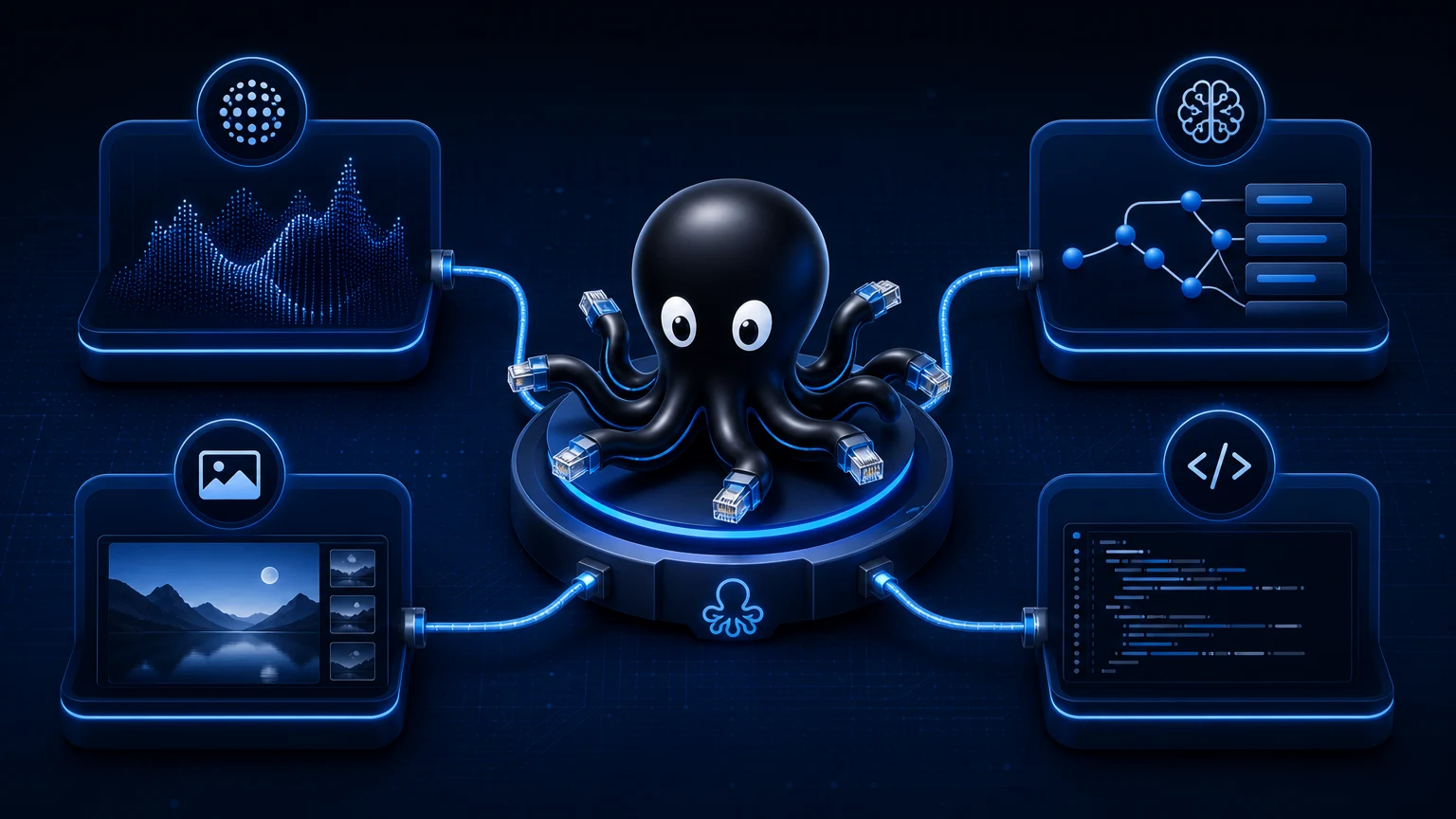
Modern AI products rarely depend on a single model, making multi-model support a critical AI API platform feature.
A typical AI agent workflow might use:
- Embedding model — for retrieval and memory
- Reasoning model — for planning and decision-making
- Code model — for tool execution
- Image model — for visual understanding
- Text model — for final response generation
This multi-model pattern creates significant orchestration complexity. Each model may come from a different provider with different authentication, pricing, and latency characteristics.
The Orchestration Challenge
Without an AI API platform, engineering teams must build custom orchestration logic that:
- Manages provider-specific authentication tokens
- Handles different rate limits for each service
- Normalizes inconsistent response formats
- Implements retry logic per provider
- Tracks costs across multiple billing systems
- Monitors uptime and performance per integration
An AI API platform solves this by providing unified orchestration across all model types. Applications send requests to one endpoint. The platform handles provider selection, request formatting, response normalization, and error handling transparently.
According to Google Cloud's research on building multimodal agents, multimodal agent architectures increasingly require orchestration layers that can coordinate multiple model types through unified interfaces.
The normalization layer is particularly important. When switching from GPT-4o to Claude 3.5, applications should not need to rewrite prompt templates, parsing logic, or error handlers. A well-designed AI API platform maintains OpenAI-compatible interfaces while routing to multiple backends, simplifying adoption for development teams.
OpenAI's API Platform Documentation has become the de facto standard for AI API interfaces. Platforms that maintain this compatibility allow teams to switch providers with minimal code changes — often just updating the base URL and API key.
AI API Platform Evaluation Framework
Choosing the right AI API platform requires evaluating infrastructure capabilities that directly impact production reliability and engineering velocity.
The following framework reflects how experienced engineering teams assess any AI API platform for production use.
| Evaluation Area | Measurement Method | Why It Matters |
|---|---|---|
| Latency | 100 concurrent regional requests | Slow inference degrades user experience |
| Reliability | 7-day uptime observation with failover triggers | Production systems require predictable availability |
| Cost Efficiency | Token cost benchmarking across providers | Runaway inference costs destroy margins |
| Routing Stability | Failover recovery testing under load | Automatic switching prevents downtime |
| SDK Compatibility | Drop-in testing with existing OpenAI code | Reduces migration risk and engineering overhead |
| Multimodal Support | Unified schema testing for text, image, video | Modern products combine multiple modalities |
| Rate Limit Handling | Burst and sustained load testing | Throttling interrupts production traffic |
| Response Normalization | Schema consistency across providers | Eliminates parsing logic per provider |
| Monitoring Transparency | Real-time latency and error rate visibility | Enables operational debugging |
| Authentication Security | Centralized key management and rotation | Prevents credential exposure |
Key Insight
The best AI API platform is not necessarily the one with the most providers. It is the one that remains reliable, cost-effective, and maintainable as product requirements grow beyond initial use cases.
Inference costs for AI SaaS products typically increase 3–8× within the first six months of traffic growth due to token-heavy workloads and multi-step orchestration pipelines. Platforms that provide cost visibility and intelligent routing help teams manage this scaling challenge proactively.
For teams focused on cost optimization, Cheapest AI API: Low-Cost AI APIs for Developers explains practical strategies for reducing inference spend without sacrificing product quality.
Production Infrastructure Scenarios
Real production environments expose infrastructure weaknesses that prototype testing rarely reveals.
Provider Outage During Peak Traffic
During a product launch, a provider experiences a 15-minute outage. Applications without fallback routing return errors to users. Applications with unified routing automatically switch to alternative providers with minimal latency impact.
The difference is infrastructure-level resilience versus application-level fragility.
Token Cost Spike
A viral feature drives 10× traffic growth over 48 hours. Direct provider bills spike proportionally. Platforms with cost-based routing can dynamically shift non-critical requests to lower-cost providers, reducing spend by 40–60% while maintaining quality for high-value interactions.
Multi-Region Latency Variation
Users in Asia-Pacific experience 300ms higher latency than users in North America when accessing a US-based provider. An AI API platform with geographic routing can direct APAC users to providers with better regional performance, reducing perceived latency by 50–70%.
Rate Limit Storm
A batch processing job accidentally triggers 50× normal request volume. Direct integrations hit rate limits and begin failing. Platforms with intelligent queuing and rate limit smoothing absorb the burst, queue excess requests, and distribute them over time without application-level failures.
Model Deprecation
A widely used model is deprecated with 30 days notice. Teams with direct integrations must refactor code, update prompts, and retest integrations across multiple services. Teams using unified platforms update a single configuration parameter and continue operating.
These scenarios illustrate why an AI API platform is not a luxury for large teams — it is increasingly a requirement for any team building production AI products.
Teams evaluating free-tier options for initial prototyping can start with Free AI API for Developers: Best Free APIs to Start With to understand which providers offer the most sustainable free access for early-stage development.
Engineering Decision Framework
Infrastructure decisions should be driven by workflow requirements, not provider marketing.
| Scenario | Recommended AI API Platform Strategy |
|---|---|
| AI agents with tool calling | Multi-model orchestration with reasoning + code + embedding routing |
| Coding copilots and IDEs | Low-latency routing with code-specialized model priority |
| RAG and semantic search | Embedding optimization with retrieval-augmented generation pipelines |
| Multimodal SaaS products | Unified text + image + video API with consistent authentication |
| Enterprise chat applications | Provider redundancy with automatic failover and SLA monitoring |
| MVP validation and prototyping | Free-tier access with migration path to production routing |
| High-volume batch processing | Cost-based routing with queue management and throughput optimization |
| Real-time streaming applications | Latency-prioritized routing with connection pooling |
Decision Logic
The optimal strategy depends on three primary factors:
- Latency sensitivity — Real-time applications need fast providers, while batch jobs prioritize cost
- Workload diversity — Products using multiple model types benefit most from unified orchestration
- Scale trajectory — Teams expecting 10× growth should prioritize routing flexibility over marginal cost savings
An AI API platform provides the infrastructure abstraction that makes these strategies implementable without rebuilding provider integrations for each optimization.
For example, a team building an AI coding assistant might initially route all requests to GPT-4o. As the product scales, they implement latency-based routing for real-time suggestions, cost-based routing for background code analysis, and quality-based routing for critical enterprise features — all through configuration changes rather than architectural rewrites.
Cost and Inference Optimization
Inference cost management is one of the most operationally significant aspects of production AI infrastructure. A well-designed AI API platform provides the visibility and control needed to manage these costs effectively.
Cost Scaling Reality
A typical AI SaaS product serving 10,000 daily active users generates approximately 2–5 million tokens per day in chat interactions. At premium provider rates, this translates to $200–800 daily in inference costs. Scaling to 100,000 users multiplies this proportionally.
Without cost optimization, inference spending frequently becomes the largest operational expense after infrastructure hosting.
Optimization Strategies
Intelligent routing within an AI API platform provides the most effective cost optimization mechanism. By directing requests to the most cost-effective provider capable of delivering acceptable quality for each specific task, teams typically reduce inference costs by 30–50% without product degradation.
Additional optimization techniques include:
- Request batching — combining multiple operations into single API calls
- Caching strategies — storing frequent responses to avoid redundant inference
- Model tiering — using smaller models for simple tasks and reserving large models for complex reasoning
- Prompt optimization — reducing token count through efficient prompt engineering
Cost Visibility
Centralized billing is a frequently underestimated benefit of an AI API platform. Instead of reconciling invoices from six different providers, teams receive consolidated usage analytics that reveal cost patterns, identify optimization opportunities, and enable accurate forecasting.
This visibility is particularly valuable for products with variable usage patterns, where cost spikes can occur unexpectedly during viral growth or seasonal demand.
OpenOctopus, as a unified AI API platform, addresses cost optimization through intelligent provider routing, transparent per-token pricing, and unified analytics that help teams understand spending patterns across their entire AI infrastructure stack.
Provider Abstraction and Failover Systems
Provider abstraction is the foundational capability that enables any AI API platform.
Authentication Abstraction
Managing API keys for multiple providers creates both operational and security challenges. Each provider uses different:
- Key formats and lengths
- Rotation policies and expiration rules
- Permission scopes and access controls
- Environment separation requirements
A centralized authentication layer eliminates this complexity by providing a single API key that routes to all providers. Security policies apply uniformly, rotation happens centrally, and access controls manage permissions across the entire infrastructure stack.
Schema Normalization
Different providers return responses with subtle but significant differences:
- Message format variations
- Metadata field naming inconsistencies
- Error code differences
- Streaming protocol variations
- Token counting discrepancies
Response normalization ensures that applications receive consistent schemas regardless of the underlying provider. This consistency is critical for maintaining reliable parsing logic, monitoring systems, and error handling across multi-provider architectures.
Automatic Failover
Production failover systems monitor provider health through:
- Latency tracking per endpoint
- Error rate observation
- Rate limit proximity detection
- Geographic performance monitoring
When degradation exceeds configured thresholds, the system automatically routes traffic to alternative providers. Recovery monitoring determines when primary providers can safely receive traffic again.
This automated resilience is particularly valuable for teams without dedicated infrastructure engineers. Building equivalent failover systems in-house typically requires 2–4 weeks of engineering effort and ongoing maintenance overhead.
According to Google for Developers guidance on optimizing web service usage, implementing proper caching, retry logic, and error handling patterns can significantly improve both reliability and cost efficiency for API-dependent infrastructure.
The Future of AI API Infrastructure
The AI API platform landscape is evolving rapidly along several predictable dimensions.
Model Proliferation
New model releases are accelerating. In 2026, major providers release updated models every 4–8 weeks. This proliferation makes provider-agnostic infrastructure increasingly important, as teams need the flexibility to adopt new models without architectural rewrites.
Multimodal Standardization
Text, image, video, and audio APIs are converging toward unified interfaces. Google Cloud's multimodal agent research demonstrates how modern agent architectures require orchestration layers capable of coordinating across multiple content types seamlessly.
Infrastructure Commoditization
AI API platforms are following the same commoditization pattern that affected cloud infrastructure over the past decade. Routing, failover, and cost optimization are becoming standard infrastructure capabilities rather than custom engineering projects.
Edge Deployment
Latency-sensitive applications increasingly require edge-optimized routing that directs requests to geographically proximate providers. This trend is driving demand for platforms with global routing intelligence and regional provider optimization.
Cost Transparency
As inference costs scale with adoption, teams are demanding granular cost visibility. Usage analytics, per-request cost tracking, and optimization recommendations are becoming standard platform features.
These trends suggest that the AI API platform will evolve from optional infrastructure enhancement to required production capabilities within the next 12–18 months.
Build on a Unified AI API Platform Today
Access GPT, Claude, Gemini, DeepSeek, Flux, and more through one OpenAI-compatible API on a single AI API platform. Reduce infrastructure complexity and ship AI features faster.