
Akool Face Swap vs WaveSpeed Face Swap
Choose the right video face swap API for your workflow
Akool and WaveSpeed AI both swap faces in video, but they serve different buyers. Akool targets marketers with templates, avatars, and a polished UI. WaveSpeed is an API-first model built for developers and SaaS teams that need batch processing, multi-person support, and simple backend integration. If you are evaluating akool face swap against a developer-friendly alternative, this comparison breaks down quality, speed, pricing, and integration.
Start with $1 credit.
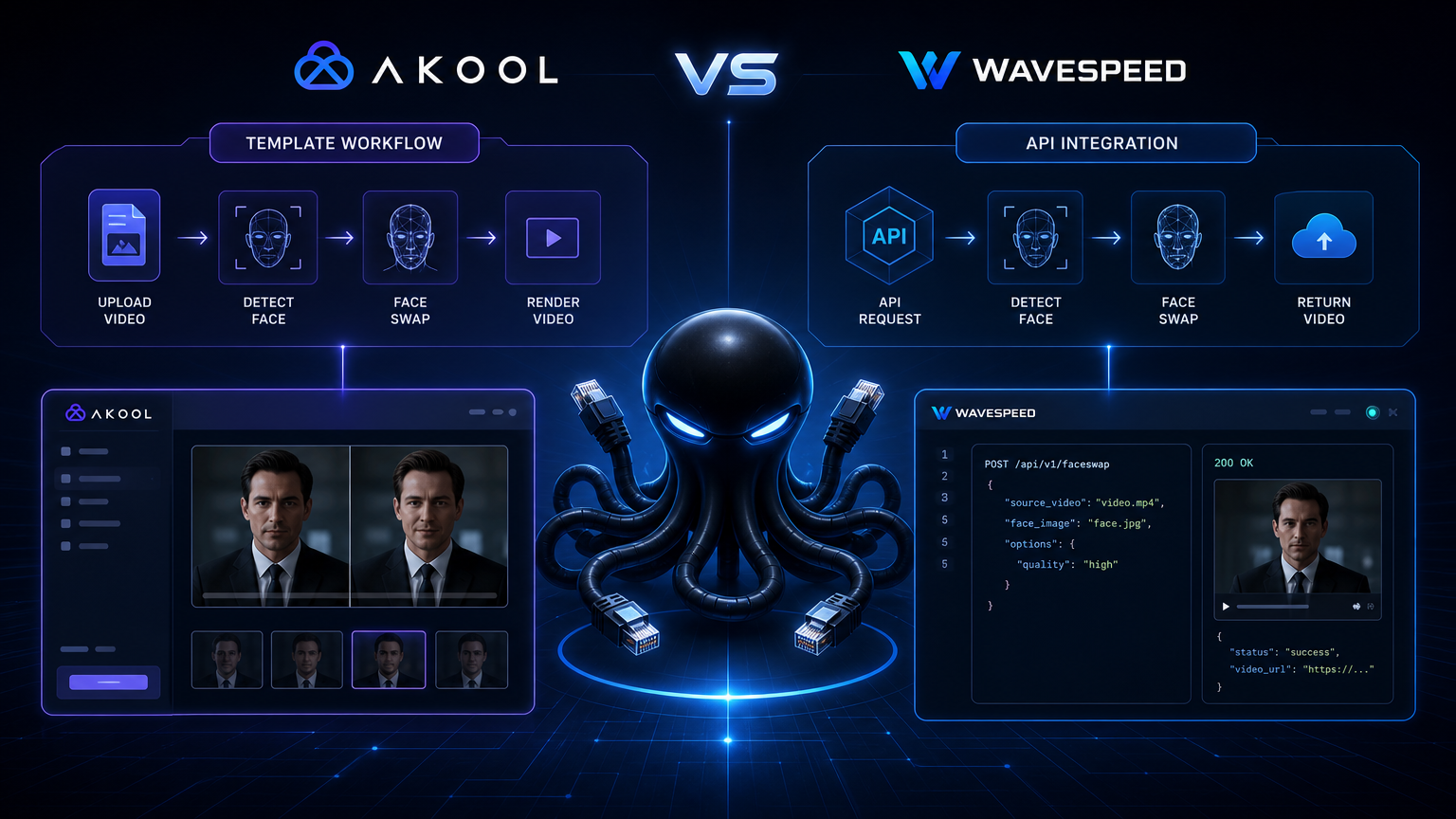
Akool face swap vs WaveSpeed at a glance
| Akool Video Face Swap | WaveSpeed Video Face Swap | |
|---|---|---|
| Best for | Marketing templates, avatar workflows, brand campaigns | Developer integrations, batch pipelines, SaaS products |
| Integration | Web UI + API | API-first, OpenAI-compatible |
| Multi-person | Limited | target_index parameter |
| Pricing | Subscription and credit tiers | Per-second video duration |
| Extras | Avatar, lip sync, video translation | Async batch, unified billing |
| Brand awareness | Higher in marketing segment | Lower, newer in the market |
This table gives a quick view of akool face swap vs wavespeed face swap. For a deeper technical look at WaveSpeed alone, see What Is Wavespeed Video Face Swap.
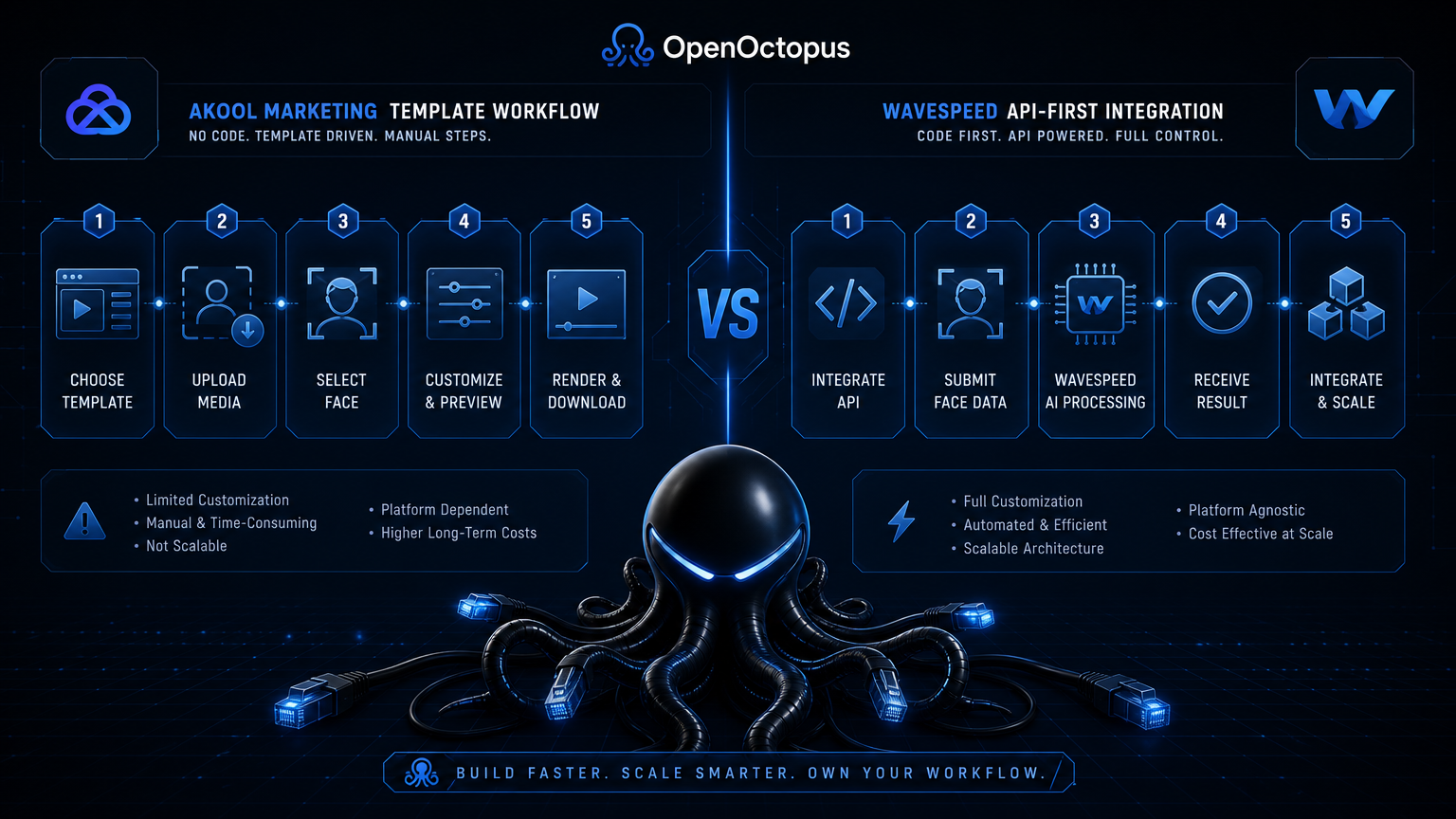
Which one should you choose?
Pick Akool when your team needs ready-made templates, avatar generation, or localized video translation for campaigns. Pick WaveSpeed when you need a video face swap API behind your own product, with control over queueing, retries, and cost per clip.
Akool is the stronger choice for creative teams that want a point-and-click experience. WaveSpeed is the better fit for engineering teams building a face swap video feature into a platform, editor, or content pipeline. If multi-person scenes matter, Face Video Swap for Multi-Person Scenes explains how WaveSpeed handles identity mapping.
Decision factors
Speed
WaveSpeed inference scales with clip length; Akool turnaround depends on plan and queue.
Quality
Both preserve identity on stable clips; fast motion and occlusion remain hard for any model.
Pricing
Akool uses credits and tiers; WaveSpeed bills per second of output.
Control
WaveSpeed exposes target_index and async polling; Akool hides more complexity behind its UI.
Pricing, quality, and integration notes
Akool pricing is tied to subscription tiers and credit packs. That can be predictable for occasional campaigns, but costs can climb at scale. WaveSpeed charges by video duration, usually with a short minimum, so cost grows linearly with usage. For teams building a face swap video app, per-second billing makes unit economics easier to model.
Quality is similar on stable, well-lit inputs. Research on video face swapping shows that abrupt inter-frame motion and occlusion still cause flickering and identity drift across most methods, which is why short, stable clips remain the safest input for either platform.
For direct integration, the WaveSpeed Video Face Swap API page has endpoint details, code samples, and a quick-start snippet.
FAQ
Start comparing with WaveSpeed
Test the WaveSpeed Video Face Swap API and see how it fits your pipeline.
Start with $1 credit.