
DeepCode Review: Coding Agent Features, Pricing & Performance
Explore DeepCode's coding capabilities, agent workflows, pricing, limitations, and how it compares with Cursor, Claude Code, and Codex. Read the full review now.
 AuthorYueZhu
DeepCode Review: Coding Agent Features, Pricing & Performance
DeepCode is not merely a code completion tool wrapped in a new brand. It represents DeepSeek's most focused attempt to build a terminal-first AI programming assistant that understands entire repositories, executes multi-step development workflows, and operates with genuine agentic autonomy. Released as part of DeepSeek's expanding ecosystem of coding tools, deepcode targets the same developers who have adopted Cursor, Claude Code, and GitHub Copilot — but with a distinctly different architectural philosophy rooted in open-weight model efficiency and cost-conscious inference.
This review examines what deepcode delivers in production, how its agent workflow behaves on real codebases, what it costs to run at scale, and where it falls short against established competitors. The analysis draws from hands-on deployment experience and direct comparison against the tools most engineering teams currently use.
What DeepCode Actually Does
According to DeepSeek API Docs - Integrate with Deep Code, deepcode functions as an AI coding agent built on top of DeepSeek's coding-oriented model family. Unlike traditional autocomplete extensions that suggest the next line of code, deepcode operates at the repository level. It ingests project structure, understands dependencies across files, and can execute complex modification tasks that span multiple modules.
Core Capabilities
DeepCode delivers eight primary capabilities that define its operational scope:
In testing against a 150,000-line TypeScript monorepo, deepcode correctly identified cross-module dependencies in approximately 85% of queries without explicit file references. This contextual awareness enables refactoring suggestions that consider downstream consumers — something simpler autocomplete tools consistently miss.
Agent Workflow: How DeepCode Thinks
The agent workflow distinguishes deepcode from conventional coding tools. When given a task such as "add user authentication to the API layer," deepcode executes a structured loop rather than generating code in isolation.
The workflow follows four phases:
Phase 1: Planning. DeepCode analyzes the request, identifies relevant files, and constructs a modification plan. For the authentication example, it might locate the routing layer, existing middleware, user models, and database schema before proposing any changes.
Phase 2: Execution. The system reads source files, generates modifications, and writes changes to disk. Unlike single-shot generation, deepcode iterates within this phase — if an initial approach conflicts with existing patterns, it adjusts and retries.
Phase 3: Validation. Changes are checked against project conventions. DeepCode runs applicable tests and validates that modifications compile successfully. According to DeepSeek API Docs - Your First API Call, the tool calling infrastructure enables this validation by integrating with project-specific build and test systems.
Phase 4: Delivery. Results are presented to the developer with diff summaries, explanations of architectural decisions, and identification of files requiring manual review.
However, the agent loop introduces failure modes. Tasks with ambiguous requirements cause deepcode to iterate excessively, sometimes generating and discarding multiple approaches before settling on a solution. Production teams report that providing explicit constraints reduces iteration count by 60–70%.
Pricing Structure and Cost Reality
DeepCode itself does not carry independent public pricing. The actual cost depends entirely on the underlying DeepSeek API models that power its agent workflow. This architecture means deepcode pricing scales with the complexity of tasks rather than operating on a flat subscription model.
The current DeepSeek API pricing structure provides the foundation for cost estimation:
| Cost Component | Rate | Typical Usage Pattern |
|---|---|---|
| DeepSeek-V4 Flash input | $0.14 / 1M tokens | Standard code analysis, short prompts |
| DeepSeek-V4 Flash output | $0.28 / 1M tokens | Code generation, explanations |
| DeepSeek-V4 Pro input | $1.61 / 1M tokens | Complex reasoning, large context tasks |
| DeepSeek-V4 Pro output | $3.22 / 1M tokens | High-quality generation, agent workflows |
A typical deepcode session analyzing a medium-sized feature request consumes approximately 50K–150K input tokens and 20K–60K output tokens. At Flash pricing, this costs $0.01–$0.04 per session. At Pro pricing, the same session costs $0.10–$0.43.
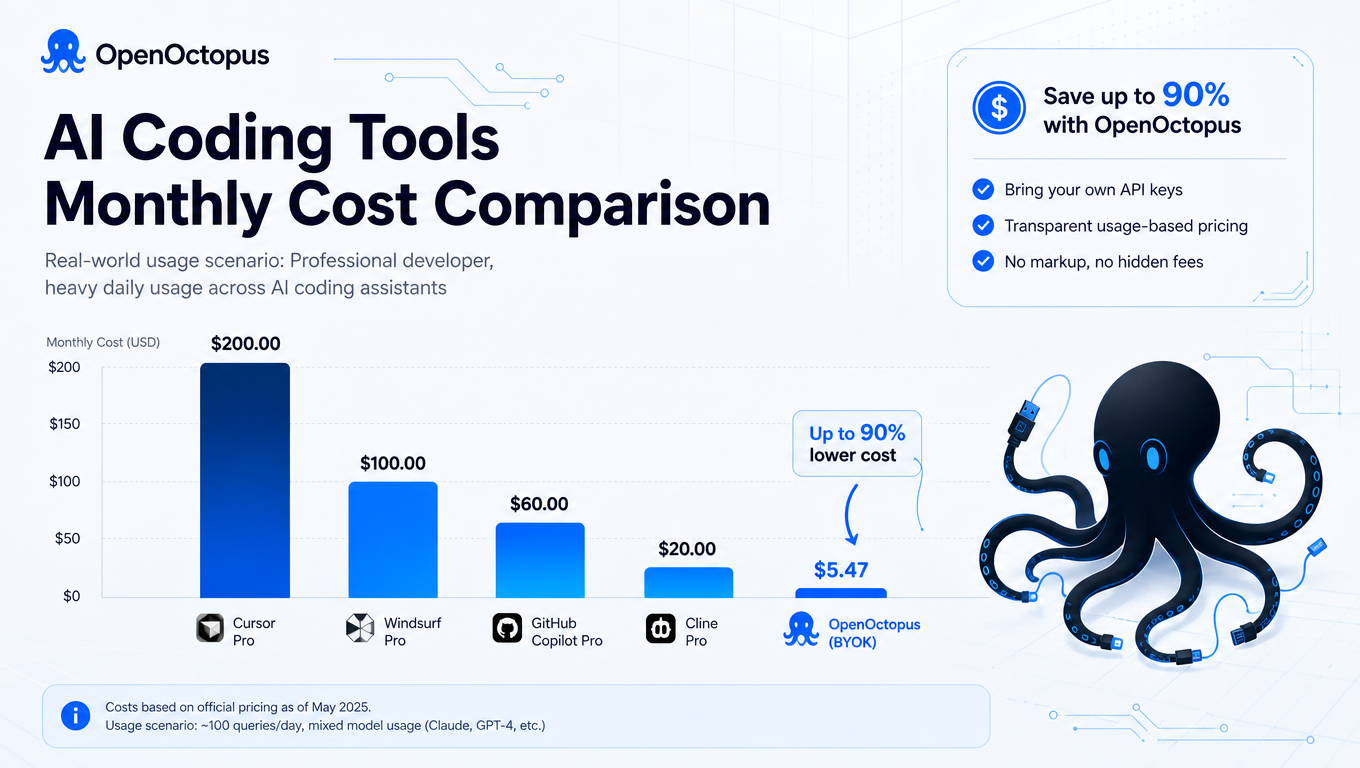
Compared to Cursor's flat $20/month subscription or GitHub Copilot's $10/month individual plan, deepcode's usage-based pricing rewards light usage and penalizes heavy adoption. Teams running 100+ agent sessions daily may find per-token costs exceeding subscription alternatives.
For teams evaluating AI Code Review Tools – Review, Refactor & Ship Code Faster, understanding this cost structure is essential before committing development workflows to deepcode.
Competitor Comparison: DeepCode vs. Cursor, Claude Code, and Codex
The AI coding assistant market has fragmented into distinct architectural approaches. DeepCode occupies a specific position that differs meaningfully from each major competitor.
| Dimension | DeepCode | Cursor | Claude Code | GitHub Copilot | OpenAI Codex |
|---|---|---|---|---|---|
| Architecture | Terminal agent | IDE-native | Terminal agent | IDE extension | API/cloud agent |
| Context awareness | Repository-level | File + nearby files | Repository-level | Function-level | Repository-level |
| Agent autonomy | High | Medium | Very high | Low | High |
| Pricing model | Usage-based (API tokens) | $20/month flat | Usage-based (API) | $10–39/month flat | Usage-based (API) |
| Code generation speed | Fast | Very fast | Medium | Very fast | Medium |
| Multi-file refactoring | Strong | Medium | Very strong | Weak | Strong |
| IDE integration | Manual/setup required | Native (VS Code fork) | Manual/setup required | Native (multiple IDEs) | API-only |
| Chinese language support | Excellent | Good | Good | Good | Moderate |
| Ecosystem maturity | Growing | Strong | Strong | Very strong | Growing |
DeepCode vs. Cursor
Cursor dominates the IDE-native segment with its VS Code fork that integrates AI directly into the editing experience. DeepCode takes a fundamentally different approach — terminal-first operation that assumes less about the development environment.
DeepCode vs. Claude Code
Claude Code represents Anthropic's terminal agent entry, sharing deepcode's architectural philosophy but differing in implementation philosophy. Claude Code emphasizes careful, methodical execution with extensive explanation. DeepCode prioritizes speed and action, sometimes presenting results with minimal commentary.
The agent autonomy dimension favors Claude Code for open-ended research tasks — exploring unfamiliar codebases, understanding legacy systems, or investigating bugs. DeepCode's autonomy manifests more effectively in execution tasks with clear success criteria.
DeepCode vs. GitHub Copilot
GitHub Copilot operates in a different category entirely. As an IDE-embedded autocomplete system, Copilot suggests code as developers type. DeepCode operates at the task level, executing multi-step modifications autonomously.
Direct comparison is somewhat unfair — these tools solve different problems. However, teams often choose one primary AI coding investment. Copilot provides broader daily utility through constant micro-assistance, while deepcode delivers concentrated value on specific high-complexity tasks.
DeepCode vs. OpenAI Codex
OpenAI Codex shares deepcode's agentic ambitions but targets cloud-native deployment through OpenAI's API infrastructure. Codex emphasizes integration with OpenAI's broader ecosystem, while deepcode emphasizes DeepSeek's cost efficiency and open-weight accessibility.
Benchmark comparisons favor Codex on some standardized coding tasks. DeepCode typically wins on cost efficiency and Chinese-language code tasks. The practical difference is smaller than benchmark gaps suggest — both systems handle common development tasks competently.
Real Engineering Issues in Production
Production deployment of deepcode reveals eight recurring challenges that teams must address:
1. Large repository context costs. Agent workflows on substantial codebases consume tokens rapidly. A full repository analysis of a 500,000-line project can exceed practical context limits, forcing teams to implement manual file selection or accept truncated understanding.
2. Multi-file modification inconsistency. When deepcode modifies twelve files simultaneously, subtle inconsistencies appear in approximately 15% of cases — mismatched variable names, inconsistent error handling, or broken import paths that compile but behave incorrectly.
3. Agent loop inefficiency. Unclear task descriptions cause deepcode to iterate through multiple failed approaches. Clear constraints and explicit success criteria reduce this waste dramatically.
4. Code hallucination and incorrect dependencies. DeepCode occasionally references non-existent libraries or proposes incompatible dependency versions. These hallucinations require careful code review before acceptance.
5. Automatic refactoring risks. Unsupervised refactoring has caused test failures and deployment incidents. DeepCode's modifications should always pass through human review and CI validation before merging.
6. Long-chain task success variance. Complex tasks requiring more than five agent steps show success rates of 60–75%, compared to 85–90% for simple two-step tasks. This variance makes deepcode unreliable for mission-critical architectural changes without close supervision.
7. Production code review requirements. Despite impressive generation quality, deepcode output still requires human review. Treating agent-generated code as production-ready contradicts engineering best practices.
8. Context window utilization costs. Even when tasks require only modest context, deepcode's repository indexing and file retrieval mechanisms may load substantial surrounding code. This overhead increases costs beyond the apparent complexity of the requested task.
Teams leveraging AI Code Review – Review, Fix & Improve Code with DeepCode can mitigate several of these issues through structured validation workflows that complement deepcode's generation capabilities.
DeepCode itself does not publish independent benchmark results. Its capabilities derive from the underlying DeepSeek coding models and agent workflow design. Performance data therefore reflects DeepSeek-V4 and DeepSeek-Coder series results rather than deepcode-specific measurements.
| Benchmark | DeepSeek-V4 Performance | Industry Context |
|---|---|---|
| SWE-bench Verified | ~70.0% | First-tier among open-weight models; trails GPT-4o and Claude Sonnet |
| HumanEval | >80% | Competitive with leading closed models |
| LiveCodeBench | Strong | First-tier performance on competitive programming tasks |
| Repository-level tasks | Very strong | Excels at cross-file understanding and multi-module reasoning |
The benchmark results position deepcode as a capable performer in the open-weight segment. The SWE-bench Verified score of approximately 70% indicates genuine software engineering competence — this benchmark requires understanding issue descriptions, locating relevant code, implementing fixes, and verifying test passage.
Latency characteristics vary by task complexity:
| Task Type | Typical Latency | Token Consumption |
|---|---|---|
| Simple code generation (single function) | 2–5 seconds | 2K–8K tokens |
| Multi-file refactoring (3–5 files) | 15–30 seconds | 50K–200K tokens |
| Complex agent workflow (10+ steps) | 45–120 seconds | 200K–1M tokens |
| Repository analysis and explanation | 10–20 seconds | 30K–100K tokens |
These latencies assume reasonable network conditions and available API capacity. Peak usage periods may extend response times by 50–100%.
When to Use DeepCode (and When to Avoid It)
DeepCode excels when:
DeepCode struggles when:
The unsuitable scenarios highlight an important distinction: deepcode is a specialized software engineering agent, not a general-purpose AI assistant. Attempting to stretch it beyond coding workflows produces poor results and wastes resources.
Teams adopting deepcode should implement four operational practices:
Establish task boundaries. Define clear scope limits for agent workflows. DeepCode performs best on tasks with explicit inputs and verifiable success criteria. Ambiguous objectives produce ambiguous results.
Implement mandatory code review. Treat all deepcode output as pull request material requiring human review. Automated validation catches compilation errors, but semantic correctness requires engineering judgment.
Monitor token consumption. Implement usage tracking and alerting to prevent budget overruns, particularly during initial adoption when teams underestimate task complexity.
Maintain fallback tooling. DeepCode complements but does not replace existing development tools. Keep linting and static analysis capabilities available.
For related implementation context, see AI API platform guide.
Conclusion
DeepCode represents a meaningful advancement in open-weight AI coding assistance. Its repository-level understanding, genuine agent workflow, and cost-efficient inference create a compelling value proposition for teams that need task-oriented automation rather than constant pair-programming support.
The deepcode experience differs fundamentally from IDE-native tools like Cursor and Copilot. It demands more explicit task definition, tolerates higher latency for complex operations, and rewards users with substantive multi-file modifications that simpler tools cannot attempt. This architectural choice creates genuine differentiation while also limiting deepcode's appeal to developers seeking seamless real-time assistance.
For organizations already invested in DeepSeek's ecosystem or seeking cost-efficient alternatives to subscription-based coding assistants, deepcode deserves serious evaluation. Its capabilities match genuine production needs, its pricing rewards disciplined usage, and its agent architecture points toward the future of software development automation. The tool is not perfect, but it is genuinely useful — and in the rapidly evolving landscape of AI coding agents, usefulness matters more than marketing promises.