
Head Swap AI vs Face Swap: Akool Use Cases
Compare head swap AI and full face swap workflows. Learn where Akool delivers better video results and when to choose an API-first alternative.
 AuthorYueZhu
Head swap AI versus face swap: why the distinction matters
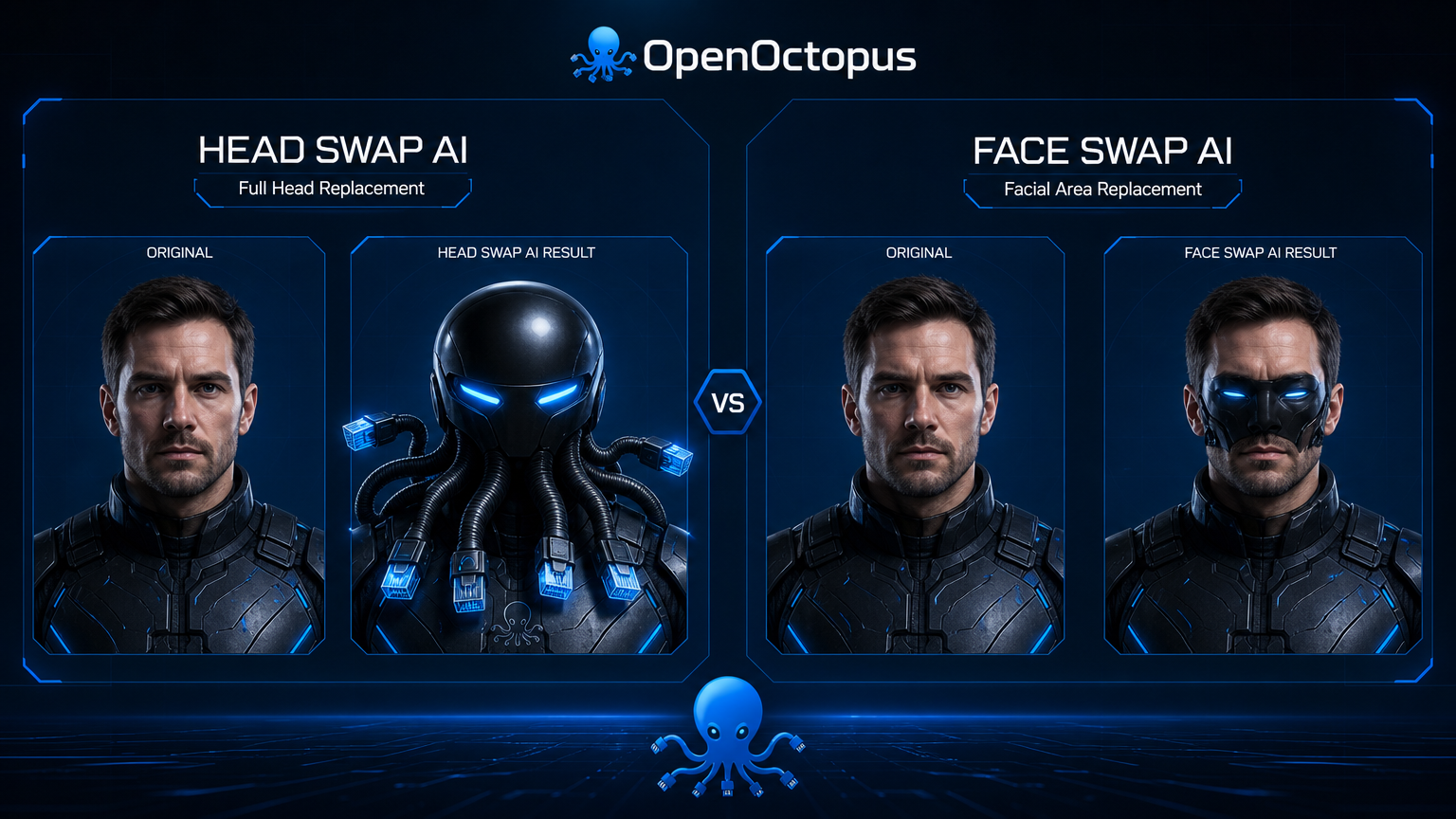
Head swap AI and face swap are often used interchangeably, but they solve different production problems. Face swap replaces the facial identity inside the existing head boundary of a target video. Head swap AI goes further: it replaces the entire head region, including hair, ears, and the head silhouette, while preserving the target's body, pose, and background. For marketers building localized campaigns or creators producing ai video avatar content, that extra coverage changes what is possible.
Akool AI is one of the platforms that makes this distinction explicit. Its AI swap toolkit offers Face Swap, Character Swap, and Head Swap as separate modes, with head swap ai positioned for precise alignment, natural motion, and lighting continuity. In this guide we compare head swap ai against standard face swap, review where Akool wins, and flag the engineering limits that push some teams toward API-first alternatives such as WaveSpeed Video Face Swap.
What head swap AI actually does
Standard face swap maps a source identity onto the target face while keeping the original head shape, hairstyle, and ears. The result works well when the source and target have similar proportions, but it can break when hairstyles, head shapes, or lighting differ. Head swap AI swaps the full head region, so the output carries the source's head structure into the target scene.
Akool's face swap app describes its three swap modes this way: Face Swap replaces faces instantly while preserving expressions and identity; Character Swap transforms entire characters across scenes; Head Swap swaps heads with precise alignment, natural motion, and lighting. This structured approach is why an akool ai workflow feels more like a creative studio than a single video face swap online utility. That framing is useful because it shows head swap ai as a middle ground between narrow face replacement and full-character synthesis.
The technical difference matters in production. A head swap ai workflow must handle the mismatch between the source head and the target background, preserve temporal consistency across frames, and maintain a natural head-torso relationship. Research on realistic head swapping in video highlights that the task is harder than face swapping because it requires modeling hair, neck, and background blending in addition to facial identity. Recent work such as GSwap: Realistic Head Swapping with Dynamic Neural Gaussian Field shows that lifting the problem into a 3D Gaussian portrait representation improves identity preservation, temporal coherence, and 3D consistency compared with 2D face-swapping methods.
| Capability | Face Swap | Head Swap AI |
|---|---|---|
| Replaces | Facial identity only | Full head region including hair and silhouette |
| Best for | Quick identity changes, similar head shapes | Dramatic identity transforms, different hairstyles |
| Harder when | Head shape or hair differs | Head turns, occlusion, complex backgrounds |
| Typical use | Social clips, memes, simple ads | Marketing variants, localization, avatar content |
For teams evaluating a video face swap online workflow, the choice between face swap and head swap ai should be driven by how much of the head needs to change. If only the face matters, face swap is faster and cheaper. If the campaign depends on a recognizable full-head likeness, head swap ai is the better fit.
Where Akool's head swap AI delivers better results
Akool AI positions itself as a generative AI platform for personalized visual marketing. Its toolkit bundles face swap, head swap ai, ai video avatar creation, video localization, lip sync, and image generation into one credit-based workflow. That integration is the main reason marketers choose it over narrow swap tools.
Head swap ai shines in three Akool workflows:
Localized marketing videos. A single spokesperson video can be adapted for different regions by swapping in local talent or language-specific presenters. Akool's video translation and lip-sync features then dub the script while adjusting mouth movements. This combination makes head swap ai part of a broader video localization pipeline rather than a one-off effect.
AI video avatar production. Instead of filming a presenter, teams can generate an ai video avatar from a script. When the avatar needs to match a specific person's full-head likeness, head swap ai can overlay that identity onto a stock avatar body. The result is useful for training videos, product explainers, and personalized outreach at scale.
Brand and social campaigns. Akool's marketing pitch emphasizes studio-grade blending, multi-face support, and high-resolution output. For short-form ads where the full head must look like a specific influencer or brand ambassador, head swap ai produces more convincing results than face-level replacement.
Akool Live Camera coverage in GamesBeat notes that the company's live suite adds real-time avatars, live face swap, and video translation with sub-100-millisecond latency. This signals where Akool is investing: interactive, real-time marketing experiences rather than batch API processing.
Akool AI review: strengths, limits, and competitor fit
Akool's strength is the breadth of its creative suite. A single subscription covers head swap ai, ai video avatar generation, video localization, talking photos, and background editing. For non-technical marketing teams, that breadth reduces the number of tools to learn and integrate.
Pros:
- Integrated avatar, lip sync, translation, and swap workflows
- User-friendly interface that does not require code or GPU setup
- High-resolution output suitable for professional campaigns
- Real-time capabilities through Akool Live Camera
Cons:
- Credit-based pricing that scales quickly with video length and resolution
- Not designed as a developer-first API platform
- Less flexible than specialized swap models for batch or custom pipelines
- Long videos and complex motion increase artifact risk
Compared with HeyGen and Synthesia, Akool offers stronger face and head swap capabilities but weaker enterprise API maturity. Compared with Captions, it is less focused on short-form editing templates and more on avatar and localization. Compared with WaveSpeed Video Face Swap, Akool is better for creative marketing suites, while WaveSpeed is better for developers who need a dedicated video face swap API.
This akool face swap review verdict is that Akool fits marketing teams who want a polished, all-in-one content studio. It is less suited for engineering teams building custom products around head swap ai, where endpoint control, usage logging, and model routing matter more than UI polish.
Engineering realities of head swap AI
Head swap AI is not a magic fix. The same research that shows progress also documents consistent failure modes. A survey of deepfake face-swap research in Multimedia Tools and Applications identifies identity preservation, lighting and occlusion handling, pose variability, and temporal coherence as persistent open challenges. These map directly to the issues production teams see with head swap ai.
Five engineering realities to plan for:
-
Marketing enhancement can trade off identity accuracy. Tools that optimize for visual polish sometimes smooth away distinctive features. Always compare the output against the source likeness before publishing.
-
Complex motion degrades consistency. Fast head turns, occlusion, and extreme angles break alignment. Short, stable clips produce better head swap ai results than long, dynamic sequences.
-
Cost scales with duration and resolution. Full-head video synthesis is compute-intensive. What looks cheap for a five-second clip becomes expensive for a one-minute campaign video.
-
Brand content needs human review. Synthetic media carries legal and reputational risk. Build a review gate for any public-facing head swap ai output.
-
Cross-language lip sync has error margins. Video localization with lip-sync looks impressive in demos, but subtle mouth-shape mismatches remain common, especially for languages with very different phoneme sets.
For a deeper look at failure patterns in dedicated swap pipelines, see the video face swap limitations guide. For image-only workflows, the Face Swap Pro review covers high-resolution portrait transfer trade-offs.
How to test head swap AI through OpenOctopus
If your team wants to evaluate head swap ai without committing to a full SaaS subscription, OpenOctopus routes the Akool Video Face Swap capability through a single API and playground interface. This gives you a video face swap online testbed that uses the same backend whether you click through the UI or call the endpoint programmatically. You can test clips, compare output quality, and then move stable workflows into production.
The fastest path is to start in the playground: upload a short clip and a reference head image, review the swapped output, and iterate on input quality before writing any code. When the workflow is ready, the same model route is available through the API for batch or product integration.
Try Akool Video Face Swap Playground View Akool Video Face Swap API
Teams that also need source footage can generate base clips with the Seedance text-to-video guide and then apply head swap ai for identity customization.
Final verdict: when to choose head swap AI on Akool
Head swap AI is the right choice when your video needs a full-head identity change, not just a facial overlay. Akool makes it accessible through a polished SaaS interface that connects head swap ai to avatars, lip sync, and video localization. That integration is ideal for marketing teams producing localized campaigns, personalized ads, and ai video avatar content.
Choose a different path when you need developer flexibility, low-cost batch processing, or tight integration with your own product. In those cases, a dedicated video face swap API or a specialized image face swap workflow is usually the better long-term investment. The key is matching the tool to the workflow: head swap ai for creative marketing suites, API-first swap models for engineered products.