Head Swap AI

Replace Heads in Photos Instantly with Realistic Results

Replacing heads in photographs used to demand hours of Photoshop work and skilled retouching. Head swap AI eliminates that bottleneck, delivering realistic face replacements in seconds through automated identity alignment, skin-tone adaptation, and edge blending. Built on WaveSpeed AI's portrait transfer architecture, this image face swap tool produces outputs that look natural under casual inspection — no manual masking, no color correction, no watermark.

Clean blue facial identity transfer visualization showing portrait head replacement with smooth blending, futuristic tech aesthetic

Head Swap AI at a glance

~4 seconds
Average generation time per request
$0.010 / run
Transparent per-run pricing
No watermark
Clean output for commercial use
Base64 + URL
Flexible output formats for any workflow
Abstract blue facial landmark mapping and identity alignment overlay on portrait grid, light tech aesthetic

What head swap AI actually delivers

Traditional photo manipulation requires cutting, masking, color matching, and manual blending. Head swap AI automates every stage of this workflow through a modular computer vision pipeline. The system detects facial landmarks in both the target image and reference portrait, encodes the reference identity into a latent representation, and maps it onto the target geometry while preserving expression, pose, and lighting.

This ai portrait transfer capability produces results that previously demanded professional retouchers. According to WaveSpeed AI Image Face Swap | AI Portrait Transfer API, the model handles face identity alignment, lighting consistency matching, and edge fusion automatically. A head swap ai workflow that consumed forty-five minutes in Photoshop now completes in under five seconds with comparable visual quality for standard portraits.

The terminal-first API design means developers integrate photo face swap into existing pipelines without managing complex inference infrastructure. For teams building content tools, marketing platforms, or creative applications, this abstraction eliminates operational overhead.

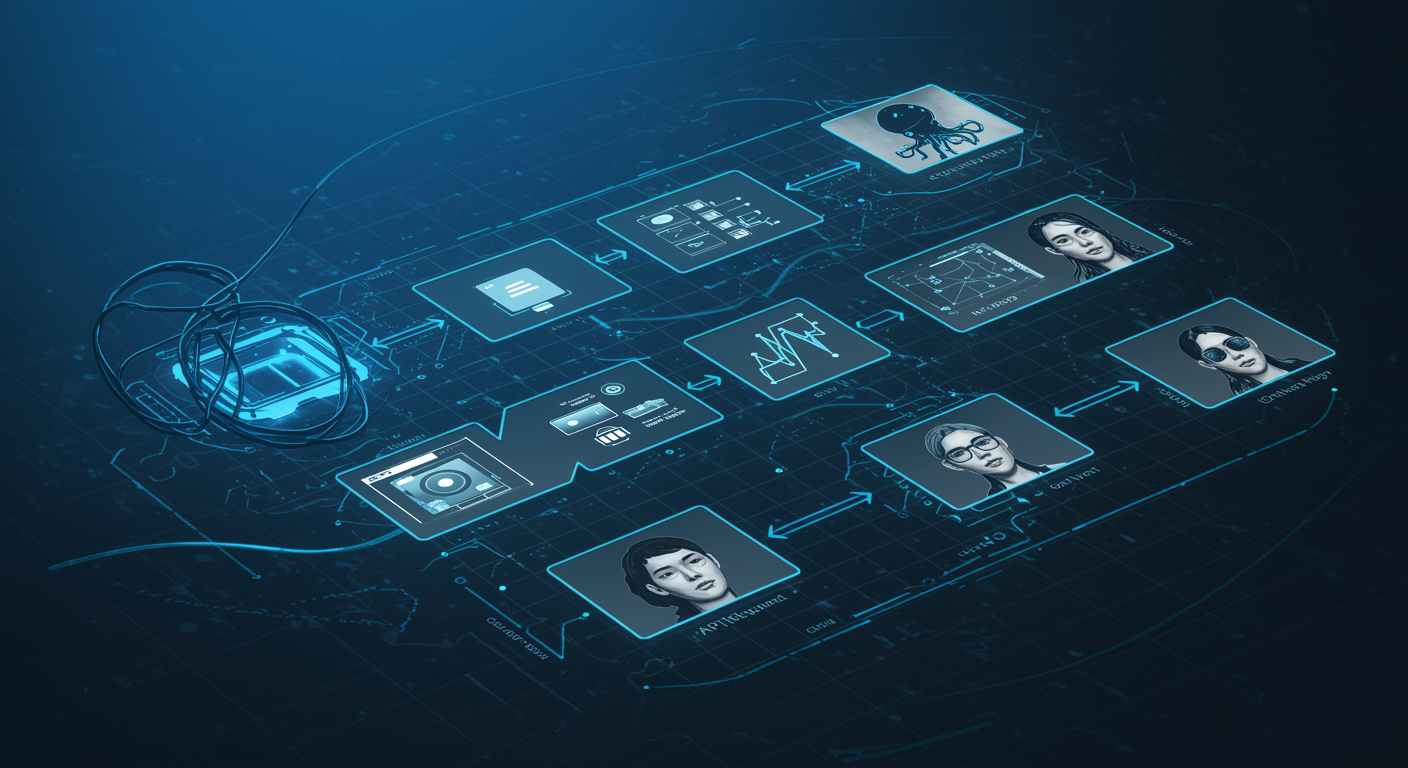
Structured blue API request flow diagram showing image upload through face alignment to output delivery, technical infrastructure aesthetic

How the head swap AI API workflow operates

The WaveSpeed AI head swap pipeline follows a structured sequence that developers can trigger through a single REST endpoint. Understanding this flow helps teams set appropriate expectations and handle edge cases.

Step 1: Image submission. The client submits a target image containing the face to replace, plus a reference image containing the desired face. According to REST API – WaveSpeedAI, the endpoint accepts JPEG, PNG, and WEBP formats with configurable output settings.

Step 2: Face detection and landmark extraction. The system identifies facial regions in both images, locating key landmarks — eyes, nose, mouth contours, jawline — that establish geometric correspondence.

Step 3: Identity alignment and blending. The reference identity encodes into a latent representation and maps onto the target geometry. Skin-tone adaptation, lighting consistency matching, and edge blending produce a natural composite.

Step 4: Output delivery. The system returns a generated image URL. Teams can optionally enable base64 output or synchronous mode for immediate response. According to Get Started with API – WaveSpeedAI, asynchronous tasks include a request_id for result polling.

This head swap ai workflow integrates into CI/CD pipelines, batch processing jobs, and real-time creative tools with minimal engineering overhead.

Core capabilities of head swap AI

1

Static image face swap

Transfer reference faces onto target images with automatic alignment

2

Reference face migration

Extract identity features and apply them naturally to target portraits

3

Multi-face target indexing

Select which face to replace in group photos via `target_index`

4

Skin-tone and lighting adaptation

Automatic color matching for realistic blending

5

Expression and pose preservation

Maintain target subject's facial expression and head angle

6

Flexible output formats

JPEG, PNG, WEBP with optional base64 encoding

7

Synchronous and async modes

Immediate response or background processing with polling

8

No watermark output

Clean images ready for commercial and creative use

Head swap AI vs competitors: WaveSpeed, Akool, and FaceFusion

The image face swap market spans consumer apps, enterprise APIs, and open-source pipelines. Understanding where WaveSpeed AI positions helps teams select the right face swap api for their workflows.

DimensionWaveSpeed AIAkoolFaceFusionPiAPI
ArchitectureCloud APICloud APIOpen-source / self-hostedCloud API
Head swap ai qualityStrongStrongStrongModerate
Speed~4 seconds~5–8 secondsVaries by hardware~6–10 seconds
WatermarkNoneVaries by tierNoneVaries by tier
Pricing$0.010 / runUsage-basedFree (self-hosted)Usage-based
API simplicitySimple RESTRESTPython CLIREST
Base64 outputYesLimitedNoLimited
Sync modeYesNoNoNo
Multi-face controltarget_indexLimitedManualLimited

WaveSpeed AI vs Akool

Akool delivers strong face swap quality through a polished web interface. WaveSpeed AI differentiates through API-first design and simpler integration. For developers building automated photo face swap pipelines, WaveSpeed's REST endpoint requires fewer configuration steps and offers synchronous mode that eliminates polling complexity.

WaveSpeed AI vs FaceFusion

FaceFusion represents the open-source alternative that teams can self-host. While free from per-run costs, it demands GPU infrastructure, maintenance, and security updates. WaveSpeed AI's cloud face swap api removes infrastructure overhead at $0.010 per run — a compelling tradeoff for teams without dedicated ML ops resources.

WaveSpeed AI vs PiAPI

PiAPI offers broader model coverage but less focused face swap optimization. WaveSpeed AI concentrates specifically on image face swap and head swap ai workflows, delivering faster average latency and more predictable output quality.

For detailed technical analysis of face swap models and limitations, read our Face Swap & Photo Face Swap: Models, APIs & Limitations. Teams evaluating alternatives should also explore FaceTool AI Alternative – Faster Face Swap API.

Clean blue comparison matrix with tool icons and capability indicators, data-driven aesthetic

Head swap AI pricing and cost reality

Understanding true costs prevents budget surprises when scaling head swap ai workflows. WaveSpeed AI publishes transparent per-run pricing without hidden fees.

Cost ComponentRatePractical Impact
Per run$0.010~100 runs per dollar
Average latency~4 secondsSuitable for real-time and batch workflows
Output formatsJPEG / PNG / WEBPNo additional format charges
Base64 outputOptionalEliminates secondary download steps
Sync modeOptionalImmediate response without polling overhead

A typical head swap ai production workload processing 1,000 images daily costs $10.00 per day or approximately $300 monthly. This pricing structure suits high-volume content production, marketing automation, and creative tool integrations.

Compared to manual retouching at $25–75 per hour, automated head swap ai delivers 50–100x cost reduction for batch portrait workflows. The economics favor automation for any production volume exceeding a few dozen images weekly.

Teams should budget for queue time during peak demand. According to WaveSpeed AI Image Face Swap | AI Portrait Transfer API, global demand fluctuations can extend queue times beyond the typical four-second average.

Abstract blue geometric bars showing cost comparison between manual retouching and AI face swap, clean data visualization

When to use head swap AI (and when to avoid it)

Head swap AI excels at:

  • Social media entertainment: Quick face swaps for viral content and engagement
  • Avatar and portrait creativity: Personalized headshots and character concepts
  • Advertising mockups: Visualizing talent in campaign concepts before photoshoots
  • Casting previews: Testing actor appearances in scene contexts
  • Photography post-production: Automated retouching for volume portrait workflows
  • Privacy protection: Replacing identifiable faces in published materials
  • Virtual production: Pre-visualization and concept art for film and games
  • Marketing visual assets: Rapid generation of personalized campaign imagery

Head swap AI struggles with:

  • Unauthorized face replacement: Any use without explicit subject consent violates platform policies and potentially law
  • Identity deception and impersonation: Creating fake content of real individuals carries legal and ethical consequences
  • Political or sensitive figure manipulation: Most platforms prohibit synthetic media involving public figures
  • ID documents and authentication images: Face swap ai outputs must never substitute for official identification
  • Low-resolution input faces: Blurry or tiny faces fail landmark detection and produce poor results
  • Complex occlusions: Sunglasses, masks, and heavy hair coverage disrupt alignment
  • Extreme profile angles: Faces beyond approximately 45 degrees from frontal lack sufficient landmark visibility
  • Anime and illustration characters: The model trains on photographic data; stylized outputs quality drops significantly

According to Best Free AI Face Swapper in 2026 - WaveSpeed Blog, the most common production failures stem from ignoring input quality requirements and attempting head swap ai on non-photographic subjects.

Structured blue decision tree showing appropriate use cases for head swap AI, clean infographic aesthetic

Real engineering issues in production head swap AI

Deploying head swap ai at scale reveals eight recurring challenges that teams must address:

1. Portrait authorization and rights compliance. Every face replacement requires explicit permission from both the reference face subject and any identifiable individuals in the target image. Production systems must implement consent tracking.

2. Deepfake abuse risk. Head swap ai capabilities enable convincing synthetic media. Teams must implement content policies, abuse detection, and reporting mechanisms.

3. Low-resolution input failures. Faces smaller than approximately 80x80 pixels or heavily compressed images frequently fail detection. Input validation prevents wasted API calls.

4. Multi-face target_index selection errors. Group photos containing multiple faces require correct target_index values. Off-by-one errors produce swapped faces on unintended subjects.

5. Skin-tone and lighting inconsistency. While automatic adaptation handles most cases, extreme lighting contrasts — theatrical spotlights, colored gels, or heavy shadows — produce visible seams.

6. Occlusion quality degradation. Glasses, masks, hands, and foreground objects overlapping facial regions reduce output quality significantly.

7. Batch generation queue management. High-volume workflows require async task handling, result polling, and retry logic for failed jobs.

8. Content moderation gaps. The API generates images without built-in content filtering. Production deployments must add moderation layers before displaying or distributing outputs.

Teams building on Get Started with API – WaveSpeedAI should architect these safeguards into their integration from day one rather than retrofitting after incidents.

Structured blue network with warning indicator nodes showing production risks, technical risk visualization

Frequently asked questions about head swap AI

Head swap AI is an automated portrait transfer technology that replaces faces in photographs using reference images. It performs landmark detection, identity alignment, skin-tone adaptation, and edge blending to produce realistic composites.

Start using head swap AI today

Replace heads in photos instantly with realistic, watermark-free results. Access WaveSpeed AI Image Face Swap through OpenOctopus for stable API routing, transparent pricing, and production-ready infrastructure.