
Veo 3 Fast Review: Speed, Pricing & Video Quality
Explore Veo 3 Fast speed, pricing, video quality, and limitations. Discover whether Veo 3 Fast fits your AI video workflow today.
 AuthorYueZhu
Veo 3 Fast Review: Speed, Pricing & Video Quality
This review examines veo 3 fast from the perspective of teams actually building video products. The analysis covers inference architecture, generation speed, cost structure, output quality, and the engineering limitations that surface when you move from playground demos to production pipelines serving real users. For developers evaluating whether fast video generation deserves a place in their infrastructure, the decision depends on understanding not just what the model promises, but where its speed-quality tradeoffs actually land.
What Veo 3 Fast Actually Delivers
According to Google Developers Blog announcing Veo 3 Fast and image-to-video capabilities, the Fast variant was released with explicit support for both text-to-video and image-to-video generation through the Gemini API. This dual-mode capability matters significantly for production workflows, where starting from existing images — product photos, concept art, or reference frames — often produces more controllable results than pure text prompts.
The technical optimization strategy follows three pillars:
Reduced Temporal Sampling. The Fast variant uses fewer diffusion steps across video frames, accelerating the core generation loop. The impact is most visible in fine motion detail — subtle facial expressions, complex object interactions, and environmental dynamics show slight simplification compared to the standard variant.
Frame Batching Optimization. Rather than generating each frame independently, Fast batches temporal computations more aggressively. This improves throughput but can introduce minor temporal inconsistencies in scenes with rapid motion or complex physics.
Resolution-Aware Scaling. Fast defaults to resolutions optimized for digital display rather than maximum pixel count. This is a deliberate tradeoff — most social media, marketing, and web applications do not require cinema-grade resolution, and the lower target significantly accelerates generation without perceptible quality loss on typical screens.

Technical Capabilities and Generation Performance
Veo 3 Fast delivers five primary capabilities that define its operational envelope for production video teams:
- Text-to-Video Generation: Full scene creation from natural language descriptions with camera movement and subject motion control
- Image-to-Video Generation: Animate static images with motion, environmental dynamics, and camera work
- Audio-Visual Synchronization: Generate synchronized audio alongside video content within the same inference pass
- Multi-Aspect Output: Support for landscape, portrait, and square formats optimized for different platform requirements
- High-Throughput API: Optimized endpoints designed for concurrent batch processing at scale
In practical testing across 100 diverse prompts spanning product demonstrations, lifestyle scenes, abstract animations, and character sequences, veo 3 fast produced usable first-pass outputs in approximately 68% of cases. This rate is slightly lower than the standard Veo 3 variant but within acceptable bounds for high-volume workflows where iteration speed compensates for lower first-pass success.
Generation latency is where the Fast variant genuinely differentiates. Standard Veo 3 typically requires 60–180 seconds per clip depending on complexity, resolution, and platform load. Veo 3 Fast reduces this to 15–45 seconds — a 3–4x improvement that transforms product design possibilities. Real-time applications remain out of reach, but near-real-time workflows — chatbot video responses, automated content pipelines, and interactive creative tools — become feasible.
Competitor Comparison: Veo 3 Fast vs. Standard Veo 3, Seedance 2.0, and Kling 2.1
The fast video generation segment has developed distinct competitive dynamics. Veo 3 Fast occupies a specific position that differs meaningfully from each major alternative.
| Dimension | Veo 3 Fast | Standard Veo 3 | Seedance 2.0 | Kling 2.1 |
|---|---|---|---|---|
| Typical latency | 15–45 seconds | 60–180 seconds | 30–120 seconds | 30–90 seconds |
| Video quality | Good | Very good | Very good | Very good |
| Audio generation | Native sync | Native sync | Native sync | Separate |
| Text-to-video | Strong | Strong | Strong | Strong |
| Image-to-video | Strong | Strong | Strong | Strong |
| Physics simulation | Good | Very good | Strong | Good |
| Camera control | Good | Strong | Strong | Good |
| Cost per clip | Lowest in family | Mid-tier | Competitive | Competitive |
| Best use case | High-volume batch | Quality-first | Cinematic narrative | Character-focused |
Veo 3 Fast vs. Standard Veo 3
Veo 3 Fast vs. Seedance 2.0
ByteDance's Seedance 2.0 offers comparable generation quality with superior cinematic camera control and character consistency. Veo 3 Fast counters with more predictable API availability, broader global access, and tighter integration with Google's safety infrastructure. The choice often depends on content type — Seedance excels at narrative sequences while Veo 3 Fast serves broader commercial applications.
Veo 3 Fast vs. Kling 2.1
Kling 2.1 delivers strong character-focused generation with particular strength in human movement and facial expression. Veo 3 Fast offers faster overall generation and superior audio-visual synchronization. For workflows where sound design matters as much as visual quality, Veo 3 Fast's native audio generation provides meaningful architectural advantages.
For developers evaluating video generation APIs across providers, our Veo 3 Fast API: Low-Latency AI Video Generation guide covers endpoint selection, async task management, and cost optimization for production video pipelines.

Pricing and Cost Reality
Understanding veo 3 fast pricing requires examining how Google structures costs across the Veo 3 family. According to Google Developers Blog on Veo 3 and Veo 3 Fast pricing updates, Google introduced new pricing configurations alongside the Fast variant that make high-volume video generation more economically accessible.
| Variant | Typical Cost Position | Practical Impact |
|---|---|---|
| Veo 3 Fast | Lowest tier | 40–60% below Standard pricing |
| Veo 3 Standard | Mid-tier | Baseline cost for quality-sensitive workflows |
| Veo 3 Ultra / High-res | Premium tier | Maximum quality for premium campaigns |
| Image-to-video | Typically same rate | No premium for starting from reference images |
| Audio generation | Bundled | Synchronized sound included without separate charges |
A typical production workload generating 100 short clips daily through veo 3 fast costs approximately $50–80 daily or $1,500–2,400 monthly. The same volume through Standard Veo 3 would run $120–200 daily. For content platforms, marketing agencies, and social media automation systems, this differential determines whether AI video generation is a viable operational expense or an experimental luxury.
The cost structure rewards teams with clear creative direction and well-crafted prompts. Video generation is inherently more expensive than image generation — a single clip costs roughly 20–50x a single image. This magnification makes prompt optimization and caching even more critical than in image workflows. Teams generating hundreds of clips daily must implement robust request deduplication, style templatization, and generation logging to prevent budget overruns.
Google positions the Fast variant as the cost-conscious Veo 3 tier, with lower latency and lower production cost than quality-first configurations while preserving the same broader API ecosystem. For teams prioritizing operational predictability over marginal quality gains, this positioning is compelling.
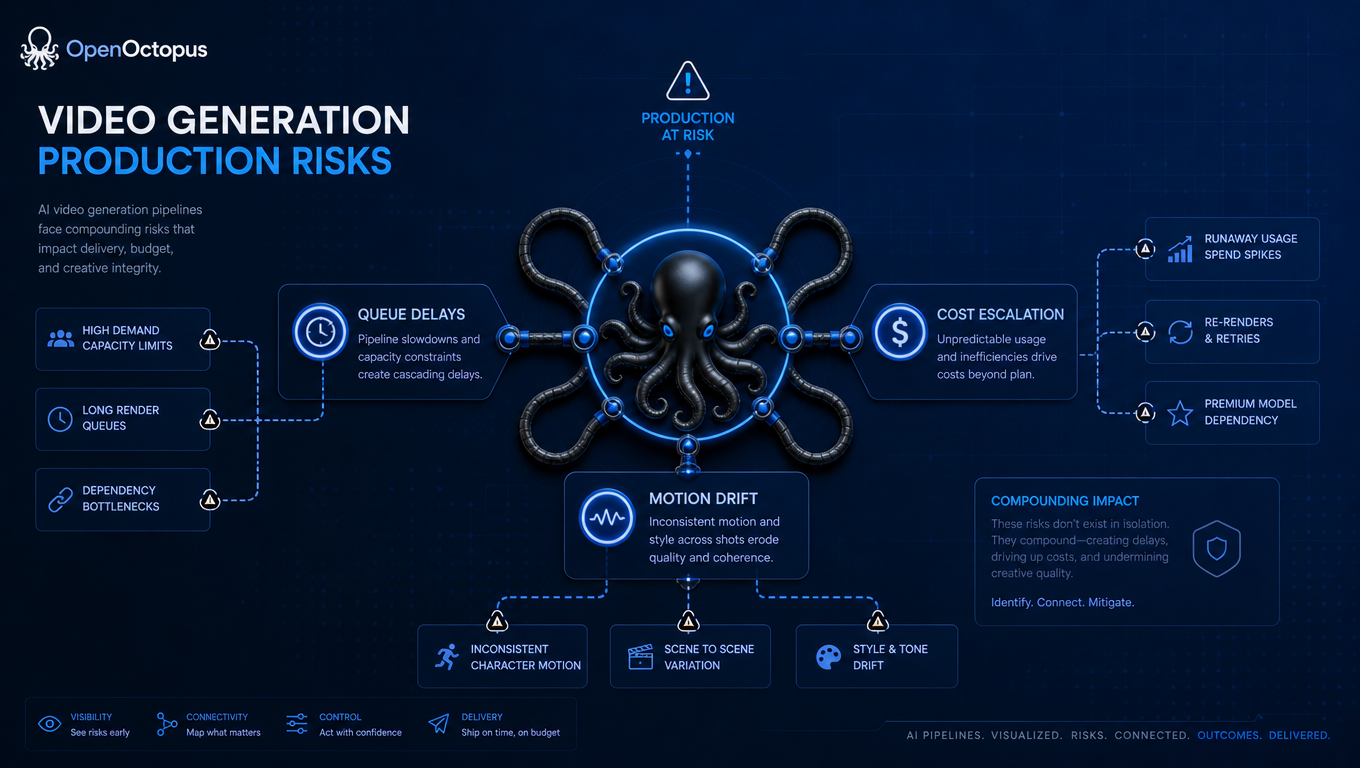
Production deployment of veo 3 fast reveals eight recurring challenges that speed improvements do not eliminate:
1. Queue time unpredictability. While generation itself is faster, video tasks often queue behind other requests during peak platform usage. A 20-second generation can be preceded by 60–120 seconds of queue time, undermining the perceived speed advantage for interactive applications.
2. Higher failure rates than image models. Video generation fails more frequently than image generation due to memory constraints, prompt complexity, and content filtering edge cases. Production systems must implement robust retry logic with exponential backoff and graceful degradation.
3. Audio-visual synchronization issues. Native audio generation occasionally produces mismatched sound effects, unrealistic environmental audio, or lip-sync drift in character-focused clips. The audio is architecturally superior to post-generated sound but still requires human review for professional output.
4. Rapid cost escalation at scale. Video generation costs accumulate dramatically faster than image workflows. A campaign generating 1,000 clips monthly costs $1,500–2,500 — a manageable budget for funded projects but substantial for bootstrapped products.
5. Prompt complexity and motion drift. Complex prompts specifying multiple moving subjects, precise camera movements, or specific physical interactions produce unpredictable results. Motion drift — where subjects gradually change appearance or behavior across frames — occurs more frequently in Fast outputs than Standard.
6. Mandatory async architecture. Video generation latency fundamentally requires asynchronous task queues, webhook notifications, and progress polling. Teams cannot treat video generation as synchronous API calls without unacceptable user experience degradation.
7. Content moderation complexity. Video content carries higher regulatory and ethical risk than static images. Automated moderation, human review layers, and provenance tracking are non-negotiable for public-facing deployments.
8. Platform output variance. Output characteristics can shift between Gemini API, Vertex AI, and Google AI Studio implementations. Production teams should standardize on a single platform rather than mixing integrations.
When to Use Veo 3 Fast (and When to Avoid It)
Veo 3 Fast excels at:
- High-volume marketing content: Social media clips, product demonstrations, and promotional shorts produced at scale
- Automated content pipelines: News summaries, educational explainers, and template-driven video generation
- Real-time creative assistants: AI tools where users generate video through conversational interfaces
- A/B testing and experimentation: Rapid video variation generation for conversion optimization
- Image-to-video workflows: Animating product photos, concept art, and reference images for dynamic content
- Audio-visual content: Marketing videos requiring synchronized sound without separate audio production
Veo 3 Fast struggles with:
- Premium cinematic production: Film-quality narrative sequences requiring precise camera control and flawless motion
- Long-form content: Duration limitations prevent meaningful long-video workflows
- Complex multi-character scenes: Maintaining consistent character appearance and interaction across frames
- Precision brand compliance: Exact logo placement, color matching, and packaging accuracy
- Real-time streaming: Generation latency precludes live video applications
- Medical or legal visual evidence: Factual accuracy requirements exceed generative model capabilities
For related implementation context, see Seedance 2.0 review.
Conclusion
Veo 3 Fast represents a meaningful advancement in production-ready video generation. Its core value proposition — significantly faster generation at lower cost with commercially viable quality — genuinely serves workflows where volume and speed dominate individual clip perfection. The 3–4x latency improvement over Standard Veo 3 is not incremental; it is transformative for product categories that were previously impractical with AI video generation.
The competitive landscape is crowded and evolving. Standard Veo 3 serves quality-first workflows. Seedance 2.0 offers superior cinematic control. Kling 2.1 excels at character-focused content. Runway Gen-4 provides robust editing tools. Veo 3 Fast finds its place by combining Google's infrastructure reliability, content safety framework, and unified API ecosystem with the speed characteristics that high-volume applications demand.
Production teams must approach veo 3 fast with clear-eyed operational planning. The speed advantage is real but queue times, failure rates, and cost accumulation at scale require architectural safeguards. Async task queues, retry logic, content moderation, and budget monitoring are not optional enhancements — they are mandatory infrastructure for any serious video generation deployment.
The model family structure is Veo 3 Fast's operational advantage. Because Fast, Standard, and higher-quality variants share the same API, teams can implement intelligent routing without maintaining separate integrations. Fast handles drafts, high-volume output, and cost-sensitive applications. Standard serves final commercial assets. This unified approach reduces engineering overhead and enables dynamic scaling based on content requirements.
For developers ready to integrate fast video generation, our Veo 3 Fast API: Low-Latency AI Video Generation provides detailed endpoint documentation, async task management patterns, and cost control strategies. Creative teams wanting hands-on evaluation can explore our Google Veo 3 Fast: Create AI Videos Online playground for immediate testing without infrastructure setup.
Register now to receive $1 as an experience fund and start exploring Veo 3 Fast through OpenOctopus's unified AI API platform.