
How Accurate Is Grammarly AI Detection? Real Results
Explore Grammarly AI Detection accuracy, false positives and real-world performance. Read the analysis now.
 AuthorYueZhu
How Accurate Is Grammarly AI Detection? Real Results
AI detectors have become standard equipment for educators, publishers, SEO teams, and content platforms. Yet accuracy remains the most contested question in this category. How accurate is Grammarly AI detection in real-world conditions? Anyone evaluating detection tools should start with this question. The marketing promise is clear, but the practical experience of content reviewers and developers often reveals a more complicated picture.
This article answers the central question — how accurate is Grammarly AI detection — directly and honestly. It examines how Grammarly AI Detection performs across different text types, what its false positive and false negative rates look like, and why accuracy numbers alone cannot tell the whole story. The analysis draws on Grammarly's own documentation, independent accuracy tests, and the practical engineering concerns that surface when detection tools are deployed at scale.
For a broader overview of the product before diving into how accurate is Grammarly AI detection, our Grammarly AI Detection Review: Accuracy & Limits covers methodology, capabilities, and integration patterns.
What Grammarly AI Detection Measures
According to Grammarly's official AI Detector page, the tool is positioned as a free AI checker for ChatGPT and similar models. It analyzes text for patterns common in AI-generated prose, including low lexical diversity, uniform sentence complexity, predictable transitions, and repetitive structural markers. The result is a probability score rather than a binary verdict.
This probabilistic design is critical when evaluating how accurate is Grammarly AI detection. A score of 80% does not mean 80% of the text is AI-written. It means the model is 80% confident that some portion of the text exhibits AI-like characteristics. That distinction matters when interpreting results.
Grammarly's AI Detector user guide explains that the tool works best on longer texts and may be less reliable on short passages, heavily edited content, or text that blends human and AI contributions. These constraints shape every answer to how accurate is Grammarly AI detection.
How Accurate Is Grammarly AI Detection in Controlled Tests?
Controlled accuracy tests provide a useful baseline for answering how accurate is Grammarly AI detection, though they rarely match messy real-world inputs. Independent testing by Unanswered.io found that Grammarly AI Detection performs respectably against competitors but falls short of perfection. The report highlights two consistent patterns: the detector is reasonably good at identifying clean, unedited AI text, and it struggles with humanized, paraphrased, or mixed-authorship content.
How accurate is Grammarly AI detection? The answer depends on the threat model. For detecting raw AI output in educational submissions, accuracy is moderate to good. For detecting sophisticated AI-human collaboration, accuracy drops.
Real-World Accuracy: False Positives and False Negatives
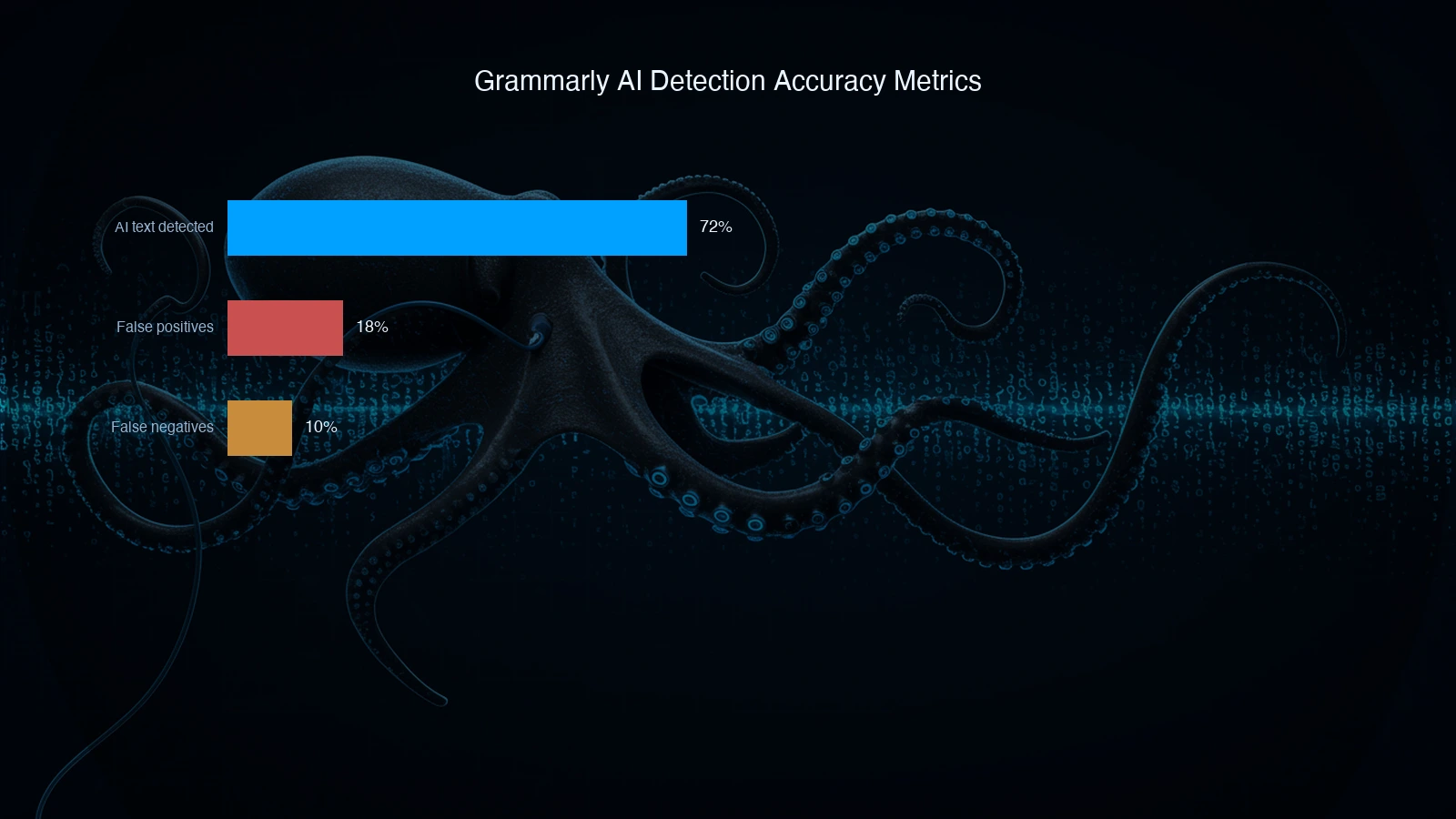
When asking how accurate is Grammarly AI detection in real-world use, the answer is best understood through two failure modes: false positives and false negatives.
False negatives occur when AI-generated text passes as human. This failure mode matters for platforms trying to enforce AI content policies or SEO teams worried about search-engine penalties, and it also affects how accurate is Grammarly AI detection. Grammarly's false negative rate is lower than its false positive rate for clean AI text, but it rises sharply when the AI text has been edited, translated, or run through humanization tools.
These failure rates explain why the question of how accurate is Grammarly AI detection cannot be answered with a single number. Accuracy is conditional on input length, editing history, language variety, and the specific AI model that produced the text.
Why Accuracy Varies by Text Type
How accurate is Grammarly AI detection? The answer changes depending on the text type. Grammarly AI Detection accuracy is not uniform across all content. Several factors influence performance.
Text length. Short passages under 100 words provide insufficient statistical signal, which lowers how accurate is Grammarly AI detection. The detector may return low-confidence results or contradictory scores for adjacent sentences. Longer documents generally produce more stable assessments.
Editing and revision. AI text that has been heavily edited by a human often loses the statistical fingerprints that detectors rely on, making how accurate is Grammarly AI detection harder to predict. Grammarly becomes less accurate on revised drafts, which is ironic because the most responsible use of AI involves exactly that kind of human refinement.
Domain and style. Technical documentation, legal writing, and academic prose sometimes trigger false positives because their formal structure resembles AI-generated patterns. Casual blog posts and personal narratives tend to score more reliably as human.
Source model. Text from newer models such as GPT-4o, Claude 3.5, and Gemini 1.5 Pro can be harder to detect than output from older systems, which directly affects how accurate is Grammarly AI detection over time. As AI models improve, detection accuracy faces a moving target, which directly affects how accurate is Grammarly AI detection over time.
According to Grammarly's discussion of AI detector accuracy, no AI detector is perfectly reliable, which is why how accurate is Grammarly AI detection remains an open question. The company itself recommends using detection scores as one input among many rather than as definitive proof of AI authorship.
How Grammarly AI Detection Compares to Competitors
Context matters when evaluating how accurate is Grammarly AI detection. Grammarly's accuracy should be evaluated relative to alternatives, not against an impossible ideal. In this comparison, how accurate is Grammarly AI detection becomes clearer.
| Dimension | Grammarly AI Detection | GPTZero | Originality.ai | Copyleaks |
|---|---|---|---|---|
| Best use case | Writing workflow integration | Academic essays | Publisher / SEO content | Enterprise security |
| AI text detection | Moderate to good | Moderate to good | Strong | Strong |
| False positive rate | Moderate | Moderate | Lower | Lower |
| Sentence highlighting | Yes | Yes | Yes | Yes |
| API availability | Via Grammarly API | Yes | Yes | Yes |
| Minimum text length | ~100 words | ~250 words | ~50 words | ~100 words |
| Pricing | Freemium | Freemium / paid | Paid | Paid |
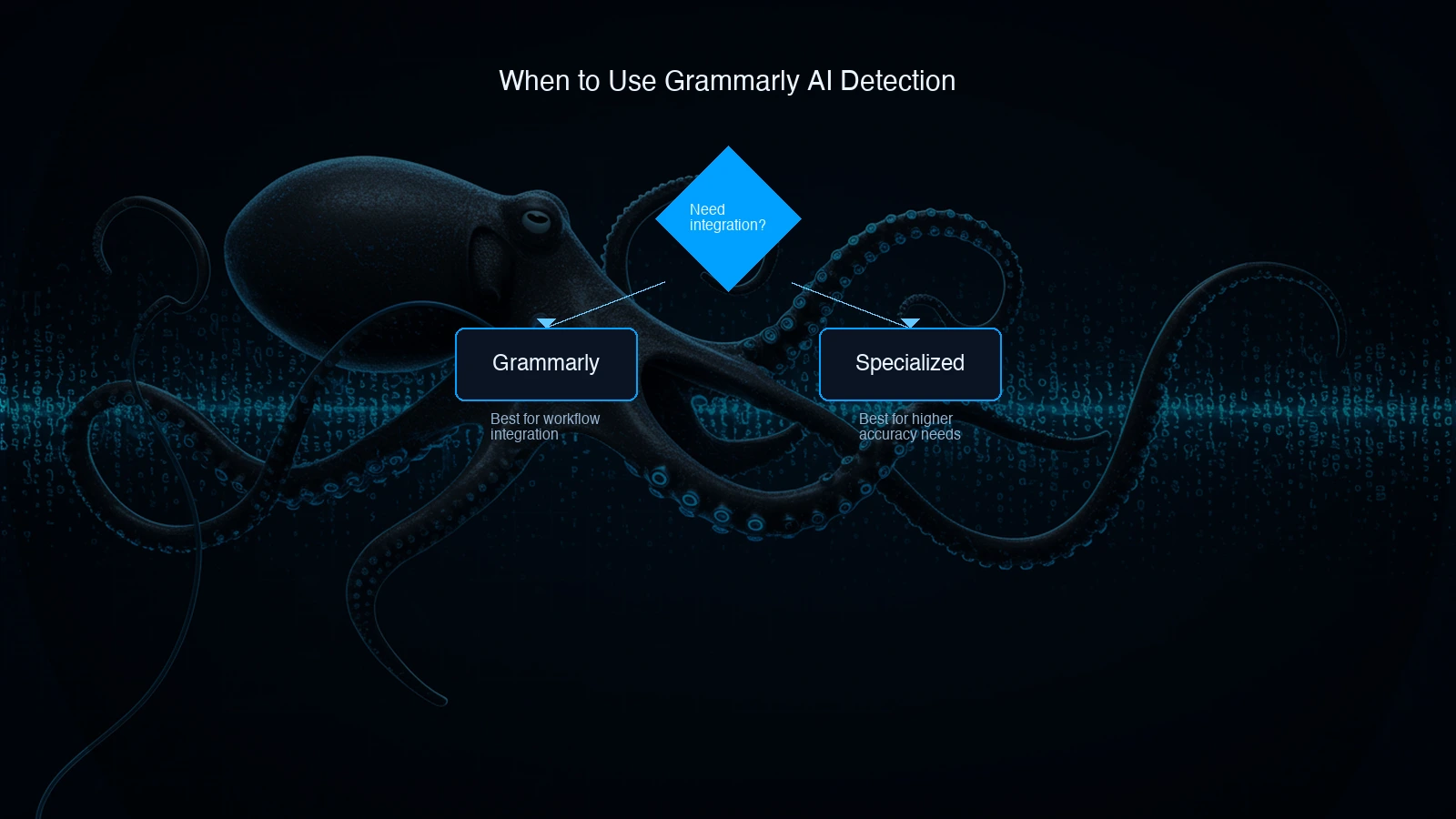
Grammarly's main advantage is not raw accuracy, even though how accurate is Grammarly AI detection is the first question buyers ask. It is workflow integration. Users can detect, edit, and refine text in one environment. For teams already using Grammarly for writing assistance, this convenience can outweigh small accuracy differences.
For teams building detection into their own products, our Grammarly API: AI Detection & Writing Analysis guide covers authentication, endpoints, and integration patterns.
Engineering Considerations for Production Use
Deploying any AI detector in production requires careful engineering. Even after confirming how accurate is Grammarly AI detection in controlled tests, production behavior can differ. Grammarly AI Detection is no exception.
Set thresholds conservatively. A high threshold reduces false positives but increases false negatives. Your threshold choice changes how accurate is Grammarly AI detection in practice. A low threshold catches more AI text but flags more human writers. Most production systems should treat medium-risk scores as review queues rather than automatic rejections.
Combine signals. Detection scores should be one input among many. Combine them with author history, writing samples, browser telemetry, and human review. Relying on a single detector score for consequential decisions is a recipe for error.
Handle short inputs gracefully. For text under 100 words, consider skipping detection or displaying low-confidence warnings. Making decisions on insufficient signal creates unnecessary disputes.
Plan for adversarial inputs. AI humanizers, paraphrasers, and translation tools are specifically designed to evade detection. No public detector is fully robust against these techniques.
Audit regularly. Detector performance degrades as new AI models emerge. Run periodic benchmark tests with your own data to verify that accuracy remains acceptable and to reconfirm how accurate is Grammarly AI detection for your specific content.
For a deeper explanation of detection mechanics that underlie how accurate is Grammarly AI detection, our How Does AI Detection Work? Grammarly AI Detection guide walks through perplexity, burstiness, and classification models.
Ethical and Practical Limits
Accuracy discussions often ignore the most important question: what should you do with the result?
Grammarly AI Detection is a useful signal, but it is not evidence. It should not be used as the sole basis for academic sanctions, employment actions, legal claims, or content bans. According to Grammarly's own guidance on AI detector accuracy, these tools provide probability estimates, not proof.
Educators should pair detector results with process evidence such as drafts, outlines, and in-class assignments. Publishers should use detection alongside editorial review and source verification. Platforms should design policies that account for uncertainty rather than treating detector output as ground truth.
How accurate is Grammarly AI detection? The answer ultimately matters less than the question of how responsibly your organization uses that accuracy.
When Grammarly AI Detection Makes Sense
Given what we now know about how accurate is Grammarly AI detection, the tool fits several workflows well despite its limitations.
Pre-submission self-checks. Students and writers can scan drafts before submitting them, identifying sections that might trigger suspicion and revising accordingly. This is a low-stakes, educational use case.
Content screening. Editorial teams can use the detector as a first-pass filter for incoming submissions, flagging high-confidence AI text for closer review. It speeds up triage without replacing human judgment.
SEO quality assurance. Teams producing large volumes of content can use detection scores to identify articles that may need additional human refinement before publication.
Internal content governance. Organizations with AI usage policies can use Grammarly detection as part of a broader compliance workflow, especially when integrated through an API.
For hands-on document analysis, our AI Document Analysis with Grammarly AI Detection tool provides a browser-based interface for testing samples.
If you find that how accurate is Grammarly AI detection is not sufficient for your use case, specialized alternatives may be a better fit. The question how accurate is Grammarly AI detection should be answered relative to your risk tolerance. Specialized detectors may outperform it in specific scenarios.
Originality.ai tends to offer higher accuracy for publisher and SEO content, with stronger reporting features.
Copyleaks provides enterprise-grade security features and broader language support.
GPTZero has strong brand recognition in education and offers classroom-oriented workflows.
Turnitin AI Detection is deeply integrated into academic submission systems, though it shares many of the same accuracy limitations.
For teams focused specifically on identifying AI writing in workflows, our Detect AI Writing with Grammarly AI Detection page compares practical detection strategies.
If your goal is to reduce AI-like signals in human-AI collaborative content, our Clean AI Text Using Grammarly AI Detection guide offers revision techniques.
Conclusion
For most teams, Grammarly AI Detection works best as a screening tool, not a judgment tool. Use it to prioritize review, guide revision, and flag edge cases. Combine it with other signals, keep human judgment in the loop, and avoid using detector scores as the sole basis for consequential decisions.
Try Grammarly AI Detection on OpenOctopus Get Grammarly AI Detection API Access
Register now to receive $1 as an experience fund.