OpenAI Image Generation API

Stable Routing, Lower Costs, and OpenAI-Compatible GPT-Image-2 Access

Building image generation into production applications through the OpenAI image generation API should not require managing provider rate limits, unpredictable latency spikes, or complex failover logic. GPT-Image-2 — OpenAI's most capable general-purpose image model — delivers strong prompt adherence, readable text rendering, and structured visual layouts. Yet developers integrating directly with OpenAI's infrastructure frequently encounter IPM throttling, high-quality mode delays reaching minute-level during peak hours, and costs that scale nonlinearly with batch workloads.

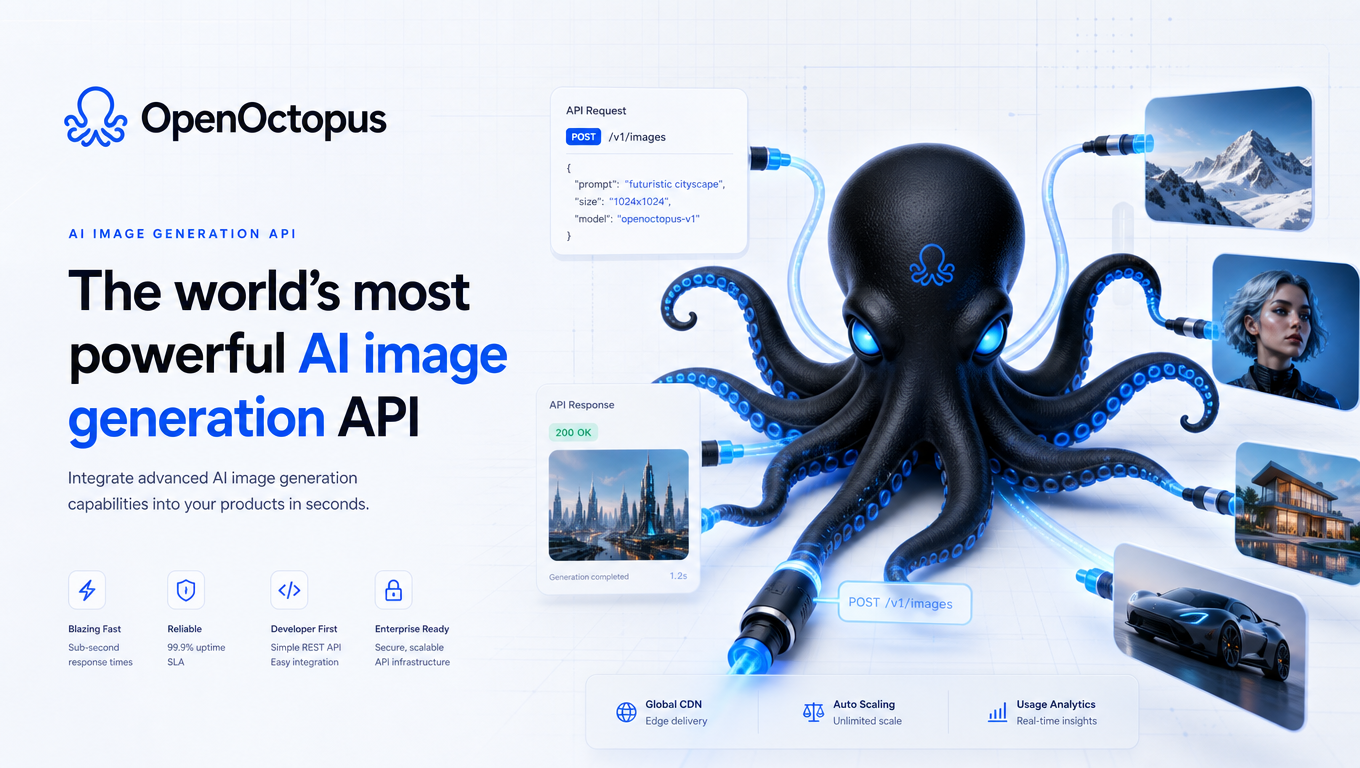
Sleek black octopus with glowing blue cable-tentacles generating AI images through API endpoints, futuristic OpenOctopus tech composition

Production-ready image generation infrastructure

< 9s
P50 generation latency for standard quality
1 API
Single OpenAI-compatible endpoint for all image workflows
50+
Models accessible through unified authentication
Clean blue API request flow diagram with octopus routing nodes, light tech grid background, minimalist infrastructure visualization

Why direct OpenAI integration breaks at scale

Developers prototyping with the openai image generation api often find the experience smooth during initial testing. The problems emerge when traffic grows. OpenAI's official IPM limits are strict — production batches of images 2 requests routinely hit throttling walls that return 429 errors and force client-side retry storms. High-quality mode latency spikes unpredictably during peak hours, making real-time user experiences unreliable.

Cost control presents another challenge. GPT-Image-2 pricing structure uses token-based billing where image input costs $8 per 1M tokens and image output costs $30 per 1M tokens. Multi-image editing workflows consume tokens rapidly, and without usage visibility, monthly bills become difficult to forecast. Teams running the openai image generation api at production scale need routing intelligence, usage dashboards, and automatic failover — capabilities that require significant engineering investment to build in-house.

OpenOctopus solves these operational gaps without changing your application code. The platform provides the same GPT-Image-2 model outputs through infrastructure designed for production reliability.

What you get with OpenOctopus image generation access

1

OpenAI-compatible SDK

Drop-in replacement for existing openai image generation api integrations. Change `base_url` and API key — no code rewrite required. Compatible with Python SDK, Node.js SDK, and REST API patterns.

2

Automatic failover

When primary provider routes hit rate limits or experience degraded performance, requests transparently route to backup infrastructure without application-level changes.

3

Real-time cost tracking

Per-request token spend visibility with usage dashboards. Predict monthly image generation costs instead of discovering them in billing surprises.

4

Fast model updates

New image 2 capabilities and quality modes deploy rapidly. As OpenAI releases improvements to images 2, OpenOctopus makes them available through the same endpoint without integration changes.

5

Stable latency routing

Intelligent provider selection maintains consistent generation speeds. Avoid the minute-level delays that plague direct OpenAI access during peak traffic periods.

6

Multimodal unified architecture

One authentication flow, one billing dashboard, one SDK for both text and image workloads. Build agents that generate images, validate them with vision models, and refine outputs through text — all through a single integration.

7

Production support

Real engineers respond to infrastructure issues. No chatbot queues or generic ticket systems when your image generation pipeline needs attention.

8

Flexible quality modes

Access both standard and high-quality image 2 generation modes with explicit cost-latency tradeoffs documented before every request.

OpenAI Image Generation API Pricing: Direct vs. OpenOctopus

Understanding the true cost of running an openai image generation api requires looking beyond headline per-token rates. Direct OpenAI pricing for GPT-Image-2 breaks down as follows according to official documentation:

Cost ComponentOpenAI Direct RateWhat It Means in Practice
Text input$5 / 1M tokensPrompt text consumed during image generation requests
Image input$8 / 1M tokensBase images uploaded for editing or modification workflows
Image output$30 / 1M tokensGenerated image data returned by the model

These rates come from OpenAI's official ChatGPT Image Model Pricing documentation. For teams running image 2.0 workloads at scale, the image output cost dominates — a single high-resolution generation can consume substantial token volume.

The hidden cost of direct integration is operational engineering. Building rate limit handling, retry logic with exponential backoff, provider failover, and usage monitoring adds weeks of infrastructure work. When the openai image generation api returns 429 errors during traffic spikes, engineering teams must either build queuing systems or accept degraded user experiences.

For teams running images 2 at production volume, batch generation workflows amplify these challenges. A single marketing campaign might require thousands of image variations. Without intelligent routing, batch jobs exhaust rate limits quickly and force expensive retry loops. The operational complexity compounds when teams need to support multiple quality tiers — standard mode for rapid iteration and high-quality mode for final assets.

OpenOctopus delivers the same GPT-Image-2 outputs with infrastructure overhead included. Transparent per-request pricing, automatic failover, and real-time usage dashboards eliminate the operational tax of managing provider relationships directly. Teams access image 2 capabilities without maintaining separate retry handlers for every provider in their stack. Cost predictability improves because routing intelligence selects optimal provider paths based on current latency and capacity conditions.

Abstract blue geometric bars showing cost savings visualization, clean data aesthetic, light background

How the OpenAI Image Generation API Works Through OpenOctopus

Integrating the openai image generation api through OpenOctopus follows a straightforward pattern that preserves existing code while adding production resilience.

Step 1: Authentication. Create an OpenOctopus account and generate an API key. The same key authenticates requests across text, image, and video models — no separate provider credentials needed.

Step 2: SDK Configuration. Update your OpenAI SDK initialization to point at OpenOctopus endpoints. The request schema, response format, and streaming behavior remain identical. Your existing prompt engineering and parameter tuning continue working without modification.

Step 3: Image Generation. Submit text prompts through the standard Images API or Responses API. OpenOctopus routes the request to optimal provider infrastructure, handles any rate limit interactions transparently, and returns the generated image in your requested format.

Step 4: Editing Workflows. Upload base images and describe modifications in natural language. The Edit Images capabilities of image 2 work through the same endpoint — inpainting, outpainting, and style modifications without separate integration paths.

Step 5: Monitoring. Track per-request costs, latency distributions, and model usage through unified dashboards. Identify which image generation workloads consume the most tokens and optimize prompt strategies accordingly.

Step 6: Scale with confidence. As image generation volume grows, OpenOctopus routing automatically distributes load across provider infrastructure. No manual capacity planning or provider contract negotiations required. The openai image generation api experience remains consistent whether you generate ten images per day or ten thousand.

The GPT-Image-2 model architecture emphasizes general-purpose image generation with strong text rendering and structured layout capabilities. According to OpenAI's GPT Image 2 Model documentation, the model handles advertising visuals, product photography, packaging design, UI mockups, and social media assets with consistent prompt adherence. These characteristics make the openai image generation api suitable for production marketing tools, e-commerce platforms, and creative applications where output reliability matters more than artistic experimentation.

For teams evaluating whether image 2 fits their use case, our detailed GPT-Image-2 technical guide examines capabilities, pricing mechanics, API limits, and real engineering issues encountered at production scale.

FAQ

No. OpenOctopus provides direct GPT-Image-2 access through a single API key and unified billing. Your existing OpenAI SDK code works by changing the base URL and authentication credentials.

Start building with the OpenAI Image Generation API today

Get instant access to GPT-Image-2 through OpenOctopus. Stable routing, lower operational costs, and OpenAI-compatible APIs — without the infrastructure complexity of direct provider management.